



Providing sustainable solutions to Vietnam’s prawn farming and food security
[HO CHI MINH CITY] When prawn farmers in Vietnam need to detect diseases in their harvest, they usually have to send samples of the crustaceans and the water to a laboratory hundreds of kilometres away. The testing process would take several days.
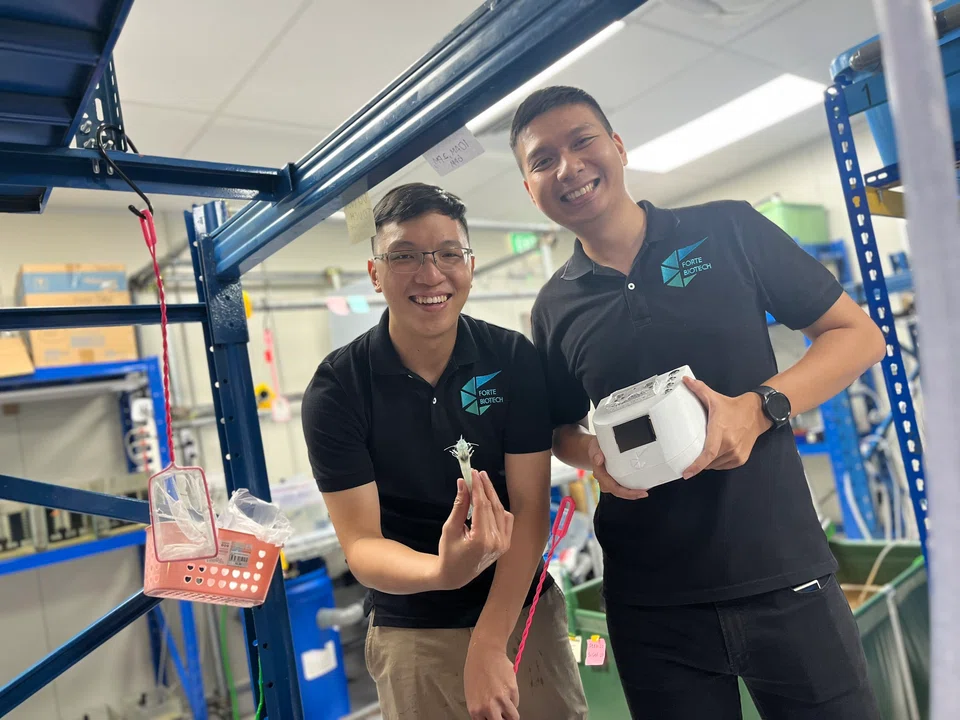
Singaporean Kit Yong and Vietnamese Michael Nguyen – two National University of Singapore (NUS) graduates who founded a biotech startup called Forte Biotech two years ago – have come up with a disease surveillance kit that allows farmers to get these test results within an hour or so.
The duo joined the university’s graduate research innovation programme and set up a site at the NUS Agritech Centre to develop a portable diagnostic kit called Rapid – short for Robust Accurate Prawn Infection Detector.
Armed with this innovation, the company ventured into the Vietnam market last August, as the country is one of the world’s largest exporter of prawns.
Latest available data showed that the value of Vietnam’s annual prawn exports is worth about US$3.5 billion to US$4 billion, accounting for about 40 per cent to 45 per cent of the country’s total seafood exports. Its main exports are white-leg shrimps and giant tiger prawns, with Singapore being the largest export destination in South-east Asia.
Singapore imports the bulk of its prawns from Vietnam, Brazil and Sri Lanka. Yong told The Business Times in a recent interview that farmed prawns in these countries face huge risks of contracting contagious infectious diseases that could wipe out the entire batch in just two days after the symptoms are first noticed.
While there is a 6 per cent year-on-year increase in the production of prawns worldwide, the risk of prawn diseases can cause up to 10 per cent loss in the annual production.
Last year, output from Thailand – another of the world’s leading prawn exporters – fell by half compared to its peak in 2011 due to illnesses such as white spot disease and early mortality syndrome.
Yong said that there are other viruses that do not kill the prawns, but restrict their growth instead. While such prawns are deemed safe for human consumption, they generate less profit for farmers.
Early detection Forte’s test kit has two main components: a patented DNA sample extraction stick produced in Singapore, and a 3D-printed device set made in Vietnam for detecting health issues in prawns. The accuracy rate is around 90 per cent.
The 3D-printed device set costs US$400, which Nguyen said is an “affordable” price. Extraction sticks and reagents are provided in monthly subscription packages for about US$4 to US$6 per disease – a fraction of the US$20 that a regular lab-based test in Vietnam costs today, said Nguyen.
Yong said that Forte “already makes money” on every test kit sold. The company is on track to have at least 60 farms as regular customers in order to break even.
The current production capacity of the company’s Singapore facility is about 1,000 DNA sample extraction sticks per week. There are plans to construct a new plant that can make up to 10,000 sticks, enough to meet the needs of 300 farms.
In Vietnam, where most prawn farms are run as family businesses with a high density cultivation, Forte’s products have been on trial at around 130 farms.
“Vietnamese farmers are very good at using technology. They always want to do more, and do it better instead of being happy with just enough,” said Yong. “Our job is to make the tool for them to do it.”
Farmers can test their ponds for diseases and infections in a more efficient way with the test kits, as this does not involve “bombarding the entire pond with disinfectants and antibiotics”, which Yong said is not sustainable.
NUS, Touchstone Partners and various angel investors have injected a total of US$240,000 into the startup so far.
Forte aims to open another round of funding by the end of this year, targeting to raise around US$1.5 million to US$2 million to finance its market expansion in other countries. The money will also be used for research and development on new prawn diseases, which are expected to appear every 10 years.
“Our thinking is: Let’s find out the problem even before it appears, turning from testing to surveillance,” said Yong. “We want people to see this as insurance, rather than ask (what happened) after their prawns have already fallen sick. It’s about changing the mindset.”






