



Push by Taiwanese circuit board manufacturers energises Thai electronics sector
A new wave of investments is strengthening S-E Asian kingdom’s printed circuit board (PCB) production
[BANGKOK] A wave of Taiwanese investments in Thailand’s electronics sector over the past two to three years, fuelled by US-China tensions, has strengthened the country’s printed circuit board (PCB) manufacturing hub – a critical player in everything from smartphones to electric vehicles and a key driver in its booming electronics industry.
Taiwanese investors ranked fourth in applications for tax privileges at Thailand’s Board of Investment (BOI) in 2024, submitting 126 projects worth 50 billion baht (S$2 billion), most of which were in PCB production.
In fact, the electronics and electrical appliances sector saw the second-largest influx of investment at the BOI last year, after the digital sector, with 407 projects worth 231.7 billion baht. Among them, 83 were focused on PCB manufacturing, valued at 86.4 billion baht.
This marks a clear rise from 2023, when the BOI attracted only 40 PCB projects, albeit with a higher total value of 100.9 billion baht – a good portion of which came from Taiwanese investors.
Amid ongoing concerns over potential tariffs on the chip sector under US President Donald Trump’s administration, particularly those targeting Chinese-made products, Taiwanese firms that have increasingly been shifting production to South-east Asia may continue or accelerate this trend. Thailand could thus emerge as a key hub for PCB manufacturing.
Cementing ground
Thailand has attracted top Taiwanese PCB manufacturers such as Compeq, Unimicron, and WUS Printed Circuit – leaders in high-density, advanced, and precision PCBs used in everything from smartphones and consumer electronics to automotive and medical devices, cementing the country’s reputation as a hub for critical electronic component manufacturing.
In line with the “One China” policy, the BOI refers to Taiwanese investments as “companies from Taiwan” to avoid implying that Taiwan is a separate country from China.
In fact, sources say the Taiwanese companies now flocking to Thailand are diversifying out of mainland China.
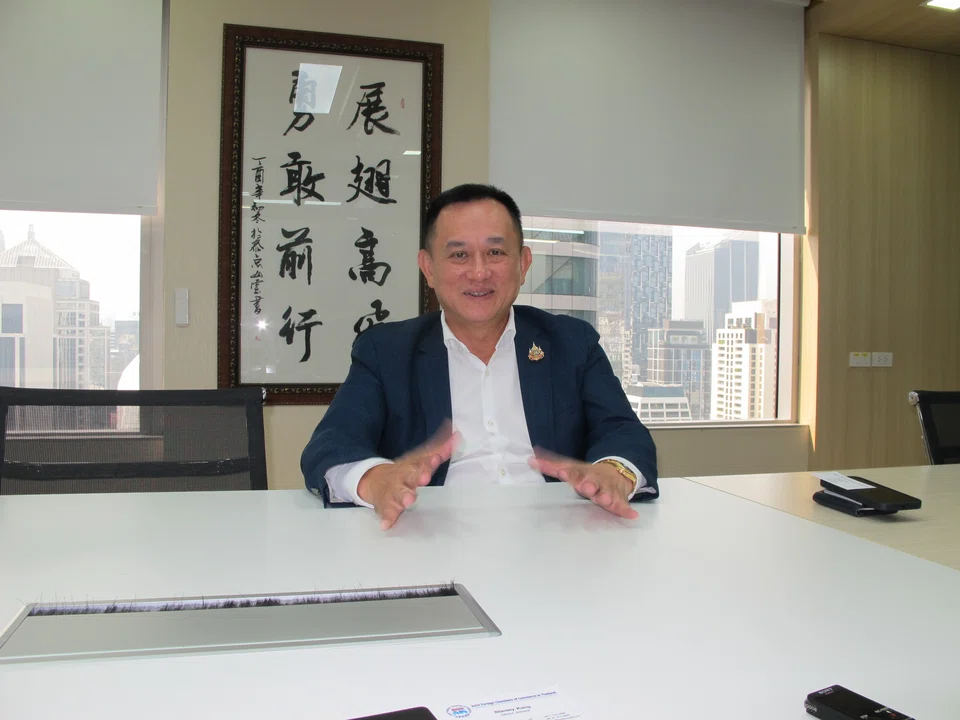
“All these Taiwanese PCB manufacturers have already been in China – so the new investment is coming from Taiwanese companies, but a lot of the middle management are Chinese,” said Stanley Kang, deputy general manager of Tuntex Textile (Thailand), and a former president of the Joint Foreign Chambers of Commerce in Thailand.
He pointed out that while the capital comes from Taiwan, many operations in Thailand are run by Chinese professionals who were part of the supply chains in China, highlighting ongoing ties between the two regions despite the manufacturing shift.
The migration of PCB production brings the supply chain with it.
“When they come to Thailand they don’t come alone, but they bring their suppliers to Thailand as well,” said Narit Therdsteerasukdi, secretary-general of the BOI. “There will be a big cluster of PCB manufacturers in Thailand.”
Taiwan calling
Taiwanese are no strangers to Thailand. They comprise the largest expatriate community, with an estimated 150,000 residing in the kingdom.
The initial inflows of Taiwanese foreign direct investment (FDI) began in the mid-1980s, when Thailand became an outsourcing destination for Japanese companies. In the early 2000s, the Taiwanese FDI flow shifted to mainland China, following its US and Japanese customer base.
And recently, with the advent of the US-China trade war, Taiwan has started to look to South-east Asia again – particularly Thailand.
“The big change started in 2017 to 2018, when the geopolitical tensions started,” said Kang, a 40-year veteran of doing business in Thailand. “By 2018, Taiwanese companies were asking themselves, ‘Where should we move to?’”
Thailand has become a top FDI destination for Taiwanese firms in South-east Asia for several key reasons.
For one, unlike China and Vietnam, Thailand kept most of its factories running and exports flowing during the disruptive Covid years, thanks to strong coordination between the government and private sector.
Second, Thailand has well-established supply chains in the automotive sector, electronics, electrical appliances, and food processing – all sectors of interest to Taiwanese.
Thai firm KCE Electronics has been manufacturing PCBs in Thailand for decades and is a major global player, supplying high-quality circuit boards to industries worldwide, including automotive, telecommunications, and consumer electronics.
Third, Thailand has perfected the art of “bamboo diplomacy”.
“Thailand is a neutral country, so if you invest here, you can export to the US, and Europe, and even to Russia,” said Kang. “This is a country from which you can export your products everywhere.”
It remains to be seen how Thailand, which ranked 10th in trade surpluses with the US last year (up to November), will fare under the Trump presidency, but observers believe any tariffs imposed will be less than those on Thailand’s trade competitors – China and Vietnam.
The PCB production base could also encourage relocations of semiconductor manufacturing, currently done regionally in Malaysia.
This is already happening. On Jan 15, semiconductor giant, Germany’s Infineon Technologies, started construction on a plant in Samut Prakan, Thailand, as part of a push to diversify its South-east Asian manufacturing beyond Malaysia.
The company is expected to concentrate on back-end processes of circuit formation. With these inflows of FDI into new sectors such as PCB, Thailand’s exports can be expected to grow in the future, after hitting a historic high of US$301 billion in 2024.
“Usually, when companies get approval from the BOI, it will take them about two years before they open, and the money starts coming in,” said Kirida Bhaopichitr, research director of the Thailand Development Research Institute.
“In 2023, there were also a lot of BOI approvals. So, maybe we will see some impact in the 2025 export figures, but in 2026, I would be more optimistic, when the production of the new sectors – PCBs and biotechnology – comes on stream,” she noted.
TRENDING NOW

If Europe goes to war, the fallout will be felt in East Asia
Stocks to watch: Seatrium, MIT, Keppel Reit, Clint, UI Boustead Reit, Digital Core Reit, ST Engineering

Chairman’s role in spotlight with raft of proposed new rules for Singapore boards

Mapletree Industrial Trust posts 6.6% drop in Q2 DPU to S$0.0297

