



Rate cut signals growth jitters as Malaysia moves to shield economy from tariff threats
Overnight Policy Rate is reduced by 25 basis points to 2.75% in pre-emptive move aimed at supporting growth amid rising external risks

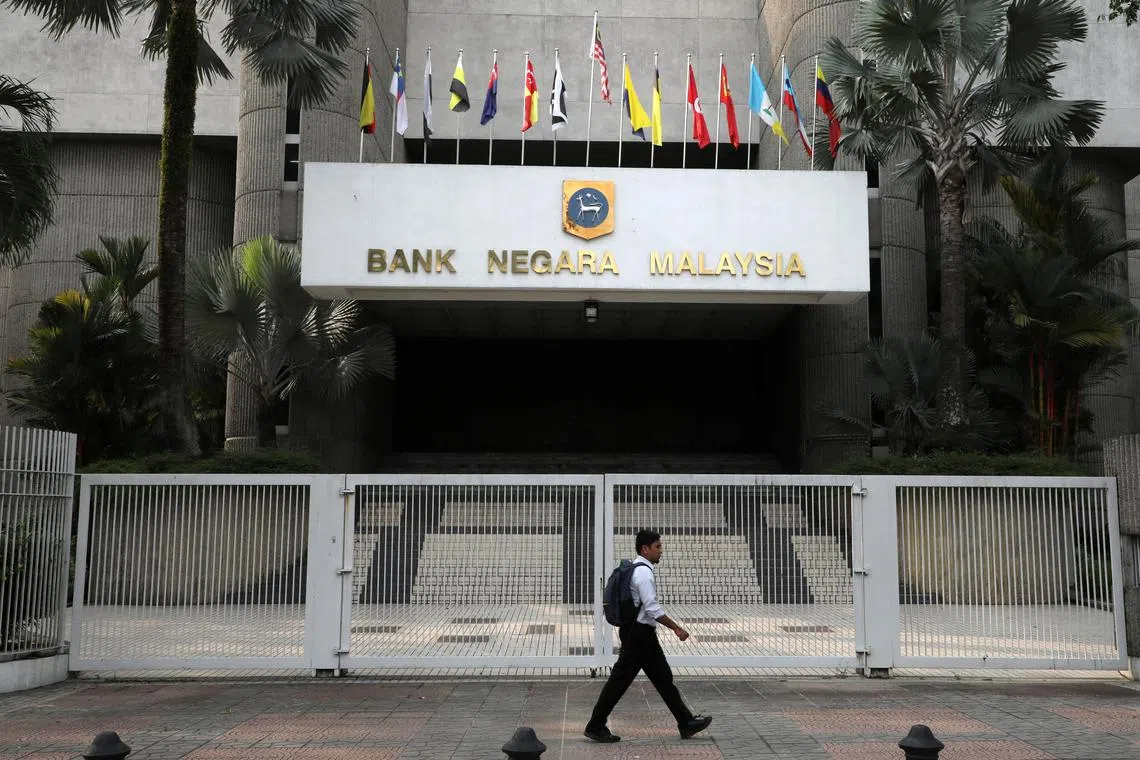
[KUALA LUMPUR] Bank Negara Malaysia’s earlier-than-expected rate cut – the first since 2020 – is sending a sign that policymakers are bracing for a tougher second half of 2025 as trade tensions with the United States and weakening global demand cast a shadow over the country’s economic outlook.
On Wednesday (Jul 9), the central bank lowered the Overnight Policy Rate (OPR) by 25 basis points to 2.75 per cent, in a pre-emptive move aimed at supporting growth amid rising external risks.
The OPR, the interest rate for overnight interbank lending, has held steady since its last hike of 25 basis points in May 2023.
“The balance of risks to the growth outlook remains tilted to the downside, stemming mainly from a slower global trade, weaker sentiment, as well as lower-than-expected commodity production,” Bank Negara said in its statement.
The central bank stressed that the reduction in the OPR is a pre-emptive measure aimed at preserving the country’s steady growth path amid moderate inflation prospects.
The move follows a recent shock decision by US President Donald Trump to raise tariffs on Malaysian exports to 25 per cent, effective Aug 1. That action has heightened fears of a wider trade fall-out, particularly for South-east Asia’s open and trade-reliant economies.
Early but justified
Economists at CGS International said the cut came earlier than anticipated, though it was justified by the deteriorating external backdrop. They noted that Bank Negara’s tone has shifted from dovish to neutral, suggesting no further cuts are planned unless conditions worsen substantially. The firm maintained its year-end OPR forecast at 2.75 per cent.
Kenanga Research’s head of economic research Wan Suhaimie Wan Mohd Saidie expects the July rate cut to be the only one this year. “Bank Negara has acted pre-emptively, and unless gross domestic product growth falls below 3.5 per cent or global risks escalate sharply, the policy rate is likely to remain unchanged for the rest of the year,” he pointed out.
Revision of GDP growth forecast

The tariff hike has triggered a wave of GDP forecast downgrades, with economists citing potential ripple effects across trade, investment and sentiment. Hong Leong Investment Bank, which previously expected 4.9 per cent growth in 2025, has lowered its forecast to 4 per cent.
Felicia Ling, chief economist at Hong Leong, said that the risks to growth have intensified. “These include the 25 per cent tariff rate, possible bans on AI (artificial intelligence) chip exports, and rising geopolitical alignment pressures – all of which likely informed Bank Negara’s latest decision,” she added.
Still, Ling believes domestic demand remains stable enough to keep growth afloat. Barring any sharp deterioration in competitiveness or a collapse in exports, she expects the OPR to stay at 2.75 per cent for the rest of the year.
Malaysia’s exports grew 5.5 per cent in the first five months of 2025, despite a contraction in May. Trade volumes for the same period were up 5.1 per cent year on year, suggesting momentum had not yet collapsed ahead of the tariff deadline.
RHB Bank senior economist Chin Yee Sian noted that Malaysia’s domestic economy remains relatively resilient. The bank recently lowered Malaysia’s 2025 GDP growth forecast to 4.2 per cent, from 4.5 per cent previously, following the tariff escalation.
MIDF Research believes the rate cut will provide an immediate boost to household disposable income by lowering borrowing costs, which could in turn stimulate consumer spending. The automotive, retail and tourism sectors are expected to benefit, along with the property market.
More cuts coming?
Not all analysts believe the easing cycle is over. OCBC economist Lavanya Venkateswaran said that the dovish tone in Bank Negara’s latest statement opens the door for another 25-basis-point cut before year-end.
OCBC expects Malaysia’s economy to slow to 3.9 per cent growth this year, with momentum potentially slipping further in the second half if the 25 per cent tariffs are fully implemented.
She predicts another OPR cut to 2.5 per cent, potentially at either the September or November Monetary Policy Committee meetings.
UOB economists Julia Goh and Loke Siew Ting concurred, citing the uncertain outcome of ongoing US-Malaysia tariff talks. The economists expect one more 25-basis-point cut by the end of 2025, also bringing the policy rate to 2.5 per cent.
TRENDING NOW

LTA proposes combining car COE categories, adding rebate-surcharge system

StarHub to acquire MyRepublic’s mobile business amid ongoing telco consolidation

DBS, OCBC, UOB rout lops billions off STI as inflation, rate concerns spook investors

Grab CEO’s wife Chloe Tong on life with Anthony Tan and finding her purpose

