From Red Sea effect to overcapacity: Tide may be turning for Asean shipping stocks

Tay Peck Gek
A RISING tide lifts all boats, and right now, the tide is lifting a flotilla of shipping stocks. Sailing route disruptions have pushed freight rates up, buoying investor sentiment, although analysts have warned that the optimism may not be sustainable.
The sector will soon face overcapacity, they said, arising from lower demand and deliveries of record orders in the past two years.
The Business Times screened for shipping-related stocks with market valuations of over US$100 million and which are listed in six Asean countries – Malaysia, the Philippines, Indonesia, Singapore, Vietnam and Thailand. Their share prices have gone up by between 5.6 per cent and 64.2 per cent in the month to Jan 16.
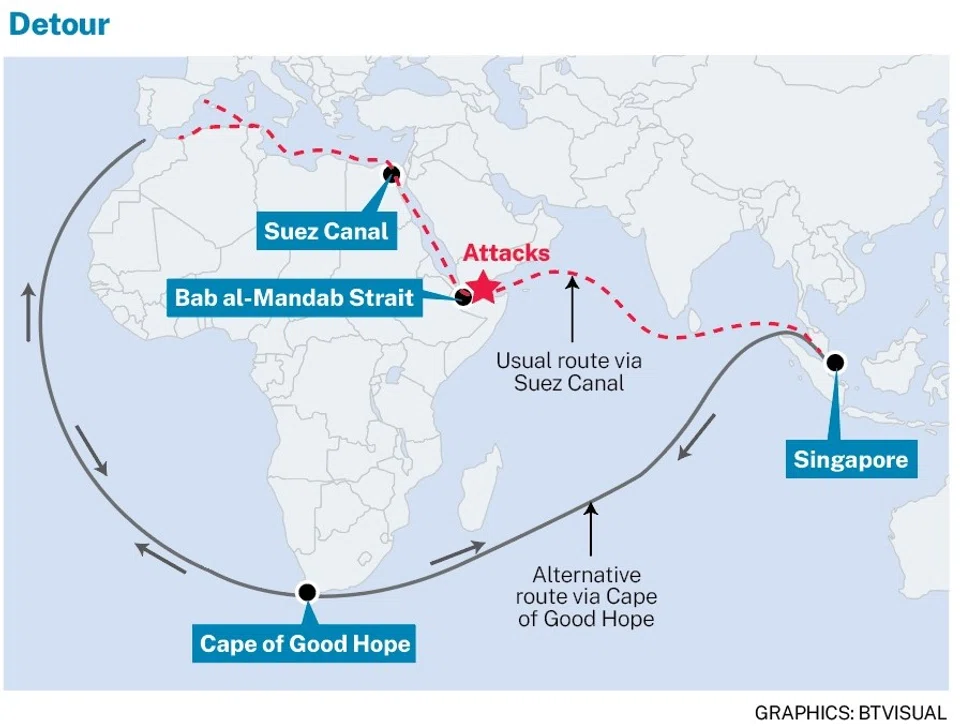
This outperformance came as Yemen’s Houthi rebels started to attack merchant ships in the Red Sea in mid-November. Major carriers were forced to make detours around South Africa as they sought to avoid assaults in the shortest Asia-to-Europe route.
Transimex Corporation – which provides logistics, freight forwarding, trucking, warehousing, shipping, cold storage, distribution and port services in Vietnam – posted the smallest gain among the 17 stocks, with a 5.6 per cent gain in its share price.
Buana Lintas Lautan – which transports oil and natural gas, offers chartering and vessel operations and ship-management services in Indonesia – saw its share price surge 64.2 per cent, making it the top performer among the 17 stocks.
The crisis in the Red Sea began just as freight rates were normalising from their dizzying heights achieved during the pandemic, when shipping was affected by lockdowns, a container crunch, manpower shortages, as well as soaring demand for consumer goods.
Now, costs for sending shipments between the East and the West have spiked back up.
According to the composite index compiled by Drewry, the cost of shipping a 40-foot container posted a 23 per cent rise in the week to Jan 18 to US$3,777 – the highest since October 2022, and 82 per cent more than in the same week last year.
Investors should be wary of making rash moves into the sector, though, because analysts expect the Red Sea effect could be cancelled out by overcapacity in time.
HSBC Global Research expects freight rates – and share prices – to fall back to December levels once the Red Sea becomes safe. The crisis would be sufficient to lift rates for the first half of 2024, but sector overcapacity will eventually filter through, and normalise rates in the second half of the year.
Jefferies also noted that liners currently have the pricing power due to network adjustments around Africa. The brokerage is nevertheless bearish on the container shipping sector over a 12-month period, due to upcoming newbuild deliveries.
Peggy Mak, research manager at Phillip Research Securities, said the containership industry is looking at excess capacity this year and the next.
Some 2 million 20-foot-equivalent units (TEUs) of new capacity deliveries were made in 2023; about 3.2 million TEUs are expected this year, and another 2 million TEUs next year. Some liners were reported to be slow-steaming – deliberately reducing their cruising speeds – before the Red Sea conflicts took place.
Mak said: “We expect cargo freight rates for the Asia-Europe route to stay high. But rates are expected to ease off during the lull between the Chinese New Year and summer. The conflict helps carriers to absorb some excess capacity.”
In the Singapore market, Samudera Shipping has been the main beneficiary of the Red Sea crisis. The company, which provides feeder services mainly in Asian waters, recorded a 28-per-cent gain in its shares in the period under evaluation.
Freight rates on its routes might rise as a spill-over effect from a tighter supply chain, Phillip’s Mak said, but she does not expect rates to rise to 2023 levels, as the macroeconomy is expected to slow.
Carmen Lee, head of OCBC Investment Research, said the impact of the Red Sea disruptions will depend on the cargo a company carries and the route it takes. She noted, however, that most of the Singapore-listed shipping companies turned in “lacklustre” performances in 2022 and 2023.
Samudera Shipping was the exception, posting a 47-per -cent in gain in 2022, but it too booked a loss of 21 per cent in 2023.
Yeo Hui Shi, assistant manager of the research and portfolio management team at FSMOne.com, said shipping share prices are susceptible to near-term fluctuations as the situation in the Red Sea remains volatile.
She said: “For investors, maintaining a diversified portfolio is crucial. Other than shipping stocks, commodities stocks stand to benefit as the Red Sea conflict drives up the prices of oil and agricultural commodities.
“The oil-and-gas industry is already grappling with years of structural underinvestment due to continued production capex discipline by producers. Consequently, oil prices are likely to remain relatively well-supported over the longer term.”