



Regional equity markets approach 2021 buoyant on the back of vaccine hopes: DBS
 Add BT as a preferred source
DeeperDive is a beta AI feature. Refer to full articles for the facts.
EQUITY markets in the region are heading into 2021 optimistic on Covid-19 vaccine deployments, trade partnerships and stable US-China ties, according to a DBS report released on Monday. In a scenario that would herald economic revival in Covid-19 beleaguered sectors, DBS also estimates about 38 per cent of the world's population could be vaccinated by end-2021, and herd immunity achieved by end-2022.
The report observed similarities between current equity markets and the post-global financial crisis bull market in 2009, when price-to-earnings (P/E) valuations remained elevated for about a year as stock markets recovered. "While this can lead to occasional periods of market consolidation, we are not alarmed by the current high forward valuation extremes. Equity markets are forward looking," DBS added.
According to DBS's data, regional markets - comprising Singapore, Malaysia, Thailand, Indonesia, and Hong Kong & China - are now trading at about 16 times their 12-month forward P/E levels, which is slightly above two standard deviations over a 15-year period.
Singapore offers the strongest earnings per share (EPS) recovery for the fiscal year 2021 at 40 per cent year on year, and the highest yield at 4.1 per cent, said the report. DBS also anticipates a solid EPS recovery of 29 per cent and 22 per cent for Thailand and Indonesia respectively.
Equity markets have rallied over the past month, despite the worrying third wave of the Covid-19 pandemic. Even as the coronavirus continues to claim over 10,000 daily deaths worldwide, investors have been reassured by the results of vaccine frontrunners Pfizer and Moderna's phase three trials, which indicate 95 per cent efficacy.
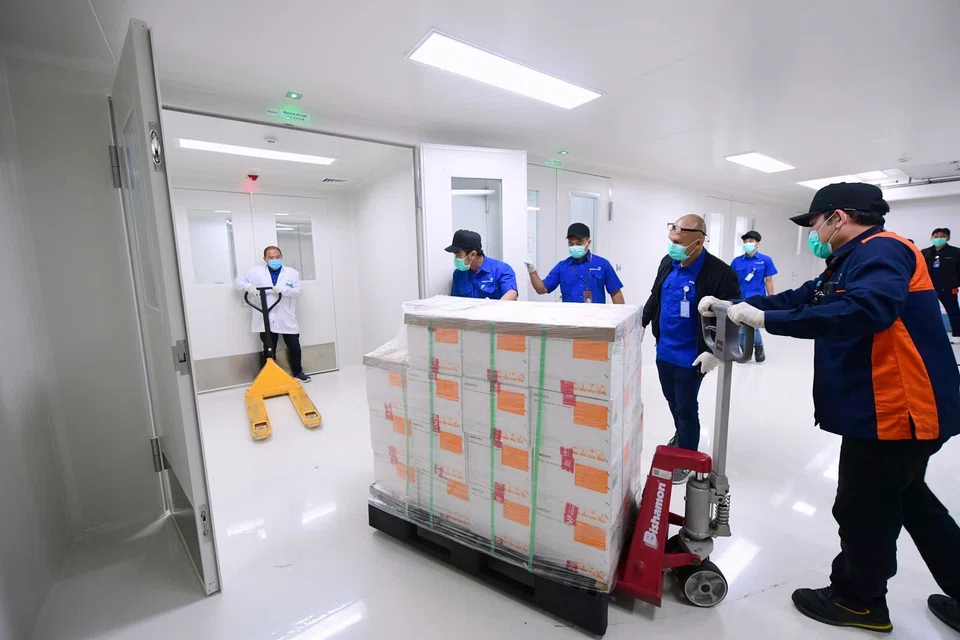
DBS's report notes that both vaccines may be authorised for emergency use in December, with as many as 60 million vaccine doses available by the year's end. Early access to vaccines is expected to be reserved for high-risk persons, including healthcare personnel, essential workers, those at high risk for severe Covid-19 illness due to underlying medical conditions, and the elderly above 65 years of age.
Navigate Asia in
a new global order
Get the insights delivered to your inbox.
While vaccinations for the broader population will take time, DBS estimates that about 38 per cent of the world's population - or 2.9 billion people - could be vaccinated by end-2021, and herd immunity achieved at about 70 per cent inoculation by end-2022.
These estimates assume that five of the frontrunners in the phase three vaccine trials will be successful in their applications, and will be able to ramp up production capacity from the first half of 2021. DBS also applied a 25 per cent discount to production capacity, to account for anticipated challenges in distribution and administration.
Continued progress on the vaccines front would spell rising fortunes for cyclical value stocks and vaccine beneficiaries, according to DBS's analysis.
Covid-19 beneficiaries such as consumer staples and personal protective equipment manufacturers underperformed cyclical value stocks over the past month - a trend that DBS expects to continue as global economies return to pre-Covid 19 levels over the next one to two years.
The rally was led by early cycle winners such as banks, properties and consumer discretionary stocks, and also looks set to broaden to mid-cycle and small-mid cap stocks next year, DBS added.
Meanwhile, industries such as aviation, hotel and tourism are expected to benefit from vaccine development. International travel is assessed as likely to "rebound sharply in months, not years" after vaccines are distributed across the globe. "We see no structural impact from Covid-19 on the travel and aviation industry," said the report.
Finally, US President-elect Joe Biden's more moderate posture towards China is expected to ease US-China trade tensions, while benefiting Hong Kong and China markets. The report deems it likely for Mr Biden to review the Trump administration's trade tariffs, which could result in a progressive rollback of US-China tariffs.
Notwithstanding the above, Mr Biden is still anticipated to face pressure from both Democrats and Republicans in dealing with China. DBS therefore expects firms to continue diversifying their bases and reconfiguring their supply chains, including by continuing to shift manufacturing bases out of China to nearby Asean hubs such as Vietnam and Malaysia.
Decoding Asia newsletter: your guide to navigating Asia in a new global order. Sign up here to get Decoding Asia newsletter. Delivered to your inbox. Free.
Copyright SPH Media. All rights reserved.
TRENDING NOW

Air India asks Tata, Singapore Airlines for funds after US$2.4 billion loss
‘Boring’ is the new black: The stars are aligning for a Singapore stock market revival

From 1MDB to ‘corporate mafia’: Is Malaysia facing a new governance test?

South-east Asian markets account for 8.8% of global capital inflows from 2021 to 2024: report

