Regional tourism growth may slow in H2, but China’s contribution to rise further

Elysia Tan
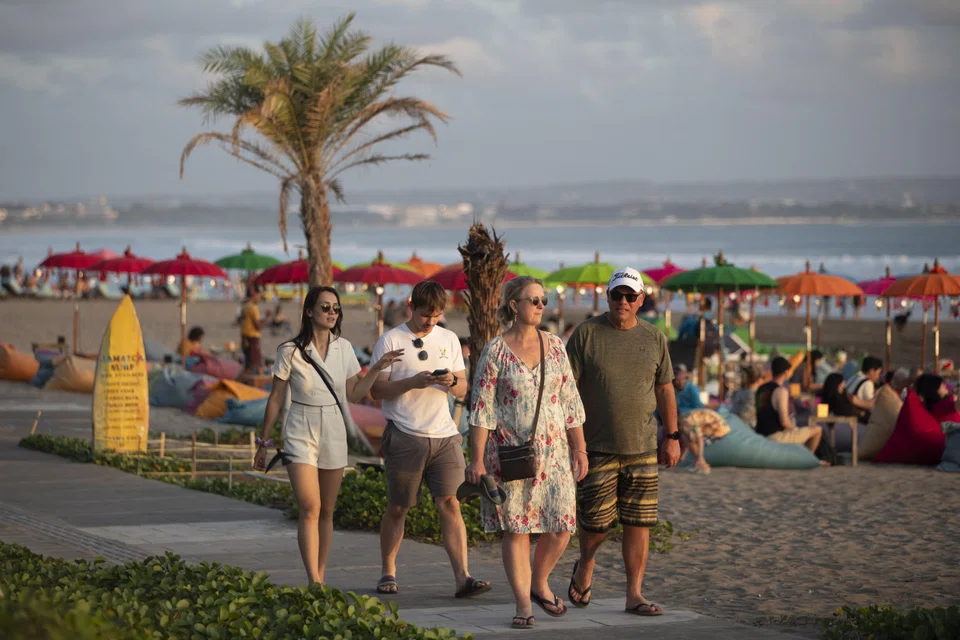
INBOUND travel into Asean destinations will likely continue to improve in the second half of this year, albeit at a slower pace compared with last year and the first six months of 2023, said market watchers.
The continued pick-up in tourism “will provide some buffer to growth and current account balances in the region, especially as the goods export outlook remains lacklustre”, said OCBC senior Asean economist Lavanya Venkateswaran in a report.
China, in particular, will be a major contributor to the region’s tourism receipts.
“China just removed the group restrictions for many countries,” said Jesper Palmqvist, senior director for Asia-Pacific at hospitality research provider STR. Many Chinese citizens have renewed their passports, and flight capacities have risen.
All this will drive increases in Chinese outbound travel, he said.
Cushman & Wakefield’s head of research Wong Xian Yang said outbound travel has had a “slow start” this year due to limited flight capacity, dearer airfares and cautious consumer spending, given the weaker-than-expected economic recovery.
The second half of the year, however, will see travel boosts from the country’s summer holidays in July and August, as well as the “Golden Week” national day holiday in early October, said Wong.
Lam Chern Woon, head of research and consulting at Edmund Tie, noted that the number of Chinese tourists arriving in Singapore in July was already more than double that in June.
“Other countries in Asean are likely to experience an increase as well, mainly due to the nearing of... festive periods and school holidays,” he said.
Subsiding roar
OCBC’s Lavanya noted, however, that the “roar from revenge travel seems to have subsided, at the margin, segueing into a more normalised pattern of travel and tourism”.
Lam of Edmund Tie, meanwhile, said the rate of growth could slow as it “reaches a saturation point”.
“Elevated air ticket prices and increased traveller caution due to sluggish economic growth in the region will weigh on the pace of tourism recovery,” added Cushman & Wakefield’s Wong.
He also noted that H2 growth will suffer from higher base effects, compared with 2022 and H1 2023.
Market watchers also flagged the potential effects of China’s economic slowdown.
“There is a case for destinations seen as more affordable to grow faster, as the Chinese economy also shows signs of a slowdown, with high youth unemployment and softening in consumer spending,” said Palmqvist of STR.
Savills Research & Consultancy’s executive director Alan Cheong, too, flagged that China’s slowing economy might pose a challenge in 2024.
“For countries that experienced strong tourism recoveries in 2023, come 2024, tourism growth may slow or even reverse as economic headwinds start to push back against travel,” he said.
Uneven Q2 performance
The more muted outlook for the latter half of the year comes after Asean tourist arrivals posted a mixed showing in Q2.
Indonesia and Singapore recorded strong tourist arrival recoveries, while Thailand saw little change. Arrivals into the Philippines ended lower.
China’s support was more visible in Q2, compared with Q1, said Lavanya.
Lam noted that Singapore and Thailand benefitted most from the return of Chinese travellers. Chinese tourists made up 9 per cent of Singapore’s tourist arrivals in Q2, a 5-percentage-point increase quarter on quarter. The equivalent figure in Thailand rose by 7 percentage points to 15 per cent.
Indonesia also benefited from simplified visa rules that took effect on May 30. Its tourist arrivals stood at 79.2 per cent of pre-pandemic 2019 levels by the end of Q2, against 64.8 per cent at end-Q1.
Tourist arrivals for Singapore were at 70.9 per cent of pre-pandemic levels by end-Q2, versus 64.1 per cent in end-Q1. Quarter on quarter, arrivals were up 15.8 per cent.
Lam said Singapore welcomed a slew of high-profile concerts in recent months that drove tourism arrivals, which coincided with China’s reopening and the resumption of more international flights.
Many upcoming concerts, the F1 Grand Prix in September, new retail and entertainment openings such as the Palawan@Sentosa, as well as Trifecta – a new snow, ski and skate attraction in Orchard Road – will continue to support tourism arrivals into Singapore, he added.
In Malaysia, Lavanya said, passenger traffic at the country’s airports marked a quarter-on-quarter improvement.
Seasonal effects could have come into play for arrival increases in the region, said Wong, noting that visitors from Western countries tend to opt for tropical destinations after the December to March period, “to get away from winter”.
In contrast, the Philippines’ tourist arrivals ended Q2 lower at 65.2 per cent of pre-pandemic levels versus 69.1 per cent in Q1. Visitor arrivals marked a 7.8 per cent drop from the first quarter.
For Thailand, tourism flows were resilient, at 67.4 per cent of 2019 levels in Q2, from 66.7 per cent in Q1. Quarter on quarter, arrivals dipped 0.6 per cent.
Data collated by Cushman & Wakefield indicated that the number of visitors from South Korea – a top source of visitors for the Philippines and Thailand – fell for both countries in Q2. The drop in outbound travel from South Korea was also due to seasonality, with December to February being popular travel periods due to the holidays, Wong said.