



Ringgit weakens to record RM3.45 against Singapore dollar, but could rebound soon
Tan Ai Leng
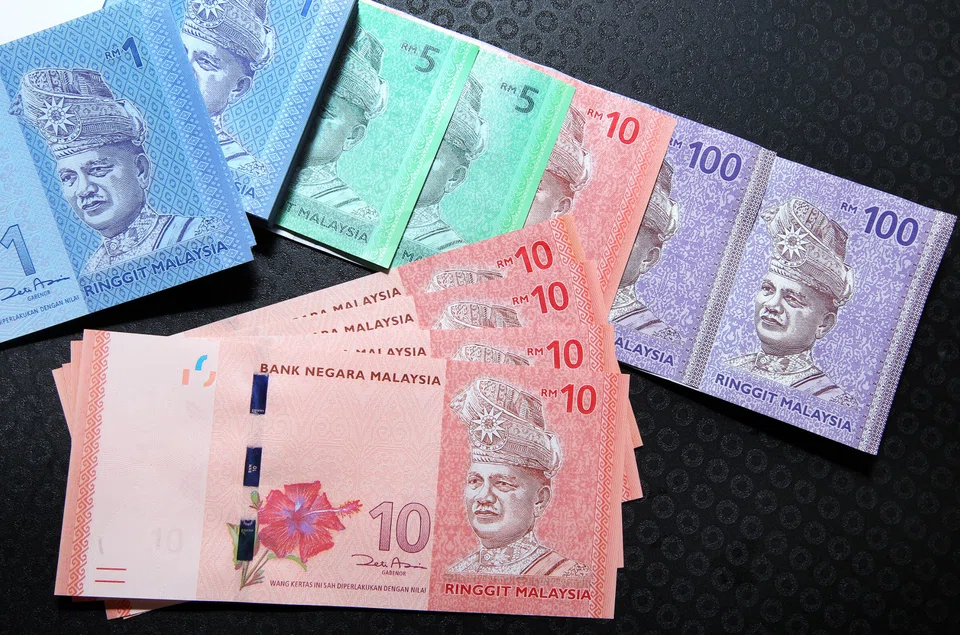
[KUALA LUMPUR] The Malaysian ringgit – one of the worst-performing currencies in Asia this year – continued its slide as it hit an all-time low of RM3.45 against the Singapore dollar on Thursday (Jun 15).
This marked a nearly 8.5 per cent depreciation from a year ago, and a 4.2 per cent dip since the start of the year.
Against the greenback, the ringgit touched RM4.6362 on Thursday – a 4.7 per cent decline from 12 months ago, and 4.5 per cent weaker than the rate on Jan 1 this year.
Analysts to whom The Business Times spoke attributed the currency’s poor showing this year to the strong US and Singapore dollars, as well as Malaysia’s weaker-than-expected economic data. Among Asian currencies, the ringgit’s year-to-date decline is the second-worst, behind the Japanese yen.
The ringgit’s performance against other Asian currencies has been mixed.
From the rate a year ago, the ringgit is down 5 per cent against the Thai baht, 3.5 per cent lower against the Indonesian rupiah, and 3 per cent weaker against the Vietnamese dong. The Malaysian currency has, however, appreciated by 1.6 per cent against the Chinese renminbi over the past 12 months.
Jeff Ng, a senior currency analyst at MUFG Bank, said the market sentiment towards Malaysia remains weak due to several sluggish economic indicators. Namely, the declining manufacturing production, a lower trade surplus, and a slow recovery for the tourism sector.
Malaysia recorded a current account surplus of RM4.3 billion (S$1.3 billion) – or 1 per cent of gross domestic product (GDP) – in the first quarter of this year. This is down from RM27.5 billion (5.9 per cent of GDP) in the previous quarter.
The country’s factory output contracted for the first time since July 2021, with the benchmark industrial production index declining 3.3 per cent in April.
MIDF Research noted that the widened interest differential between the US Federal Reserve’s funds rate and Malaysia’s overnight policy rate is another factor that caused the outflow of funds from Malaysia.
Last week, foreign investors continued to net-sell Malaysian equities for the eighth consecutive week, at RM443.8 million.
“We believe that other factors like changing sentiment in local markets and recent developments surrounding domestic issues led to an outflow of foreign funds, causing the ringgit to weaken further,” said MIDF in a report dated Jun 13.
It expects the ringgit’s performance to improve and head towards the RM4 level by the end of this year, due to better economic growth “sustained and anchored by growing domestic activities”.
Despite the Fed leaving its benchmark rate unchanged at 5.25 per cent on Wednesday, analysts say this is unlikely to give the ringgit a boost, as the expectation is for the US central bank to raise rates later this year to bring inflation down to its target of 2 per cent.
Even with this gloomy outlook, observers say the ringgit’s depreciation will carry on for a while longer, but will likely improve towards the end of this year.
UOB expects the ringgit to continue to fall against the greenback and reach RM4.68 in the third quarter of this year, followed by a rebound in the final three months as China’s economy builds momentum.
On the other hand, MUFG Bank forecasts the ringgit to climb up to RM4.30 against the US dollar by the end of 2023, and improve to RM4.20 in the first quarter of next year.
It also expects it to strengthen to RM3.30 against the Singapore dollar by year’s end, and appreciate further to RM3.25 in the first quarter of 2024.
TRENDING NOW

Grab CEO’s wife Chloe Tong on life with Anthony Tan and finding her purpose

US trade chief to consider trade deal tariff caps in excess capacity probe

Bee Cheng Hiang customers’ e-mail addresses exposed in Singapore’s first case of AI-related data breach

DFI Retail to take over Starbucks business in Asia from Maxim’s Caterers

