



Ringgit’s rebound tests Malaysian exporters as Singdollar remains resilient
Businesses say the strengthening ringgit is starting to squeeze exporters’ margins, though SME importers get cost relief


[KUALA LUMPUR] Malaysia’s ringgit has surged to its strongest levels in years, but for businesses trading across the Johor Strait, the key question is how the currency will fare against the resilient Singapore dollar.
The ringgit’s rally, buoyed by improving domestic fundamentals and waning confidence in the US dollar, is lifting investor sentiment.
However, some businesses warn that the stronger currency is beginning to squeeze exporters’ margins, particularly for manufacturers selling into Singapore and global markets.
Analysts said the Singapore dollar will remain a key benchmark for the Malaysian currency in the months ahead, shaping cross-border trade flows and pricing decisions for businesses operating between the two economies.
Peter Chia, senior FX strategist at UOB, said the Singapore dollar is expected to stay firm through 2026, with Singapore’s exchange-rate policy framework and its reputation as a regional safe-haven currency continuing to attract capital flows amid global uncertainty.
“Technical indicators suggest the SGD/MYR pair established a floor around 3.07 in late February,” he told The Business Times, adding that the exchange rate is projected to edge higher toward 3.10 by the end of the year.
That would imply modest ringgit weakness against the Singapore dollar, even if the Malaysian currency continues strengthening against the US dollar.
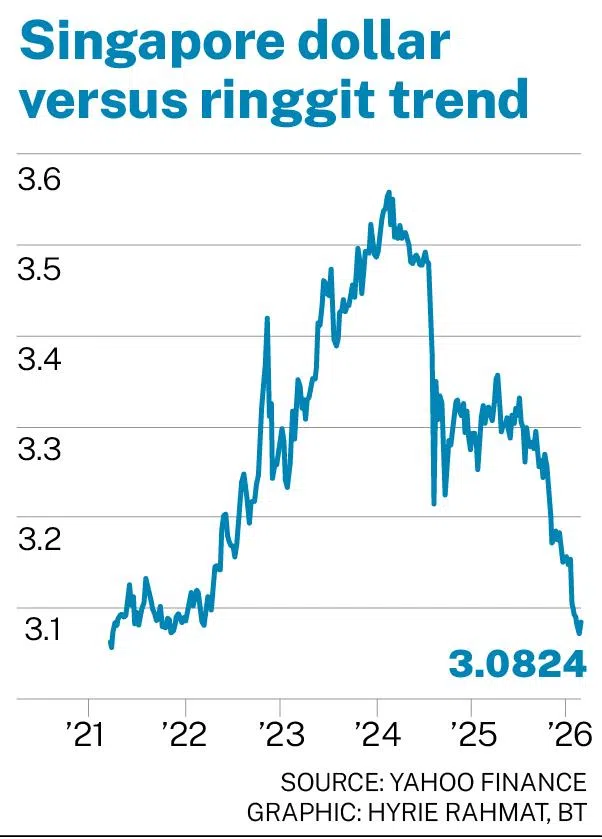
By midday on Wednesday (Mar 11), the ringgit strengthened to 3.087 against the Singapore dollar; this was up 2 per cent from 2025, and nearly 13.5 per cent from its February 2024 trough of 3.568.
It also gained 4.3 per cent against the US dollar to trade at 3.9236. With a 12-month surge of over 11 per cent against the dollar, the ringgit has secured its spot as the top-performing currency in Asia.
Jeff Ng, head of Asia macro strategy at Sumitomo Mitsui Banking Corporation (SMBC), holds a slightly more constructive outlook for the ringgit.
He said the Malaysian currency may outperform the Singapore dollar in the near term as Malaysia’s macroeconomic outlook improves and investor sentiment toward emerging-market currencies strengthens.
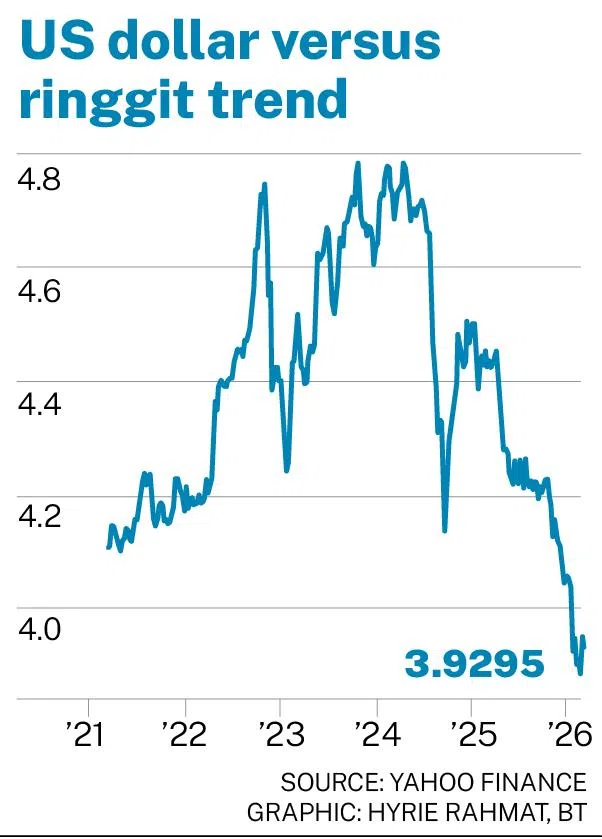
SMBC forecasts the USD/MYR exchange rate to strengthen to about 3.80 by September, and around 3.75 by the end of the year.
Against the Singapore dollar, the bank expects the ringgit to approach the 3.00 psychological level by year-end.
Ng cautioned that the dynamic could shift if the Monetary Authority of Singapore tightens its policy further to manage inflation, a move that could reinforce the Singapore dollar’s strength against regional currencies.
Bank Negara Malaysia, in its latest update on the country’s economic developments in February, noted that while external factors will continue to influence the ringgit, resilient domestic fundamentals are expected to provide enduring support for the currency.
Weakening dollar and stronger fundamentals
Economists say the ringgit’s rebound reflects broader shifts in global currency markets.
Mohd Afzanizam Abdul Rashid, chief economist at Bank Muamalat Malaysia, said the waning confidence in the US dollar has been a key driver behind the Malaysian currency’s rally.
The United States lost its final triple-A sovereign credit rating when Moody’s downgraded the country in May 2025, following earlier downgrades by S&P in 2011, and Fitch in 2023.
Afzanizam said: “The US Dollar Index has remained below the 100-point mark despite geopolitical shocks, which suggests investors are reassessing the strength of the dollar.”
Malaysia’s domestic fundamentals have also helped support the currency, he added. The country continues to run a current account surplus, and its foreign exchange reserves stood at US$128.3 billion as at late February 2026.
The country’s banking system also remains well-capitalised and highly liquid.
“When a currency strengthens alongside strong domestic fundamentals, it reflects genuine investor confidence rather than speculative volatility,” Afzanizam said.
Geopolitical tensions, however, could inject volatility into the ringgit’s trajectory in the coming months.
Afzanizam noted that rising tensions in the Middle East and volatile oil prices have created a “wait-and-see” environment for global investors.
While higher oil prices typically support Malaysia as an energy exporter, the relationship between oil prices and the ringgit has become less straightforward in times of geopolitical stress.
“In such risk-off environments, investors often rush into US dollar liquidity, which can offset the trade benefits commodity exporters typically enjoy when oil prices rise,” he added.
Exporters face margin pressure
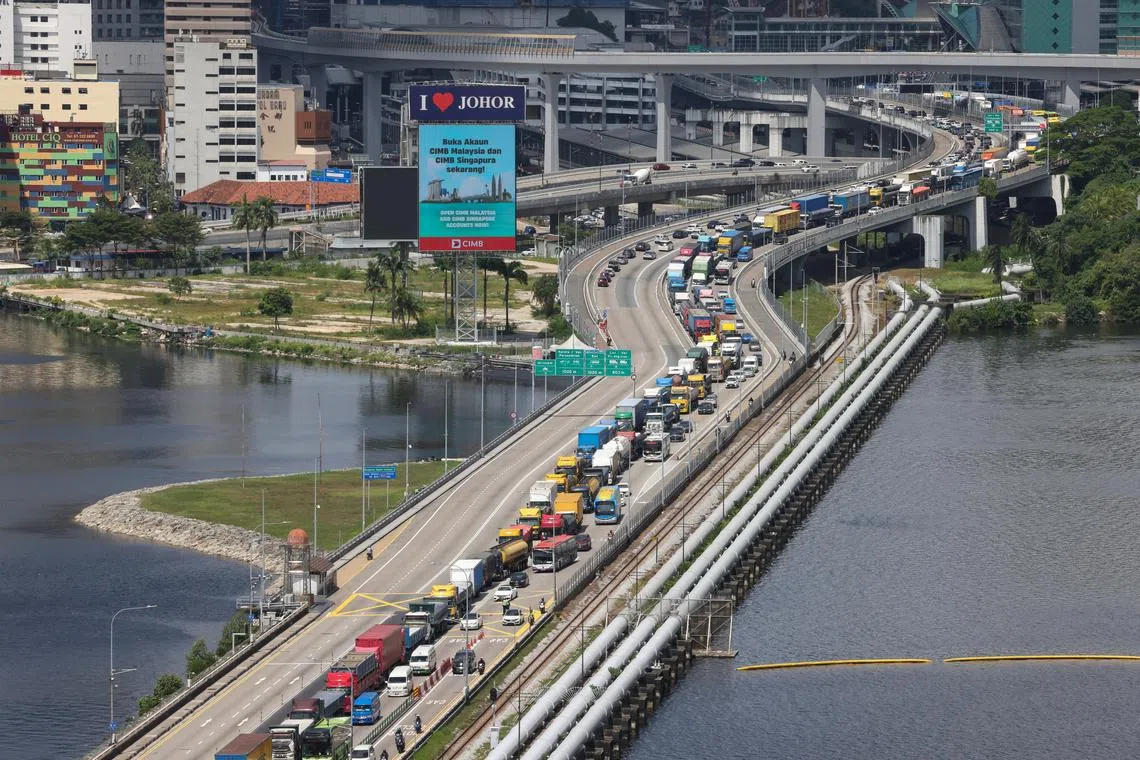
For exporters, however, the stronger ringgit is already creating pressure on margins.
Teh Kee Sin, adviser and founding president of the SME Association of South Johor, said a stronger currency reduces the value of export earnings when foreign revenue is converted back into ringgit.
“When the ringgit strengthens, export revenue translated into ringgit becomes smaller. That squeezes margins and can make Malaysian products less competitive than those of neighbouring countries,” he said.
The impact is particularly pronounced among export-oriented manufacturers that transact largely in foreign currencies.
Still, Teh described the currency’s appreciation as a “double-edged sword” for businesses.
While exporters face pressure on margins, companies that rely heavily on imported machinery, components or raw materials may benefit from lower costs.
“For SMEs that import materials or equipment, the stronger ringgit can actually help reduce costs,” he said.
Many manufacturers in Johor depend on imported inputs for production, meaning the currency’s appreciation could offer some relief on operating expenses, he added.
However, Teh cautioned that currency volatility itself remains a concern for small and medium-sized enterprises.
Rapid exchange-rate movements make it harder for businesses to plan costs, set prices and negotiate contracts with overseas buyers, he said.
Furniture exporters feel the squeeze
Furniture exporters are facing similar pressures. Steve Ong, president of the Muar Furniture Association, said most furniture exports are priced in US dollars, meaning a stronger ringgit directly reduces the value of export earnings when revenues are converted back into the local currency.
“An appreciating ringgit means companies receive less in ringgit terms when they convert export earnings, effectively squeezing profit margins,” he said.
However, Ong said the stronger currency has not yet resulted in a noticeable decline in orders.
Demand for furniture tends to be driven more by product design, quality, supply-chain reliability and long-term customer relationships, rather than short-term currency fluctuations, he added.
“Customers usually do not immediately shift orders purely because of currency movements,” he said.
Nevertheless, Teh and Ong shared the view that if the ringgit remains elevated while production costs in neighbouring countries are more competitive, Malaysia’s export competitiveness could eventually come under pressure.
Cost pressures also remain high across the industry.
While a stronger ringgit may slightly reduce the cost of certain imported inputs, Ong said rising labour costs, logistics expenses and higher domestic operating costs continue to weigh on exporters.
Malaysia’s minimum wage increase to RM1,700 (S$549) in 2025, alongside rising transportation and operational expenses, has pushed up overall production costs.
Ong said that for many manufacturers, the modest gains from currency appreciation are not enough to offset the broader rise in the cost of doing business.
In the longer term, he added, furniture exporters will need to focus on improving production efficiency, strengthening design capabilities and diversifying export markets to maintain their competitiveness in the global market.
Teh said the recent currency movement should remind businesses against relying solely on exchange rate to stay competitive.
“If SMEs depend purely on currency advantage, that is never a sustainable strategy… Exchange rates can change anytime. This is a wake-up call to businesses to strengthen productivity and competitiveness,” he added.
TRENDING NOW

Analysts cut DBS target price on lower 2027 earnings, but see buying opportunity after share price slide

Waymo founder predicts ‘landslide’ robotaxi adoption in Singapore, driven by high car costs

The limits of China’s trade concessions to Europe

Nvidia CEO Jensen Huang drops from world’s top 10 richest after chips sell-off

