



Rising rates intensify Asean’s debt burdens, but financial crisis remains unlikely

Annabeth Leow

ASEAN economies whose public debt levels rose during the pandemic may feel squeezed by rising interest rates, but they are now more resilient against the risk of a financial crisis compared to the past, say analysts.
While the Asean+3 Macroeconomic Research Office (Amro) “remains wary of risks to the region’s fiscal sustainability”, “a major financial crisis is unlikely at this point”, Amro chief economist Khor Hoe Ee told The Business Times.
“The realisation of a sovereign debt crisis in the Asean+3 region is deemed a tail risk at this juncture,” he added. Asean+3 refers to the 10 Asean member states as well as China, Japan and South Korea.
Recent reports have flagged leverage levels – both public and private – in regional economies.
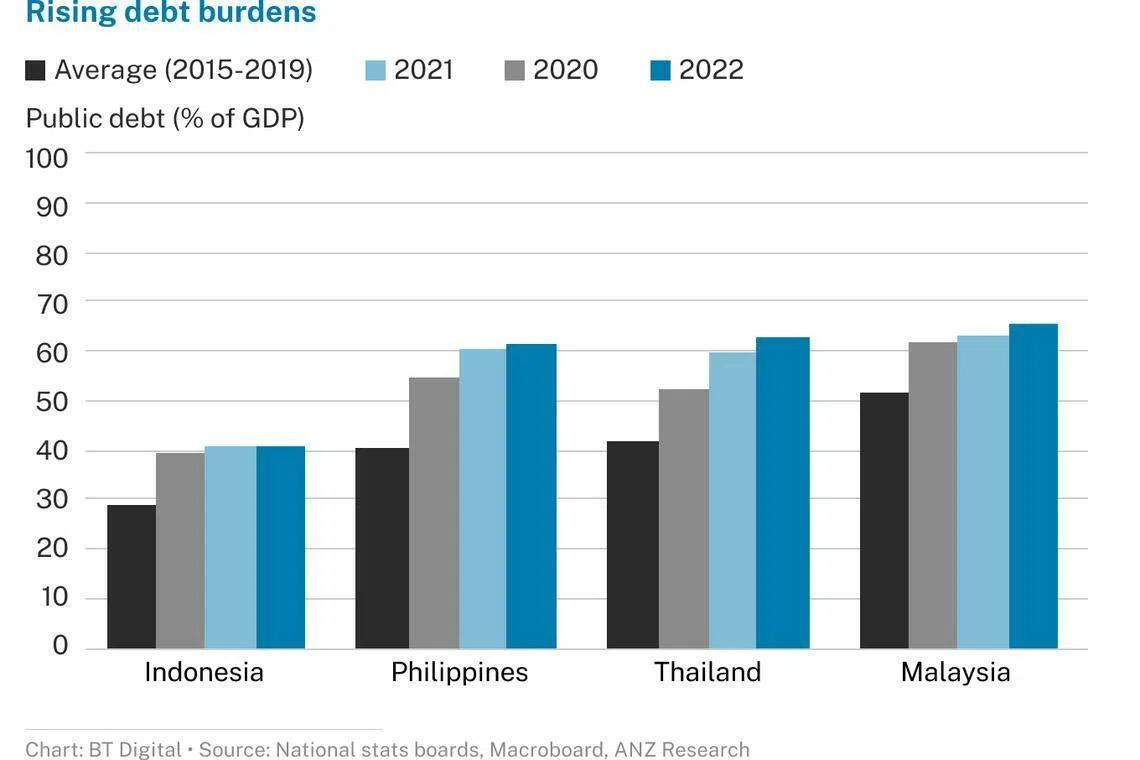
“Unwinding the pandemic-induced surge in public debt will be challenging for Asean and India,” ANZ economists Sanjay Mathur and Krystal Tan wrote on Jul 20, as they warned of the challenges from both tighter monetary policy and a looming global growth slowdown.
Individual economies could be hit by lower investment and “diminished ability to respond to another shock” like Covid-19 or a global recession, Mathur told BT. Along those lines, he expects medium-term growth to be more constrained in Malaysia and Thailand.
Malaysia’s general government debt, including guarantees serviced by the government, stood at 77.7 per cent of gross domestic product (GDP) at end-2021, up from 65.2 per cent in 2019, according to Fitch Ratings.
Over the same period, the Philippines’ debt-to-GDP ratio climbed from 34.1 per cent to 53.4 per cent, figures from the Philippine Department of Finance showed.
Household loans have also come under scrutiny amid rising rates.
“Elevated household debt remains a major problem despite a recent slowdown in the pace of household debt growth,” a Moody’s Analytics report said on Jul 20. “Many South-east Asian countries are also facing skyrocketing housing prices as hot money and speculation continue to push up prices.”
Bank Negara Malaysia disclosed in its latest annual report that the country’s household debt-to-GDP ratio rose to 89 per cent in end-2021, up from 82.7 per cent in end-2019 before the pandemic, which “remains on the higher end compared to regional economies”.
Over the same period, Thailand’s household debt-to-GDP ratio rose from 79.9 per cent to 90 per cent, according to figures from the Bank of Thailand.
Noting the high household debt-to-GDP levels in South Korea, Malaysia and Thailand, Steve Cochrane, Moody’s Analytics chief Asia-Pacific (APAC) economist, said: “The greatest risk is in Thailand because its economy has been the slowest to recover from the Covid-related downturn.”
Amid rising global rates, the Moody’s report warned household loans in Malaysia and Thailand “are at risk of non-performance as interest rates normalise”.
Meanwhile, Dr Khor from Amro said: “Rising household debt, especially if alongside surging property prices, warrants close monitoring, as this can lead to the build-up of financial imbalances across Asean.
“Additionally, high household debt – if coupled with high unemployment – can be a drag on private consumption, for example, in Thailand.”
Still, analysts believe that the region is in a resilient position, with little risk of spillover.
“Given the same debt profile, a growing economy with rising income and profits such as those in the Asean region would be less vulnerable compared with one that is stagnating,” said UOB research head Suan Teck Kin, who tips Asean to grow by 5 per cent per year in 2022 and 2023.
Even with emerging economies’ weaker tax abilities, he stressed that “it is not just the amount of debt or the extent of indebtedness (that matters), it also depends on the ability to service this debt”.
“Even though debt levels have increased across Asia, leverage remains far more manageable than elsewhere,” said Frederic Neumann, chief Asia economist at HSBC, who called public debt levels in the region “considerably lower than the average for emerging markets globally”.
UOB’s Suan also compared total debt-to-GDP levels – such as 82.5 per cent in Indonesia, 206 per cent in Malaysia and 232 per cent in Thailand as at end-2021 – to higher levels in China (286.6 per cent), emerging markets (227.7 per cent) and Group of 20 economies (261.4 per cent).
UOB economists concluded in a report in May that household debt in Asean “remains at an acceptable rate of increase”. That conclusion still applies, as UOB had already factored interest rate hikes by regional central banks into its analysis, Suan told BT.
Though Amro has identified sharper-than-expected tightening by the United States Federal Reserve and sovereign debt distress as key short- to medium-term risks for Asean, the likelihood of widespread contagion is deemed low.
Dr Khor noted that the bulk of fiscal deficits was funded by domestic savings and government bonds with “significantly lower” interest rates – making the risk much lower than if debt were fuelled by foreign capital inflows.
Added Neumann: “Unlike in past cycles, notably around the Asian financial crisis in the late 1990s, local banking systems are in robust shape, well capitalised and well provisioned with liquidity. The regulatory oversight has also improved greatly, reducing the risk of unforeseen shocks, such as unwarranted exchange rate exposure of local debtors.”
For example, Indonesia’s economy has stronger macro-fundamentals than before, and a “very narrow” current account deficit, while high foreign exchange reserve levels in the Philippines and Thailand offer “a welcome cushion against short-term debt obligations”, he said.
Similarly, Cochrane said that the region is in better shape to avoid a government debt crisis than during the global financial crisis and Asian financial crisis, despite higher debt burdens. “There is some pressure on currencies but most APAC central banks are in the process of normalising interest rates, which will help to stabilise exchange rates.”
HSBC’s Neumann added: “The primary concern of higher interest rates at the moment is that they will inevitably curb the region’s economic rebound, but leverage has not increased anywhere close to levels that would indicate imminent financial stress.”






