



Robotaxis are coming to Singapore, but the rest of South-east Asia might have to wait
Analysts say cost, manpower and infrastructure factors stand in the way of autonomous vehicles operating commercially in the region

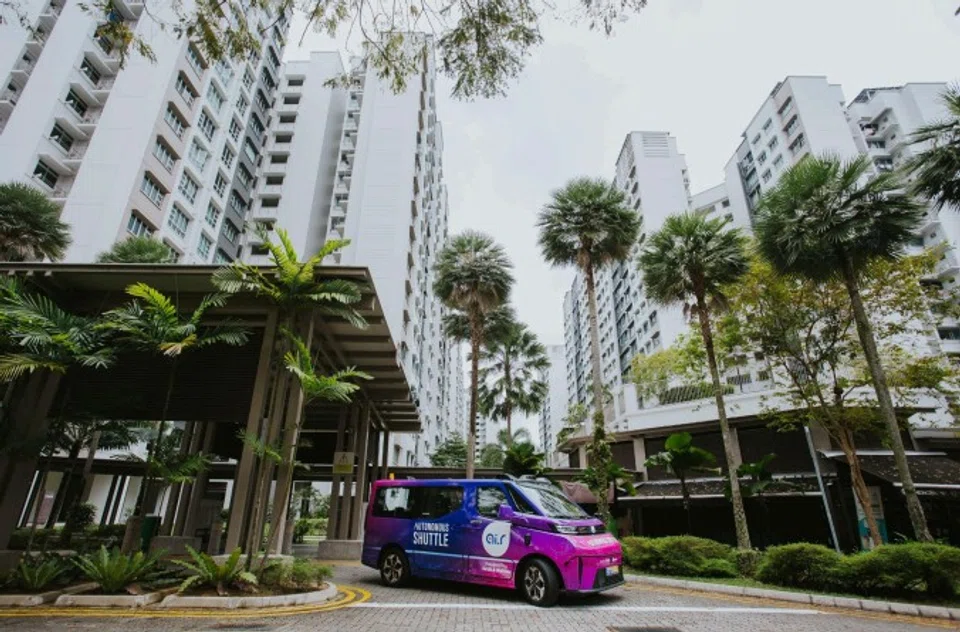
[SINGAPORE] Robotaxis are already plying the streets of cities in mainland China and the United States, and these robotaxis are expected to become a transport option in Singapore as well.
But even as consumer trust in the technology grows, consumers from the rest of South-east Asia would likely take their first robotaxi rides in Singapore, because it is unlikely that commercial robotaxi services will become available in the rest of the region anytime soon.
Countries such as Vietnam and Malaysia are already testing autonomous driving options, but analysts think factors such as cost, manpower and infrastructure stand in the way of commercial robotaxi services.
Timothy Wong, a senior lecturer at the National University of Singapore who researches into transport economics, said labour costs in South-east Asia, excluding Singapore, are low.
A lower cost of labour means less impetus for transport operators to invest in adding autonomous-vehicle options, as it would still be cheaper to have a human driver.
Grab, the region’s largest ride hailing operator, has made this point before, but nonetheless continues to make investments in autonomous driving as part of its long-term strategy.
At a recent earnings call, its chief executive Anthony Tan also made the point about labour costs in South-east Asia, excluding Singapore, being significantly lower than in the US. “We believe, therefore, that it will require considerable time for the unit economics to reach parity with human drivers,” he said.
He added that the crossover point for South-east Asia could occur when autonomous vehicles are proven to be safer and cheaper than some of the current modes of transportation.
Labour costs aside, providing ride-hailing services has arguably gone from being a gig to a full-time job for millions of people in the region, so a quick adoption of automation may well result in political backlash as drivers demand that their livelihoods be protected.
SEE ALSO


Wong thinks that in Singapore’s case, the country’s ageing population and shrinking base of taxi drivers mean robotaxis will enable the city-state to maintain its point-to-point fleet as existing drivers retire.
Infrastructure matters
Singapore-headquartered transport operators ComfortDelGro and Grab are conducting tests in the Punggol residential district for their respective robotaxi services. Their respective autonomous vehicle fleets will first launch as a shuttle service in Punggol early next year.
Commercial services are expected to start in Singapore later in 2026. Acting Transport Minister Jeffrey Siow previously said the aim is to expand the fleet of self-driving vehicles to between 100 and 150 by the end of next year.
Beyond manpower and costs, infrastructure matters as well.
“An economy needs roads that are built for and used primarily by cars,” said Francis Ostermeijer, an assistant professor of economics at VinUniversity in Vietnam.
Using Vietnam as an example, he noted that cars make up only a small portion of road traffic in most cities in the country, and that the software in autonomous vehicles could face a challenge in mixed-use roads, where traffic flow is a lot less predictable.
Hanoi and Ho Chi Minh City have large motorcycle populations that share the road with cars; this is also the case in other major cities in South-east Asia – Bangkok, Jakarta and Manila, for example.
Motorcycle taxis also ply the roads in many South-east Asian cities, and are cheaper than regular taxis.
Ostermeijer noted that Vietnam’s electric-vehicle manufacturer VinFast is focused on developing the electric vehicle (EV) industry and capturing market share for EVs first, given the higher upfront costs for autonomous vehicle technology.
VinFast is owned by VinGroup, which also owns VinUniversity. Ostermeijer added that his views are his own and do not reflect that of VinGroup.
Elsewhere in the region, Malaysia, Thailand and Indonesia are also focused on developing their own automotive industries to take advantage of the opportunities in the EV space.
“Outside Singapore, the rollout (for South-east Asia) will likely be in a 10-year, rather than five-year horizon,” said Wong of NUS.
He thinks commercial robotaxi services will be first available in markets such as Hong Kong, South Korea and Japan, where costs and demographics are similar to those in Singapore.
“If the technology is well tested and well trusted in other cities, it may be more easily and quickly implementable in the rest of South-east Asia,” he said.
Decoding Asia newsletter: your guide to navigating Asia in a new global order. Sign up here to get Decoding Asia newsletter. Delivered to your inbox. Free.
Copyright SPH Media. All rights reserved.
TRENDING NOW

Once staunchly pro-China, Malaysian Chinese businesses are now distancing themselves from Beijing

Looking beyond looming CEO succession, should UOB potentially pursue a transformative merger?

Could stablecoins be the future of money?

Grab CEO’s wife Chloe Tong on life with Anthony Tan and finding her purpose

