



S-E Asia continues to feel the heat from US dollar’s hot streak


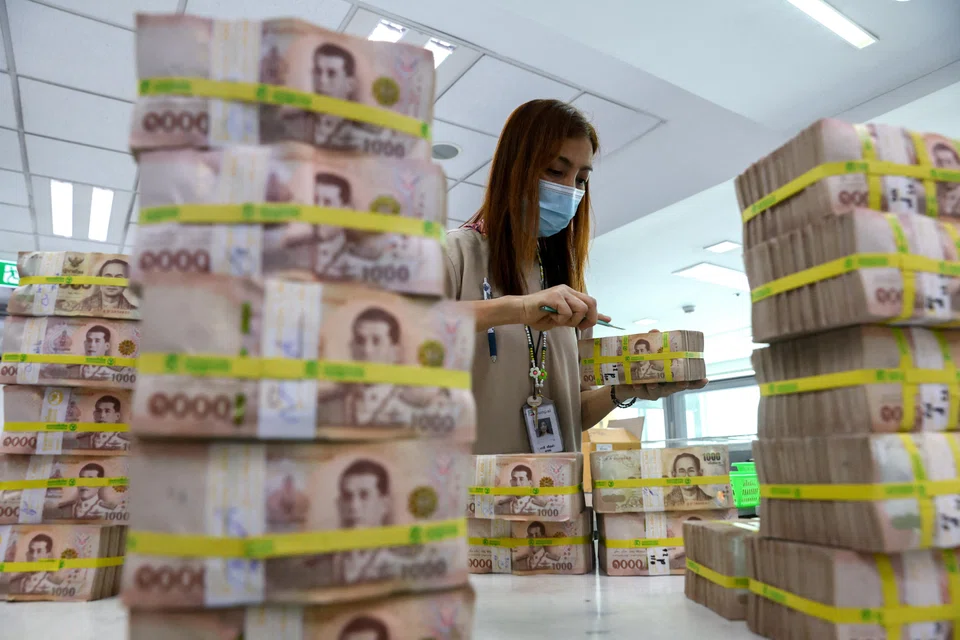
SOUTH-east Asian currencies have been feeling the burn as the US dollar continues its winning streak since mid-July – the greenback’s longest such run in nearly a decade – on the back of the US Federal Reserve’s “higher for longer” interest rate policy and increasing Treasury yields.
On Oct 23, the benchmark 10-year yield breached 5 per cent, rising to its highest level since 2007. As the US dollar and assets appear to be more attractive to global investors, the demand for the US dollar has increased in tandem.
The US dollar index, which measures its value against a basket of six major currencies – the euro, Japanese yen, British pound, Canadian dollar, Swedish krona, and Swiss franc – has gone up by about 5 per cent since July.
Within South-east Asia, the currencies of Malaysia, Thailand and Indonesia are among the hardest hit.
The ringgit has dropped to a 25-year low since the Asian financial crisis in the late 1990s, reaching 4.777 to the US dollar last Friday (Oct 27).
The baht sank to an 11-month low at 37.095 per US dollar on Oct 3 and has depreciated by nearly 7 per cent so far this year.
The Indonesian rupiah, which stood as Asia’s final holdout against the US dollar for much of 2023 – also joined its neighbouring countries in the red early this month.
As at Oct 27, the rupiah has weakened to 15,939 per US dollar – a level last seen in April 2020.
Similarly, the Lao kip has depreciated from about 9,000 per US dollar in May 2020 to breach the 20,000 mark in September. Its value has been plummeting since Aug 2020 amid the Covid-19 pandemic due to high debt distress.
Higher imported costs
A stronger US dollar makes Asean exports, as well as tourism activities in the region, cheaper, thereby boosting their competitiveness. This is a tailwind for regional exporters and the tourism sector’s ongoing recovery from the pandemic.
However, as global trade tends to be overwhelmingly denominated in dollar terms, a weaker local currency will also increase the price of imports, contributing to imported inflation.
A significant portion of Asean exports is integrated into global and regional value chains. According to a 2022 report by the Asian Development Bank (ADB), Asia’s value chain linkages account for about two-thirds of its total trade. Cheaper exports will hence be offset by the increased cost of imported inputs.
“The recent strength of the US dollar, alongside uncertainty in the global oil market, is likely to bring some upside risks to inflation in Asean via higher imported costs,” said Yun Liu, Asean economist at HSBC.
She expects all Asean economies, with the exception of Malaysia where inflation is partially shielded by subsidies, to be sensitive to higher energy prices.
DBS economist Chua Han Teng noted that the weakening local currencies could also exacerbate potential food price shocks from El Nino weather disruptions.
“A sliding peso risks magnifying price pressures facing the Philippines, which is already experiencing an upturn in inflation on higher imported food and energy prices,” said Chua, highlighting that the economy’s headline inflation has accelerated for the second consecutive month as at September this year.
Small, low-income economies which tend to buy a lot of food imports appear to be the most vulnerable.
“Presently, the strengthening US dollar is contributing to high food inflation in Laos, Timor-Leste, and Cambodia,” said James Villafuerte, ADB’s lead economist for South-east Asia.
Siddharth Mathur, BNP Paribas’ head of macro strategy and emerging markets research (Asia-Pacific), said the sensitivity of inflation to exchange rate depreciation tends to be low due to the inertia that producers and sellers face in raising prices.
“Usually these pass-throughs are less than 10 per cent. So it takes a large change in exchange rate for the effect to really show up in inflation measurements,” he said.
Long-term impact
By making imports more expensive, a stronger greenback could also make imported goods and services less desirable to local consumers, potentially improving the trade balances of several Asean economies.
A stronger dollar could also further worsen debt sustainability as it increases both the local currency equivalent and debt service burden of a country’s external debt.
All these would hurt investor appetite in the long run and decrease currency inflow into the region, said economists from DBS and BNP Paribas.
On the other hand, they pointed out that a weaker local currency might help attract more foreign direct investment (FDI).
“If the depreciation is perceived to be temporary, foreign investors are likely to acquire land and other existing assets to take advantage of the bargain prices. If the depreciation tends to be more permanent, they will encourage greenfield investment,” said ADB’s Villafuerte.
Statistics show that FDI inflows into Asean have been going up since the start of the pandemic in 2020. Inflows grew by 5.5 per cent to US$224.2 billion last year, from US$212.4 billion in 2021. This was despite the depreciation of many Asean currencies against the US dollar throughout 2022.
Less room for monetary policy easing
Given the Fed’s “higher for longer” policy stance on interest rates and the higher inflation in the region, room for Asean economies’ central banks to ease their monetary policies is largely limited, observers said.
The State Bank of Vietnam was the first central bank in Asia to cut interest rates this year, delivering a 150 basis point (bp) reduction in the second quarter.
But due to the uncertain environment, analysts from HSBC have removed an earlier call of another 50 bp cut and expect Vietnam to have completed its loosening cycle for now.
Bank Indonesia’s unexpected rate hike of 25 bp on Oct 19 was also seen as a “pre-emptive and forward looking measure to mitigate the impact of imported inflation,” said BNP’s Mathur.
While the pass-throughs of the stronger greenback to inflation in Asean are hard to predict, “the effect of currency depreciation at the very least, keeps central banks from concluding that the inflationary pressure has subsided”, he said.
Beyond monetary policies, DBS senior economist Radhika Rao said that central banks are pursuing non-policy measures to attract portfolio inflows.
These include the introduction of debt or money market instruments, bond sales, and offering higher returns on dollar deposits to channel export proceeds back to onshore markets.
End of depreciation is near
While this round of weakening of Asean currencies seems unprecedented, Mathur said that it is still part of the boom-and-bust cycle, “although this cycle is longer so that the Fed has to tighten its monetary policy more aggressively in containing inflation”.
He added that policymakers in the region are generally very active in managing foreign exchange rates, as seen from Bank Indonesia’s unexpected Oct 19 rate hike.
“The market will respond in anticipation to rate cuts by the Fed. By the middle of 2024 or the end of the first quarter the pressure on exchange rates will be eased,” he said.
This prediction was echoed by DBS’ Rao, who said: “Our base case is for the broader dollar to stabilise in 2024 as an extended period of high rates bite and US growth moderates.”
TRENDING NOW

First Resources blames El Nino, outside fires for Kalimantan hotspots amid haze scrutiny

High Court rules against Julius Baer’s Singapore trust arm in US$50 million family trust dispute
Singapore key exports jump by higher-than-expected 68.4% in September, led by non-electronics

MSCI proposes standalone status for Indonesia; Jakarta stocks plunge 8%

