S-E Asian businesses in the Gulf take safety measures as they hunker down for prolonged disruption
Some SMEs and exporters could face operational and cost pressures as US-Iran conflict spills over

[SINGAPORE] South-east Asian companies with Gulf exposure are in contingency mode as the US-Iran conflict ripples through the region, causing margin pressures as freight and energy costs spike.
Exporters to the Middle East, companies in the oil and gas (O&G) chain, small and medium-sized enterprises (SMEs) with ventures in Gulf countries, as well as those with presence in international business hubs such as Dubai are all watching developments with furrowed brows.
In the meantime, security and safety precautions are the topmost priority for companies with teams in the region.
Alan Ng, founder and chief executive officer of Singapore startup QuikBot Technologies, told The Business Times that its team may be forced to suspend operations for its automated delivery robots in two free trade zones in Dubai.
He said that the team of 10 in the emirate will be hoping to return to Singapore for at least “two to three months” until the situation calms. “The emotional pressure on the team and their families is huge.”
Ng added that the company remains committed to the region, but is pessimistic that the conflict can be resolved in the next three to six months. “We don’t see a clear ending.”
Hostilities spread further after Israel attacked Lebanon in response to strikes by Hizbollah, and Iran kept up its attacks on Gulf states that host US military bases.
Thai O&G producer PTT Exploration and Production (PTTEP), which has projects in Oman and the United Arab Emirates, said in a Monday (Mar 2) statement that its personnel in high-risk areas have been evacuated.
However, it added that petroleum exploration and production in the Middle East would continue without interruption at this time.
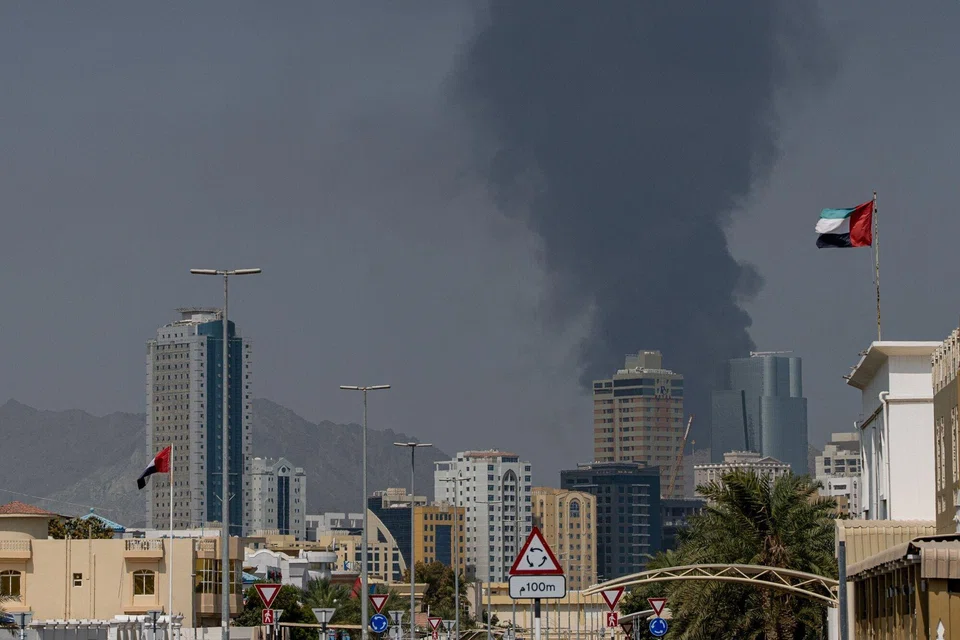
Dubai, whose reputation for safety in a politically volatile region has long positioned the emirate as a hot spot for foreign investment, has notably not been spared from the conflict.
Retaliatory attacks from Iran have been carried out on US bases in the UAE, causing damage from debris to notable Dubai landmarks such as the Burj Al Arab hotel and the city’s main international airport.
Other companies such as Aureus Academy, a Singapore music school which recently opened two branches in Dubai, are more hopeful about their regional operations.
Julius Holmefjord-Sarabi, chief technology officer of Aureus, told BT that the school cancelled lessons on Sunday and Monday as a safety precaution, following an advisory from the Dubai government.
But he remains optimistic that business confidence in the UAE will stay strong despite the conflict.
“We plan on investing significantly and heavily in the region,” said Holmefjord-Sarabi. “We’re not going to sign new leases in the next few weeks, but I think in the end we will just let these next few weeks play out.”
The music school had planned to open a third Dubai branch on Mar 6, but Holmefjord-Sarabi expects this will now be delayed.
“For now, our priority is just the safety of our staff and our customers.”
Similarly, Singapore energy company Sembcorp, which operates power plants in the UAE and Oman, said that it is not facing any current disruption to its operations.
“All our staff are safe. We have contingency measures in place, and the safety and well-being of our employees remain our top priority as we maintain operational stability,” said a company spokesperson.
Ng of QuikBot noted that regional conflicts spilling over into countries like the UAE is not something that anyone would have expected.
“I’ve been coming to the region for more than 20 years,” he said. “A bombing in Dubai has never happened before.”
Strikes on military and civilian infrastructure were reported in other Gulf cities including Abu Dhabi, Doha (capital of Qatar) and Manama (capital of Bahrain), causing airlines to suspend flights across the Middle East.
Cost concerns
For exporters such as Indonesian food and beverage producer Indofood, CreditSights analysts said in a Monday report that the company’s sales to the Middle East could soften, as higher logistics costs raise prices and squeeze margins.
“The UAE is a vital transhipment point, ”said CreditSights analysts Karen Wu, Lim Ze Hao and Trung Tran. “Trade corridors would be re-established at higher cost to exporters.”
Higher freight rates would have a cascading effect on importers and exporters, including SMEs in Asia, they noted.
Logistics players such as Singapore air cargo and ground-handling company Sats could also suffer the impact of airspace closures, through the company’s air-freight terminal in Riyadh and key clients like Qatar Airways.
The company’s stock price plunged 5.9 per cent on Monday, the largest drop on the day among Singapore blue-chips.
“In the near term, given airspace closures, there will likely be a build-up of inventory across the global cargo network as various players reassess trade routes and the evolving geopolitical situation,” said Ada Lim, equity research analyst at OCBC.
However, Lim observed that the situation could play out in Sats’ favour in the medium to longer term, as disruption to the Strait of Hormuz shifts freight movement from sea to air cargo.
Sats declined to comment when reached by BT.
QuikBot will also feel the impact of suspended air-freight services into Dubai, which are used to transport the majority of the company’s product deliveries, said Ng.
Economists noted that South-east Asian business ventures in the Middle East may experience shocks from continuing uncertainty in the region.
“Businesses that have exposure to the Middle East may have to deal with spillover effects such as trade diversion and higher risk premiums until things settle, or there is light at the end of the tunnel,” said OCBC chief economist Selena Ling and senior Asean economist Lavanya Venkateswaran in a Monday note.
Meanwhile, South-east Asian companies within the O&G supply chain could see mixed outcomes as energy prices spike.
CreditSights said that upstream-focused O&G producers, such as Malaysia’s Petronas, Indonesia’s Pertamina and MedcoEnergi, and Thailand’s PTTEP, stand to benefit as a result of higher oil prices.
Meanwhile, downstream refiners such as Thai Oil and the Philippines’ Petron could suffer from higher feedstock costs, added CreditSights.
But OCBC economists Ling and Venkateswaran noted that oil supply and production shocks in the region are often more damaging in the short term, with precedents suggesting that fears could ease quickly.
“Historically, the impact of Middle East conflicts tends to be sharp and front-loaded – that is, sell first and ask questions later.”