Sand mining requests surge after Indonesia lifts 20-year export ban
Nearly 70 companies are awaiting approval for sediment sand extraction permits as the government reviews applications

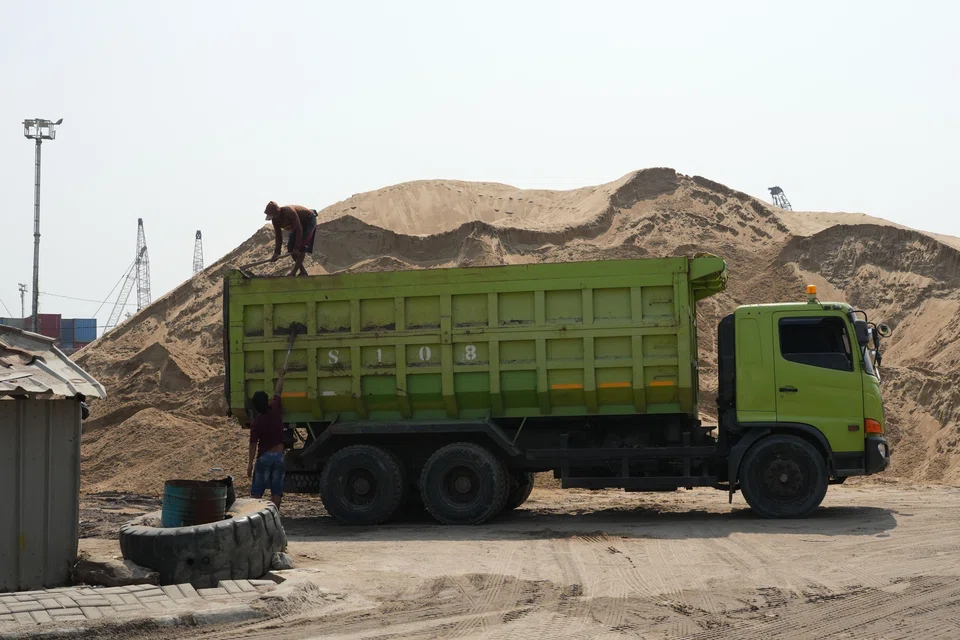
[JAKARTA] Indonesia has witnessed a surge in mining requests from sand producers, following the government’s decision to lift a 20-year ban on sand exports.
The Indonesian government recently disclosed that 66 companies are awaiting approval for sediment sand extraction permits, with applications still under review, said Doni Ismanto, special assistant to the Minister of Marine Affairs and Fisheries.
The decision to lift the ban was initiated by President Joko Widodo in May 2023 and is now governed by two newly revised export regulations from the Ministry of Trade, which were just issued last Friday (Sep 13).
The Ministry of Trade revealed that potential buyers of sea sand include foreign entities from China and neighbouring countries such as Singapore, Malaysia and Brunei, local media Kompas reported.
Meanwhile, foreign companies from the Netherlands, Belgium and Japan have shown interest in being involved in dredging activities. The Indonesian government, however, stressed that local companies would be given priority in conducting dredging operations.
Under the new regulation, dredging will be allowed only in seabed areas where sediment from land run-off has accumulated, a move also expected to reduce ship traffic.
The Ministry of Marine Affairs and Fisheries has designated seven extraction locations across the archipelago. These include coastal areas along the Java Sea and several regions around Karimun, Lingga and Bintan in the Riau Islands province, near Singapore.
The potential volume of mining from sea sedimentation is estimated to be at least nine billion cubic metres.
Tighter policies await
Jakarta first imposed a ban on sea sand exports in 2003 and reinforced it in 2007, driven by growing concerns over the severe environmental impact of excessive sand mining.
The government announced that mining activities will be more tightly regulated this time.
Plans are underway to introduce a regulatory framework similar to the domestic market obligation, which would require marine sedimentation to be prioritised for domestic use before allowing any exports.
The trade regulation stipulates that companies that are awarded export permits must submit a plan for social and environmental responsibility.
“This plan should address the impact of sediment removal in coastal areas and ensure the effective use of the sediment,” it stated.
Before the 2003 ban, Indonesia was a key supplier of sea sand for land reclamation to Singapore. Based on United Nations Comtrade data, Indonesia exported at least 150 million tonnes of sea sand to Singapore in the five years leading up to 2002.
The government’s decision to reopen sand exports is expected to generate additional revenue amid the country’s declining export performance, driven by falling commodity prices. The Ministry of Trade expects that sand exports could bring in up to 733 billion rupiah (S$61 million).
Environmental concerns
While the plan has received positive feedback from miners, environmentalists warned that it could lead to a significant increase in sand extraction.
They argued that the extraction of sea sand not only harms marine ecosystems, but may also adversely affect coastal communities that depend on these ecosystems for their livelihoods.
A study conducted in 2017 by the Indonesian Forum for the Environment (Walhi) found that the cost of restoring ecosystems affected by sea sand mining could be as much as five times higher than the profits generated from the exports.
Parid Ridwanuddin, Walhi’s coastal and marine campaign manager, said the resumption of sand extraction could accelerate the drowning of coastal villages and small islands, making them more vulnerable to rising sea levels and the impact of climate change.