



Satellites can spot Malaysia’s water leaks, but can they fix them?
Digital tools can buy time, but without major pipe renewal, Malaysia will keep losing water faster than it can save it
[KUALA LUMPUR] Every day, Malaysia loses more than a third of its treated water before it even reaches a tap – more than double the global benchmark of 15 per cent.
Now, utilities agencies are turning to satellites, artificial intelligence (AI)-driven analytics and smart meters to manage water systems more efficiently and gain quick, high-return improvements.
The idea is simple – use predictive intelligence to pinpoint the riskiest portions in the network, fix those sections fast, and get more bang for the buck. It’s a “huge win”, said Yohei Nishiyama, vice-president of business development at Tokyo-based Tenchijin.
As investments under the country’s Water Sector Transformation 2040 (WST 2040) road map accelerate, he believes the fastest way to cut non-revenue water (NRW) is not to replace every ageing pipe, but to let data decide where the wrenches should go first.
“Rather than replacing kilometres of pipe blindly, operators can target the top 5 to 10 per cent of sections where failures are most likely. (This is) a huge win – knowing which pipelines to replace first, and which not to,” Nishiyama told The Business Times in an interview.
Tenchijin is a space-technology company that uses satellite data and AI to support sustainable water infrastructure management.
The company, which supports utilities in Japan and France, set up operations in Malaysia last year to serve as a base to expand in the region.
However, he added: “Digital tools can buy time and efficiency, but structural renewal remains the endgame.”
But while pipe replacement delivers the deepest structural reduction in NRW – treated water lost through leaks, theft or inaccurate metering – it can be prohibitively expensive.
State of water play
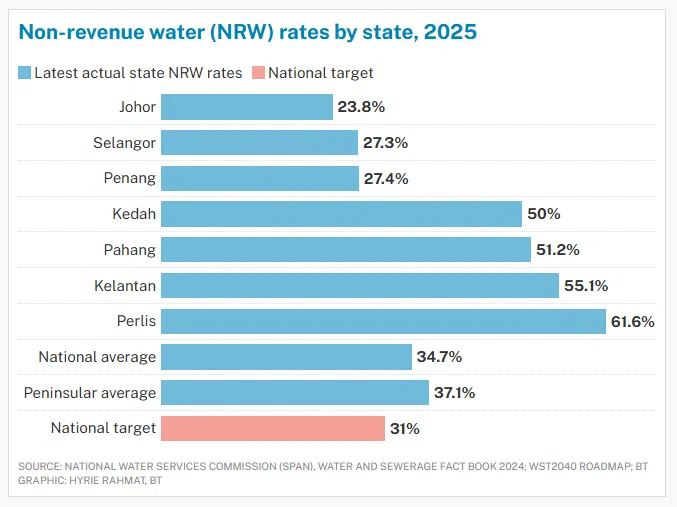
Across Peninsular Malaysia and Labuan, NRW losses average 34.7 per cent – but the picture varies sharply from state to state.
Wealthier, urbanised states such as Johor, Selangor and Penang have kept leaks under 30 per cent. The northern and east-coast states such as Perlis, Kelantan and Pahang are losing more than half their treated water before it reaches consumers, according to data from the National Water Services Commission (Span).
Last year, Span chairman Charles Santiago warned that Malaysia’s water infrastructure crisis stems from “decades of neglect”.
Ageing pipes – some more than 50 years old – and poor management have already cost the country about RM8 billion (S$2.5 billion) in NRW losses between 2018 and 2022. Without urgent intervention, Santiago cautioned, another RM18 billion could vanish over the next decade.
Span has proposed about RM30 billion in total investment by 2040 to replace ageing pipelines, upgrade treatment facilities and integrate digital leak-monitoring tools.
But with federal and state budgets stretched thin, that timeline looks aspirational at best. That gap between ambition and affordability is where digital tools now claim their niche.
The tech solution
Malaysia’s largest water operator, Air Selangor, is already piloting digital tools. In a pact with local firm Cubiq Meters, it began rolling out Kamstrup ultrasonic smart meters two years ago, with plans to install nearly 50,000 units to improve billing accuracy, detect leaks faster and build advanced metering infrastructure that could pay for itself within four years.
Similarly, Tenchijin’s KnoWaterleak platform uses satellite data and ground sensors to create risk maps that help utilities prioritise repairs without the guesswork.
Such smart metering and digital tools that enhance visibility at both household and district-metered area levels can cut leak detection from months to days, said Nishiyama.
Johor’s lesson: discipline, not data
If there is a counter-argument to tech optimism, it is Johor – the state with the lowest water losses in Malaysia.
Much of that comes from consistent investments and infrastructure maintenance and discipline – not satellites or AI use – proof that the old-fashioned approach works best when well funded and executed.
“Johor’s efficiency shows what disciplined management can achieve,” said Ranhill Technologies business planning and development head Muhammad Nazir Musa. “But new industrial demand means the bar keeps moving.
“With both approaches – data and physical renewal, plus discipline – Malaysia can realistically reach 20 per cent NRW by 2040,” he added.
Singapore’s famed 5 per cent water loss rate wasn’t the work of better software, but of decades of steady funding, regulation and political will. Technology helped optimise an already-strong system; it was not a substitute for one.
Malaysia, by contrast, risks reversing that formula: deploying sensors on infrastructure so degraded that knowing where it fails becomes an exercise in managing the inevitable.
The Perlis problem
Nowhere is this tension more visible than in states such as Perlis, where NRW exceeds 60 per cent. At that level, the network is not leaking – it is disintegrating.
Can satellite imagery help Perlis prioritise repairs? Probably. Will it prevent pipes from bursting next week? No. And if the state cannot afford to act on the data it receives, the technology becomes little more than expensive documentation of a crisis everyone already knows exists.
The WST 2040 road map calls for about RM30 billion in investment to deploy AI, smart meters and predictive monitoring across Peninsular Malaysia and Labuan. Yet Budget 2026 earmarks only RM3 billion, enough to replace 820 km of old pipes – roughly a tenth of the funding regulators say is required.
Prime Minister Anwar Ibrahim has repeatedly emphasised that water stability is critical to investor confidence, calling wastage and outdated infrastructure “persistent hurdles”.
But investor confidence requires more than real-time leak data. It requires reliable supply – something only physical infrastructure can deliver.
TRENDING NOW

Indonesia’s coal tycoon Low Tuck Kwong replaced as Bayan Resources president-director

Nvidia reinstates Jensen Huang as CEO; Trump says move poses no national security risk

Six workers file employment claims against Crystal Jade Food Manufacturing

AI agents and stablecoins a ‘perfect match’ for payments, says MetaComp’s Tin Pei Ling

