



SIA, MAS team-up on Singapore-KL route set to shake up world’s fourth-busiest air corridor
The tie-up is expected to create more competitive fares and higher flight frequencies for travellers between Kuala Lumpur and Singapore


[SINGAPORE / KUALA LUMPUR] A planned tie-up between Singapore Airlines (SIA) and Malaysia Airlines (MAS) is set to upset the pecking order on the busy Singapore-Kuala Lumpur route, threatening AirAsia’s long-held grip on the world’s fourth-busiest air corridor in 2024.
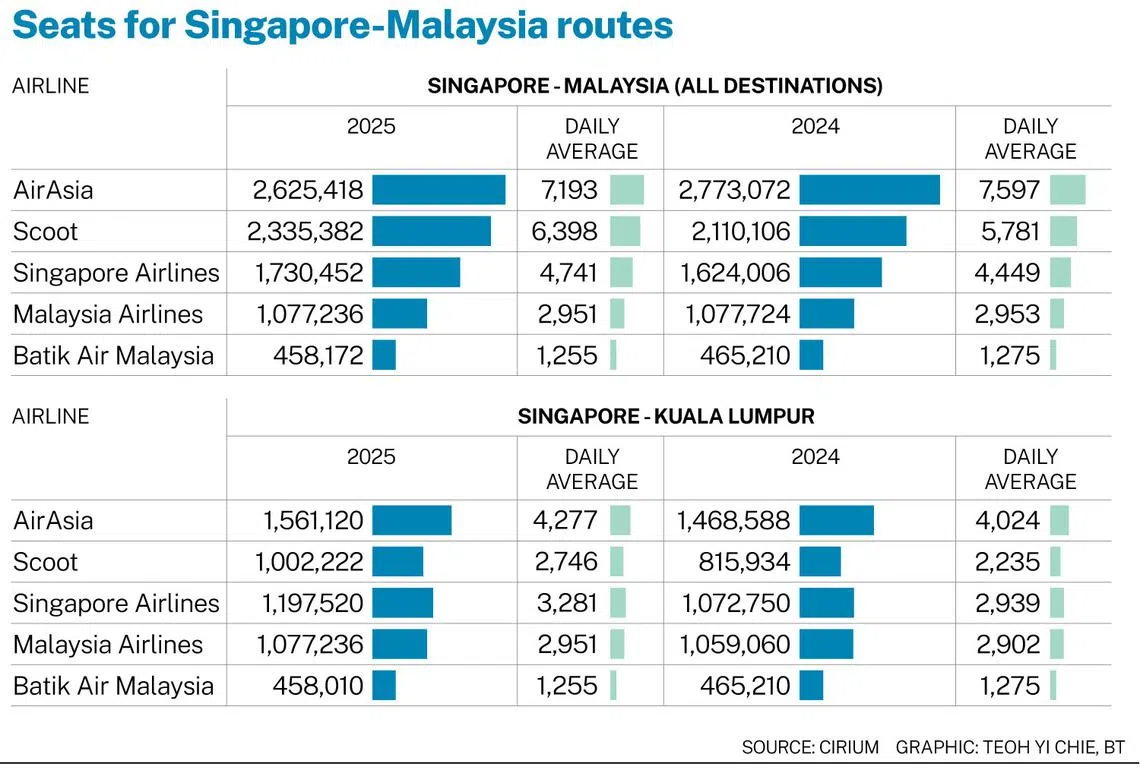
In 2025, Singapore Airlines and Malaysia Airlines are projected to collectively operate nearly 12,000 return flights between Singapore and Kuala Lumpur, offering about 2.3 million seats. This would top AirAsia’s expected 7,600 flights and 1.6 million seats, noted aviation analytics provider Cirium.
Breaking down the numbers: SIA is set to run 5,582 flights with nearly 1.2 million seats; MAS is to contribute 6,252 flights and around 1.1 million seats.
Aviation consultancy Endau Analytics’ founder Shukor Yusof said: “A key concern during the approval process will undoubtedly be the potential impact on other industry players, such as AirAsia and Batik Air, as this collaboration could significantly alter the competition landscape.”
The partnership, which will initially focus on the Changi-KLIA corridor to boost both tourism and business travel, is subject to approval from the Malaysian Aviation Commission (Mavcom). A decision is expected by end-July.
An analyst who declined to be named said Mavcom is not expected to block the deal, as the partnership has long been discussed. Moreover, other airlines also engage in code-sharing partnerships and that the SIA-MAS tie-up is unlikely to pose a significant threat, particularly to budget airlines, he said.
“It’s going to be business as usual due to the different offerings and pricing. We do not expect the SIA-MAS collaboration will change the competition dynamics meaningfully,” he added.
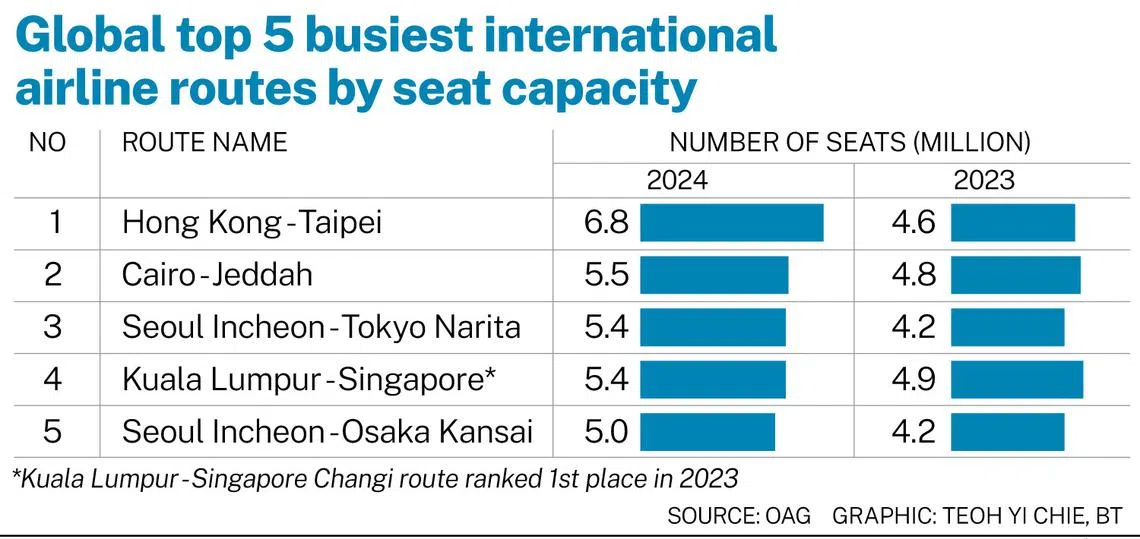
In 2023, the Singapore-Kuala Lumpur route topped the global rankings among the busiest flight routes, with a total seat capacity of nearly 4.9 million.
In 2024, however, the route’s total seat capacity rose to nearly 5.4 million, but it was ranked the fourth-busiest air corridor globally, after Hong Kong-Taipei, Cairo-Jeddah, and Seoul Incheon-Tokyo Narita.
The SIA-MAS pact is generating buzz in the air travel space because analysts expect the tie-up to lead to more competitive fares and higher flight frequencies for travellers between Singapore and Malaysia.
Shukor noted that Jetstar’s recent exit created room in the market, which the SIA-MAS collaboration is well-positioned to absorb by filling the void.
The Competition and Consumer Commission of Singapore (CCCS) granted conditional approval for this collaboration on Monday (Jul 7).
This joint venture between the airlines is set to cover various commercial aspects, including scheduling, pricing, sales and marketing, as well as the expansion of code-sharing on routes between Singapore and Malaysia.
One key aspect of the tie-up requires both airlines to maintain at least their current flight frequencies and seat capacities, with built-in flexibility to increase flights in response to rising market demand.
Shukor suggested that MAS could benefit from the pact, because the carrier would be able to secure the limited prime morning slots at Changi Airport – a challenge MAS previously faced against low-cost rivals, namely AirAsia.
“For Singapore Airlines, the collaboration opens an opportunity to further promote its premium products to travellers on this popular route, catering to those seeking a more elevated travel experience,” Shukor said.
Aviation analyst Mohshin Aziz views the tie-up as a strategic move that will enable the two flag carriers to optimise network connectivity.
He added that the partnership could even bolster preparedness in emergencies, such as if one carrier has an accident or suffers a significant delay to a long-haul flight, passengers can just be swiftly transferred to the other airline.
Such collaborations are not new, he noted, citing existing contingencies within code-share agreements between MAS and Qatar Airways, and between Batik Air and Turkish Airlines.
The true “game-changer”, said Mohshin, would be if SIA and MAS could carry out “genuine resource sharing”. He suggested that during peak periods, if one airline faces a shortage of pilots or cabin crew, the other could step up to “share” human resources. This deeper level of integration would unlock significant operational efficiencies.
Modest impact to budget airlines
Not everyone deems the pact between the national airlines of the neighbouring countries a big deal.
DBS analyst Tabitha Foo said the commercial cooperation agreement is a “non-event” from a financial perspective, as it primarily formalises existing collaboration and addresses competition, specifically on the Singapore-Kuala Lumpur route.
“While it may support some growth in feeder traffic into SIA’s long-haul network via Singapore, the overall impact remains modest,” she added.
Mohshin anticipates a dip in price competition within the full-service segment, which could push consumers to choose between cheaper tickets from low-cost carriers and paying more for a premium, full-service flight.
“It would be interesting to see whether there are any airlines that could fill the mid-pricing gap,” he said, noting Batik Air’s potential for the role, but that it runs fewer routes.
The collaboration between SIA and MAS has been in the works since mid-2019, when both sides formalised an intent for deeper commercial cooperation through a memorandum of understanding. This was followed by a wide-ranging commercial agreement a few months later.
That deal aimed to strengthen the partnership via revenue sharing, expanded code-sharing and joint marketing, all subject to regulatory approvals. But then the Covid-19 pandemic threw a spanner in the works.
It was not until March 2023 that both airlines jointly applied to CCCS for an anti-competition assessment, clarifying in November 2023 that the pact would involve only their full-service operations and exclude their low-cost subsidiaries Scoot and Firefly.






