Singapore developer to build luxury township near Cambodia’s new airport
[PHNOM PENH] Singapore-based real estate developer Sir Stamford Raffles Group (SSRG) is building a 22.6-hectare freehold township in Cambodia, a short drive away from the new international airport that’s under construction in the capital Phnom Penh.
The flagship project called Marum Estate – located in Kandal province, just south of the capital – broke ground last October and is the size of roughly 35 to 40 football fields.
The luxury mixed-use development is being built over eight phases and slated for completion in 2030. It will have 642 landed residences and 259 shophouses, along with retail, healthcare and educational facilities.
SSRG also announced a collaboration with Singapore’s Parkway Cancer Centre and Cambodia’s Khema International Polyclinic to form a medical hub within the township.
SSRG founder and co-chief executive officer Ng Aung San said the company was investing heavily in Cambodia largely because of the expected boom in tourism and business activities once the new US$1.5 billion Techo Takhmao International Airport opens in 2025.
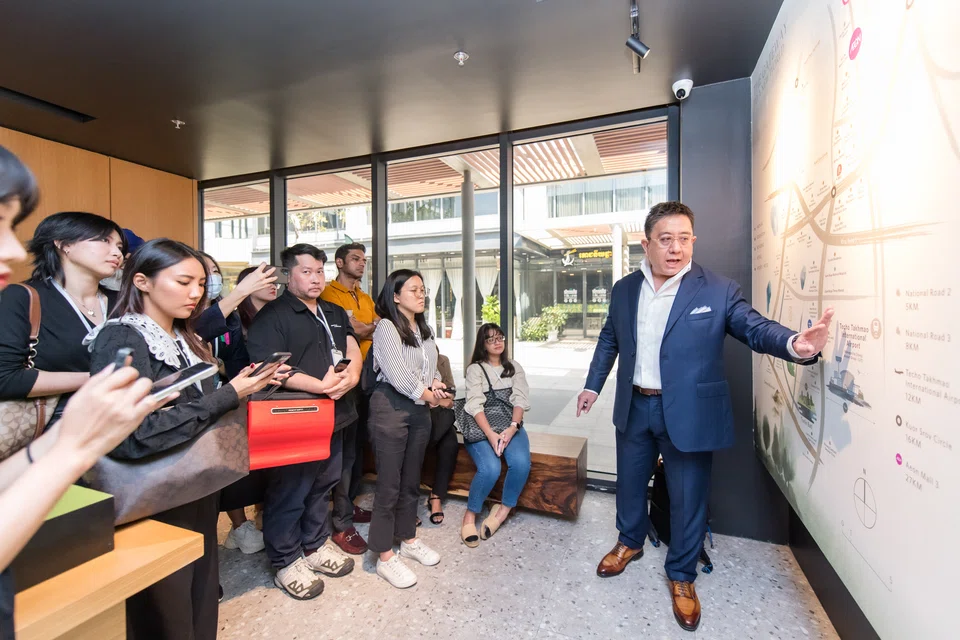
“As the airport (takes shape), the development will inevitably shift to the south (of Phnom Penh),” he said in an interview with The Business Times at the recent soft launch of Marum Estate.
“Superior infrastructure often leads to comprehensive government support in connectivity and other areas, providing us with favourable positions in both accessibility and capital appreciation,” he added.
Techo Takhmao is poised to be the ninth largest airport in the world. Cambodia has said that it wants to develop the airport into a regional transit hub that is capable of handling up to 50 million passengers per year by 2050 and compete with the likes of Bangkok and Singapore.
“The rapid implementation of the airport, which has been on track even during the Covid-19 period, and the development of supporting infrastructure convinced us (to quicken the development of the township),” said Ng.
SSRG, which has not announced its total investment capital for Marum Estate, is targeting affluent Cambodians for about 80 per cent to 85 per cent of the residences, with the rest to go to international buyers.
Indochina strategy
SSRG was formed in 2017 and has primarily focused on opportunities in Indochina – specifically Cambodia, Laos, Vietnam and Myanmar. Unlike developed markets such as Singapore, these countries have a large young population who are likely to buy their first and second homes in the next decade, said Ng.
This opens up many opportunities for Singaporean investors who are looking to diversify their portfolios beyond the traditional markets, he added.
Vietnam’s property market is more mature and advanced than other countries in Indochina. Cambodia, meanwhile, is growing rapidly at a more sustainable pace than landlocked Laos and politically unstable Myanmar, said Ng.
Before the pandemic, Cambodia’s economy grew at an average annual rate of 7.2 per cent from 2011 to 2019, according to data from the World Bank.
Cambodia’s GDP per capita is forecast to hit US$2,071 in 2024, up from US$1,917 in 2023, according to the Ministry of Economy and Finance.
Nearly 70 per cent of Cambodia’s 17.2 million population are 35 years old or younger. Over two decades, the country underwent a transformation from being one of the region’s poorest nations to a lower middle-income economy in 2015, fuelled by growth in garment exports, tourism and agriculture.
Having set foot in Cambodia more than a decade ago, Ng expresses confidence in the country’s longer-term prospects, highlighting positive changes in its pro-business legal environment, efficient banking system, and relatively low-cost workforce.
“Politically, the country has enjoyed stability with the same party in power for a long time, which is similar to Singapore. The current Cambodian government is also even more business-friendly than before,” said Ng.
With Cambodia located at the heart of South-east Asia and being highly dollarised, he said this positions the country as a strategic gateway to other Asean markets.
“With very little limits on foreign shareholding and capital controls, the investments and repatriation of profits are very smooth,” he added.
Ng also shared his bullish views on the country’s investment prospects. He cited the recent meeting between Cambodian Prime Minister Hun Manet and Temasek chairman Lim Boon Heng in Davos when the latter expressed the Singapore investment company’s intent to increase its investments in Cambodia.
“We are not afraid of competition. What we are afraid of is a generally negative view of the Cambodian market, which is unfounded,” said Ng. “The perception of Cambodia is a big hurdle for Singaporeans. When more players come in, they will help our efforts to raise the awareness and viability of the market.”
TRENDING NOW
Grab CEO’s wife Chloe Tong on life with Anthony Tan and finding her purpose
HDB reviewing ‘jumbo’ flat scheme after Telok Blangah unit listed for sale at S$2.18m
He built the Vingroup empire. Now South-east Asia’s richest man is handing some key roles to his sons
Singapore judge raises doubts iron ore trader Radiant World is owed US$1 billion