



Singapore’s STT GDC to co-develop US$420 million data centre in Vietnam
The Temasek-backed data centre operator has tied up with Vietnam’s tech unicorn VNG to expand data centre projects in the country
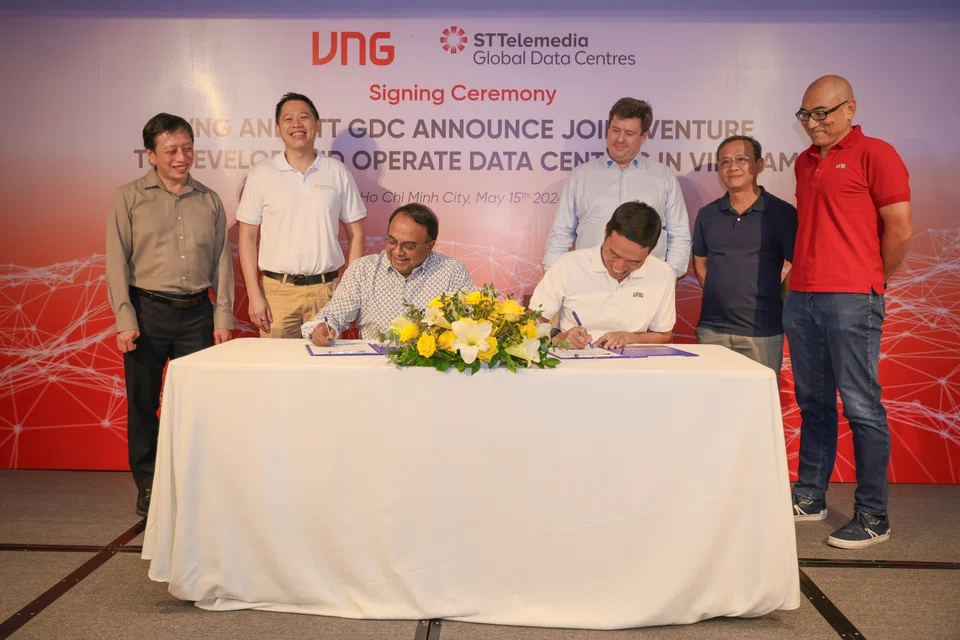
[HO CHI MINH CITY] Singapore-headquartered ST Telemedia Global Data Centres (STT GDC) has joined hands with Vietnam’s tech firm VNG Corp to develop, construct and operate data centre projects in Ho Chi Minh City.
Under the joint-venture partnership announced on Wednesday (May 15), a new facility named STT VNG Ho Chi Minh City 2 will be established in the southern metropolis of Ho Chi Minh City, with an IT load capacity of up to 60 megawatts (MW) when fully constructed. It is expected to become operational in the first half of 2026.
STT GDC’s chief executive for South-east Asia Lionel Yeo said the firm is targeting a development cost ranging between US$7 million and US$10 million per MW for the new facility.
This could mean an investment of at least US$420 million by the Temasek-backed data centre operator and its partner in Vietnam.
“(The investment) will be done in phases, depending on the market demand,” he said. “We are long-term capital (investors), so that’s probably the start of it. We will continue to invest beyond that.”
Yeo revealed that a lot of STT GDC’s hype-scaler customers – or large cloud service providers – had expressed interest in the Vietnam market but were hindered by the lack of substantial data centre capacity in the country.
“The demand is there. We only needed to wait for the correct formula and the correct partner to come in before we could really expand into Vietnam,” he added.
As part of the pact inked on Wednesday, STT GDC and VNG will continue to operate the existing STT VNG Ho Chi Minh City 1, previously referred to as VNG Data Center, located in an industrial zone specialised for the production of export goods.
The 9.6 MW facility was officially launched in November 2022 as Ho Chi Minh City’s first carrier-neutral connectivity hub and one of a few Uptime Tier-3 rated facilities in Vietnam.
In recent years, due to the continued moratorium on new data centre development in Singapore, operators have started to look outside the city-state for new digital hubs.
International data centre players have since made forays into Vietnam to bridge the gap. Some notable ones include a 30 MW project developed by Singapore-based Worldwide DC Solution in a high-tech park in Ho Chi Minh City.
Hong Kong private equity firm Gaw Capital is set to put its 20 MW data centre into operation in 2026, while Japanese telecom giant NTT and local IT firm QD.TEK are also co-developing a US$70 million facility.
In 2022, Amazon announced that it would build 10 local zone data centres in six countries, including Vietnam.
“Once (those hyper-scalers) are in the country, the expected growth will benefit data centre providers like us as we will be able to serve a lot of similar customers,” Yeo said.
Mordor Intelligence noted in a recent report that Vietnam is home to around 18 data centre operators and 32 facilities, with an estimated IT capacity of 169.8 MW in 2024. The market research company has forecast the volume to reach 242.4 MW by 2029, growing at a compound annual growth rate of 7.38 per cent.
Riding the AI wave
Established in 2014, STT GDC operates over 95 data centres including those under development across 11 countries. The firm has the most significant presence in India, Germany and the UK.
Yeo revealed that the operator is currently managing a combined 180 MW of operational load across its South-east Asia facilities and plans to double the capacity over the next three years.
He said countries in the region stand to benefit from their large availability of land and power resources for large-scale facilities to serve the training and executing of AI models that rely on substantial computing power and enormous data storage.
“The reason why we’re growing so quickly is driven by the demand from cloud as well as AI,” Yeo said. “We are catering larger campuses to meet some of these AI demands and growth that are coming in.”
TRENDING NOW

Once staunchly pro-China, Malaysian Chinese businesses are now distancing themselves from Beijing
Looking beyond looming CEO succession, should UOB potentially pursue a transformative merger?

Could stablecoins be the future of money?

Grab CEO’s wife Chloe Tong on life with Anthony Tan and finding her purpose

