Sorry Asean, Trump’s return may sideline South-east Asia’s economic aspirations
His focus on China and bilateral, transactional tendencies could undermine Asean’s hopes of being recognised as a unified bloc with significant economic clout

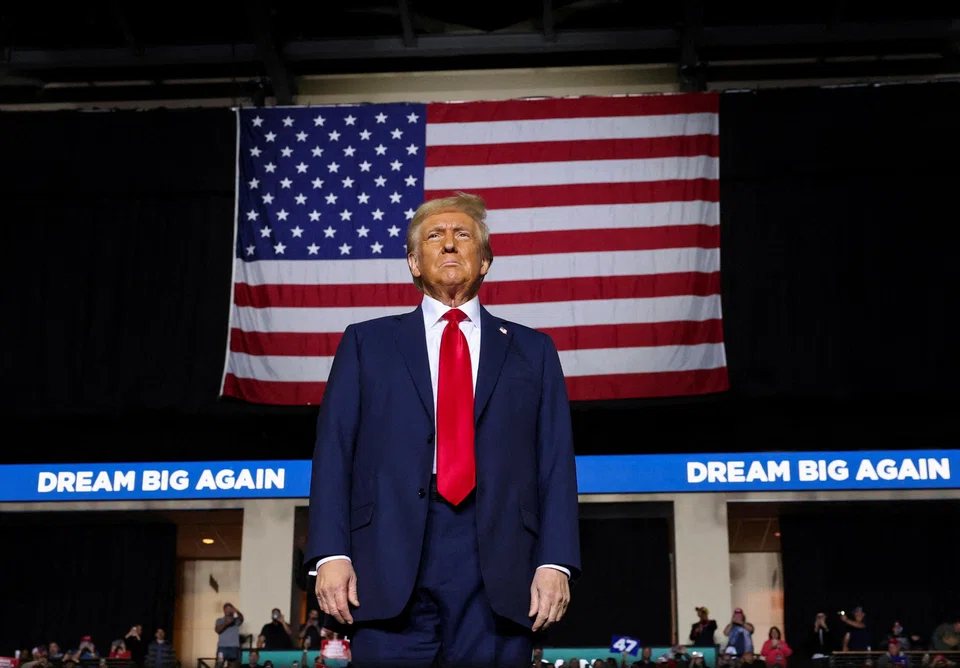
DESPITE being Asean’s largest foreign investor, the US is expected to put the bloc on the back-burner – trade-wise – as the Trump administration makes a return, dashing the group’s hope of being viewed by world superpowers as an economic heavyweight.
In short, Asean should manage its expectations, observers have said.
Dominated by China hawks and US president-elect Donald Trump’s loyalists, the incoming administration threatens to knock off-keel US-Asean relations, often likened to a three-legged stool held up by defence, economic and diplomatic relations.
The three are linked – and Asean has been trying, with some success, to break out of its mould as a pawn in a political chess match and be engaged for its own economic might and potential.
But as Trump is set to be inaugurated on Monday (Jan 20) and his top-level picks sit for Senate confirmation hearings from Jan 14 to 21, pundits have cautioned that South-east Asia’s expectations of the US in the next four years may need to be tempered.
Divide and conquer
“I would anticipate the US to continue struggling to improve economic offerings in the region, especially as there is little to no appetite for new trade agreements in the US,” said Lucas Myers, senior associate for South-east Asia at Wilson Center’s Indo-Pacific Program.
Long-time observers tell The Business Times that the president-elect, with his penchant for bilateralism and transactionalism, will likely pursue relationships with individual countries.
This includes the Philippines – one of the US’ oldest Asian allies, and well-aligned with its interests in maritime security and countering Chinese influence in the South China Sea. Also on the list is Vietnam, currently on tenterhooks about drawing Trump’s ire as its trade surplus with the US soared two weeks before his inauguration.
His aversion to engaging on a multilateral level sets off alarm bells for Asean.
Under Trump, the US is less likely to pay lip service to Asean centrality – a concept that emphasises the bloc’s role as the dominant regional platform to overcome common challenges and engage with external powers, said Myers.
He believes the incoming administration will engage Asean member states with an approach predicated on achieving key US interests – such as access to critical minerals, confronting Chinese influence in the region and the pursuit of opportunities for US businesses.
The way Myers sees it, the new administration will be focused on great power competition “in ways that might raise eyebrows in Asean”.
This differs from the US under outgoing President Joe Biden, who engaged partners in South-east Asia on a “bilateral and issue-by-issue basis” while enhancing relations with Asean as a bloc, he explained.
For example, both parties had in 2022 upgraded relations to a comprehensive strategic partnership – broadly understood as the highest level of relationship between the regional alliance and its dialogue partners.
Last year, the US and Asean issued a joint statement on artificial intelligence cooperation, with the former becoming the bloc’s first dialogue partner to do so.
“I would anticipate the US to continue struggling to improve economic offerings in the region, especially as there is little to no appetite for new trade agreements in the US.”
Lucas Myers, senior associate for South-east Asia at Wilson Center’s Indo-Pacific Program
But the incoming Trump administration’s America-first approach, focused on maximising US economic and security benefits, could likely threaten Asean’s priorities and reverse progress made earlier, said Joanne Lin, senior fellow and co-coordinator at the Asean Studies Centre, Iseas-Yusof Ishak Institute.
She explained: “Trump’s aversion to multilateralism may result in reduced US engagement with Asean-led mechanisms such as the East Asia Summit, including the potential absence of the US president from Asean-related summits.”
Missing: The US president
True to form, a common grievance raised when discussing the US’ commitment to South-east Asia is the absence of its head of state at the Asean Summit.
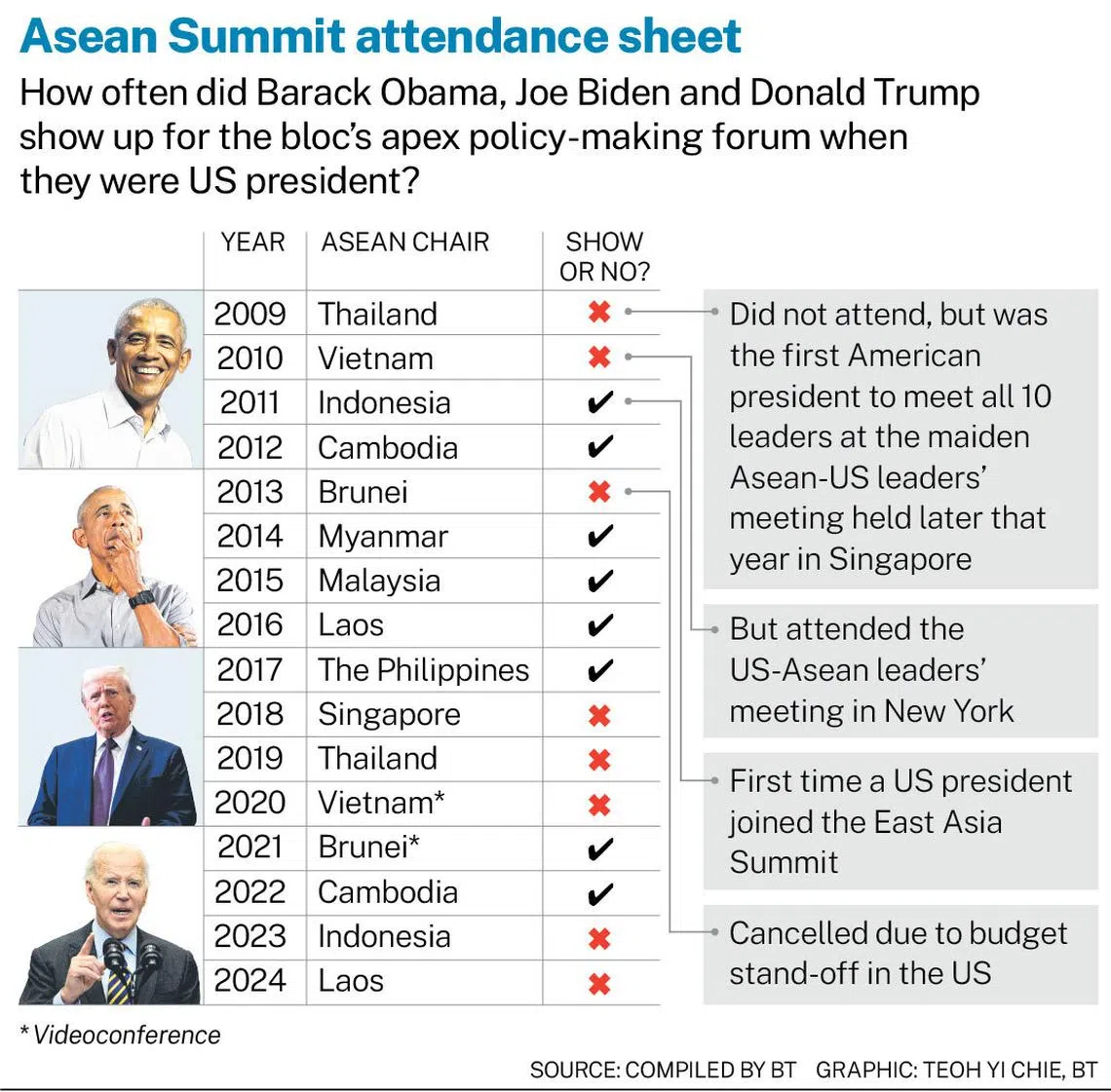
Pundits are split over these no-shows – some say it is not personal, others call it a snub.
Lin said: “In a region where personal diplomacy and symbolic gestures carry significant weight, the lack of top-level representation can be interpreted as a lack of respect for Asean as an institution.”
This sends mixed signals about the US’ strategic priorities, particularly as China continues to expand its influence in South-east Asia through consistent high-level engagement, said Lin, who had previously served at the Asean Secretariat from 2015 to 2021.
“This gap between US rhetoric and action undermines trust in its reliability as a partner and risks ceding influence to more engaged powers,” she concluded, warning that the region may increasingly pivot towards middle powers such as Japan, South Korea, India and the European Union as China solidifies its presence.
Others said that while attendance is important, an absence is not necessarily reflective of a lack of commitment.
“At some point, we have to be realistic,” said Julio Amador, founder and trustee of non-profit Facts Asia, which produces research on foreign and public policies to influence policymakers.
He posited: “If you are the leader of the most powerful country in the world by any objective measure, why does Asean think it can demand your presence?”
Amador added: “If you’re important, you don’t need to shout. People will come and attend your party because they like you, and you’re important to them.”
Several academics BT spoke with also questioned why Chinese President Xi Jinping does not appear to receive flak for not attending the same meetings, most times sending Premier Li Qiang or other lower-level officials.
Zack Cooper, a senior fellow at the American Enterprise Institute, where he studies US strategy in Asia, said: “Getting the US president to Asia is always hard, and more so when there are no deals to announce in the region.”
He added: “This sends a mixed message, but perhaps it would be best to focus on the deliverables from the meetings rather than the level of attendance.”
Dr Cooper, who is also a public and international affairs lecturer at Princeton University, believes Malaysia’s chairmanship of the regional bloc this year will muddy the waters.
“(Malaysian Prime Minister Anwar Ibrahim’s) support for Hamas will interact badly with Trump’s support for Israel, and make it difficult for US-Asean engagement through next fall,” he explained.
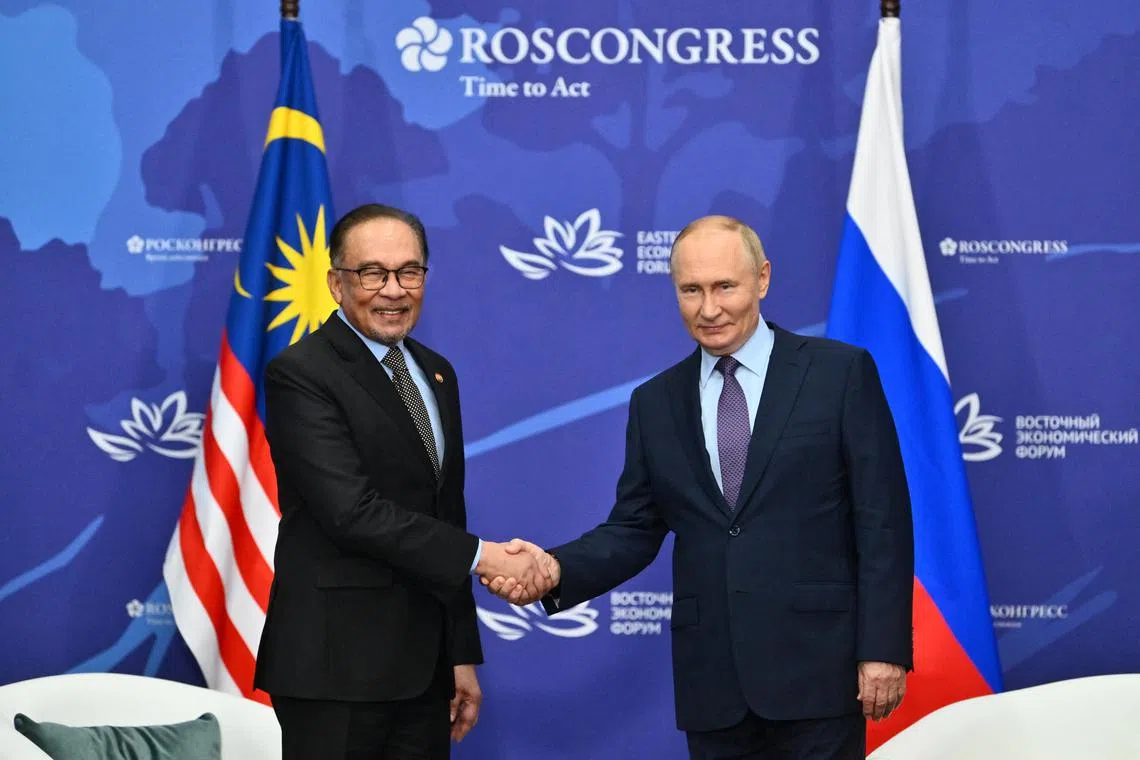
Anwar had earlier also invited Russian President Vladimir Putin to the Asean Summit, which has been attended by Foreign Minister Sergey Lavrov.
It takes two
The onus also falls on Asean to make itself worth showing up for, say observers.
Initiatives such as the upcoming Digital Economy Framework Agreement – the world’s first regionwide pact of its kind targeted for conclusion this year – will help Asean reduce its dependency on external powers and support resilient supply chains, mitigating the impact of US-China tensions, said Lin.
Other projects like the Asean Power Grid will support the region’s clean energy transition and promote energy security, she added.
Singapore, Thailand, Malaysia and Laos are currently involved in a power integration project that marks the first collaboration among four Asean countries on multilateral cross-border electricity trading.
“To sustain its relevance, Asean should also diversify its markets to mitigate economic decoupling risks,” continued Lin.
“By advancing these priorities collectively, Asean can be a proactive regional leader rather than a passive player in the region.”
The art of woo
While Asean may not be a priority for the US, South-east Asia could be, said pundits.
Amador noted: “Many South-east Asian governments have already been thinking about what they can do to attract US interest in their countries (and) to shift the attention away from things the US government may not like – Vietnam’s trade surplus, for example.”
But for Asean to steal the spotlight, Amador believes the crux lies in being seen again as an effective platform for converging great powers. This can only happen if the 10-member bloc is armed with a clear regional agenda.
“The onus is on Asean really – how we can make ourselves an attractive market,” said Amador. In the past, he said, the bloc had a converging power – it was able to speak as one body, making it an effective diplomatic platform.
“Now it’s not as before,” he concluded. “National interests (outweigh) regional interests and if that’s the case – whether it’s economic or security – Asean loses its lustre”.