South-east Asia gets tariff breather as Trump resets duties, but too early for region to rejoice
Most of the region’s economies now face tariff rates that are lower by up to 3.5 percentage points, analyst notes

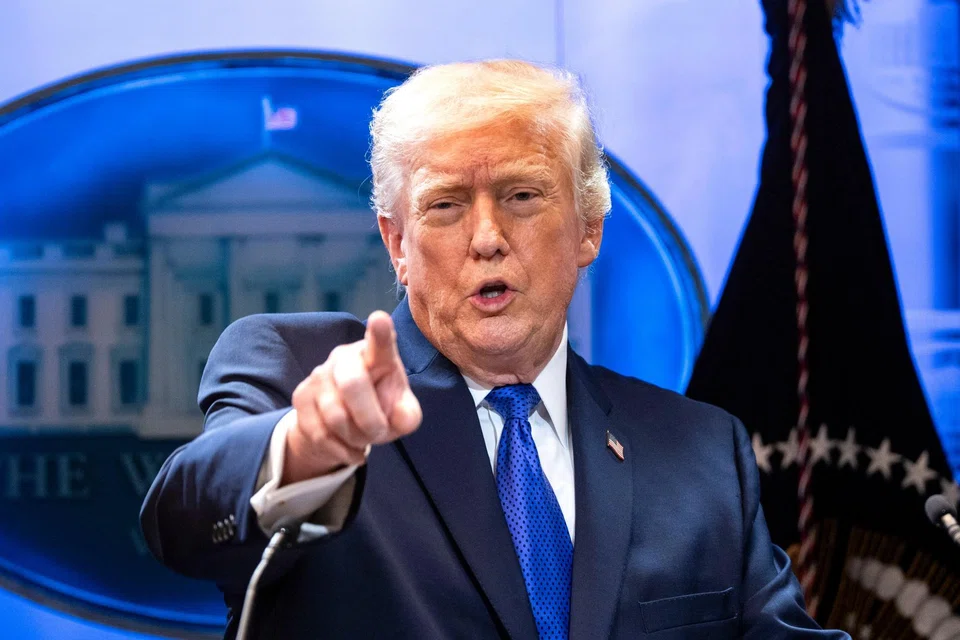
[SINGAPORE, JAKARTA, KUALA LUMPUR, HO CHI MINH CITY, BANGKOK] South-east Asian exporters just caught an unexpected break from tariff pressure, with US President Donald Trump announcing his intention to impose new global tariffs of 15 per cent on Saturday (Feb 21).
It is a reset that effectively lowers duties for most of the region, easing the trade burden that had earlier threatened to stifle growth.
One view is that companies may start to assume the worst of the tariff and trade uncertainty is behind them.
Morgan Stanley economists said in a note on Sunday: “We think it is more likely that businesses will hold the view that the peak level of uncertainty on tariffs and trade tensions has passed.”
Maybank’s director of macro research Erica Tay told The Business Times that the effective tariff rates on South-east Asian economies, apart from those imposed on Singapore, would fall by between 1.2 and 3.5 percentage points.
Effective tariff rates are the levies faced by a country, weighted by the share of its exports that are subject to overall duties, including product-specific tariffs and exemptions.
Under a global tariff rate of 15 per cent, Tay said that Singapore, now facing a higher tariff rate than before, will see a 1.8 percentage point rise in effective tariffs. However, its duties remain the lowest in the region by far, at an effective rate of 6.9 per cent.
The newly imposed global tariff rate, however, currently stands at 10 per cent following an executive order signed on Friday. Trump has not officially issued a directive to increase the rate to the threatened 15 per cent, though officials said that the White House is working on a formal order to do so.
China, however, would be the biggest beneficiary as its effective rate falls by 4.9 percentage points. Michael Langham, emerging markets economist at Aberdeen Investments, said that this could weigh on the region’s business sentiment.
“Chinese exporters will be more competitive following the ruling, and this will likely reduce South-east Asia’s exports to the US,” said Langham.
After the US Supreme Court deemed that Trump’s original “Liberation Day” tariffs imposed under the US’ International Emergency Economic Powers Act (IEEPA) were illegal, the US president turned to Section 122 of the US Trade Act of 1974, which allows him to impose tariffs of up to 15 per cent for as long as 150 days.
Tariff rates imposed across South-east Asia under the IEEPA framework had ranged from 10 per cent for Singapore to 40 per cent for Myanmar, with the majority of the region’s economies hit with duties of around 20 per cent.
Morgan Stanley reckoned that the new tariff rates would have a limited adverse impact on South-east Asia’s economies, and could even boost the region’s trade performance.
The bank said: “Tariffs now appear unlikely to rise further, which should support the regional trade cycle and, by extension, more trade-oriented economies such as Singapore, Malaysia and Thailand.”
Even so, caution remains in the air. Maybank’s Tay noted that the region’s businesses are likely to beef up their supply chain resilience despite the lower tariff rates.
“Given the fluid situation, it still makes sense for firms to diversify their bases to more countries,” she said. “Resilience is key. Therefore, supply chain shifts should still continue in earnest.”
Without congressional approval, Trump’s newly imposed tariffs under Section 122 will expire after 150 days.
Tan Altundag, investment manager for emerging equities at Pictet Asset Management, told BT that Trump’s administration is unlikely to allow this to happen when the 150-day window closes.
He suggested that the US President would turn to other avenues to impose tariffs; these come from Section 232 and Section 301, which give him the leeway to impose trade barriers against specific sectors and economies, respectively.
Maybank’s Tay said: “However, these tools are subject to lengthy investigations. We may see trade front-loading of these products as soon as new investigations are launched.”
Priyanka Kishore, principal economist at consultancy Asia Decoded, wrote in a Saturday note: “The Section 122 tariffs buy the Trump administration time to consider other avenues available to rebuild the tariff wall.
“That said, we think it is unlikely that tariffs will be rebuilt to the same breadth and levels as under IEEPA.”
The new global tariff rates come after several countries in South-east Asia made trade agreements with the US on various bilateral issues. US officials have indicated that some agreements, including those with Vietnam’s regional peers Malaysia and Cambodia, would remain in place despite the lower global tariff baseline.
Thailand: A waiting game
Thailand has won short-term relief, but uncertainty over US-Thai trade ties remain. Exporters are also unsure what would happen when the 150-day window closes.
In a sense, that timeline fits well with Thailand’s political transition. “Initially, under the reciprocal tariff system, we were planning to have everything concluded by July (anyway),” said a Thai government source. An agreement would require the approval of the new government.
Thailand has yet to finalise a US-Thai trade deal. Talks were delayed by the Thai-Cambodia border conflict, and then the Feb 8 election and formation of a coalition.
A new government is unlikely to be functional before June 2026 at the earliest, though negotiations have continued under acting Commerce Minister Suphajee Suthumpun, who is expected to stay on under a government led by the Bhumjaithai Party.
A Thai government source said the US Trade Representative (USTR) had made 80 requests, and warned that with 17 remaining, failure to meet them could expose Thailand to tougher US trade action, including Section 301.
“If we cannot agree to all 80 requests, the US side may raise the tariff on us, invoking Section 301 of the Trade Act,” said the source.
US importers are likely to front-load Thai goods during this window, especially electronics and electrical appliances, said an observer.
Thailand’s strong export performance – and its large trade surplus with the US – could complicate negotiations. BY PETER JANSSEN
Indonesia: Exporters in “holding pattern”
The US Supreme Court ruling came just as Jakarta was preparing to proceed with ratifying the Agreement on Reciprocal Trade (ART) – a pact President Prabowo Subianto sealed with Trump just the day before the court decision.
With the reciprocal tariff mechanism now invalidated, debate has intensified over whether Indonesia should ratify the ART at all. Some analysts argue that the decision gives Indonesia leverage to renegotiate terms; critics of the deal warn that it could still expose Indonesia to import surges that weigh on the trade balance and the rupiah.
While the ruling removes the immediate threat of reciprocal tariffs, Indonesian businesses say it does not eliminate wider trade uncertainty. “The dominant approach right now is caution,” said Shinta Widjaja Kamdani, who chairs the Indonesian Employers Association (Apindo).
Exporters in labour-intensive sectors are reassessing orders as well as investment and hiring plans amid an increasingly unclear outlook for US demand.
Firms are looking to diversify markets, with some pinning hopes on expanded access through an Indonesia-European Union free-trade agreement, though that ratification process remains ongoing.
Indonesia was dealt a 19 per cent tariff under the reciprocal policy announced last July. On Feb 19, Jakarta reached an agreement with Washington involving increased purchases of US goods, selected openings in critical-minerals investments, and the removal of certain non-tariff barriers affecting US agricultural imports.
The deal, signed but not yet ratified, would grant zero import duties on 1,819 Indonesian tariff lines entering the US; these goods range from palm oil, coffee, cocoa and rubber to semiconductor components and aircraft parts, with textiles and garments to benefit via a tariff-rate quota scheme. BY ELISA VALENTA
Vietnam: Economy remains exposed
Analysts say that while a temporary lower-tariff window does not fundamentally alter Vietnam’s structural competitive advantages, it could ease short-term cost pressure on exporters, and lift sales as importers step up on front-loading ahead of possible policy changes.
However, the country remains highly exposed to tariff threats.
Despite US tariff hikes in 2025, Vietnam recorded a trade surplus of US$133.9 billion with the US, up 28.2 per cent from the previous year’s surplus, official data indicates.
US data showed its goods deficit with Vietnam widening by US$54.7 billion to US$178.2 billion – making Vietnam the third-largest contributor to the US trade deficit after China and Mexico.
Trinh Ngoc Nam, special counsel at Ho Chi Minh City-headquartered law firm Vilasia, said: “The sheer scale of the trade imbalance has placed Vietnam squarely within the priority target of the Trump administration’s protectionist agenda.”
The US is Vietnam’s largest export market, accounting for roughly a third of its total foreign shipments annually.
Under a bilateral tariff framework agreed last October, Vietnam negotiated a 20 per cent tariff rate – significantly lower than the previously threatened 46 per cent penalty.
That agreement, Nam said, reinforced Vietnam’s competitive advantage relative to China, and sustained its role as a safe haven for supply-chain relocation and foreign capital inflows.
The trade framework was premised on presidential authority under the IEEPA, but with that authority struck down by the US Supreme Court, the legal durability of the arrangement is now in question.
“Vietnam could lose an already structured bilateral agreement and face an environment in which President Trump, angered by the court ruling, may deploy new legal tools without prior negotiation safeguards,” Nam added.
Michael Wan, senior currency analyst at MUFG Bank, noted that countries which had secured trade agreements could become “slightly worse off in the interim”.
He said the tariff gap between other Asian exporters and China – which has not finalised a comprehensive trade deal with the US – has narrowed.
“(This) reduces the incentive to re-route exports to the US at the margin... In relative terms, Vietnam could lose some export competitive edge against China,” he added. “However, the current situation should be seen as a bridge and temporary stopgap measure towards China receiving higher tariffs later.” BY JAMILLE TRAN
Malaysia: Front-loading effect
The latest twist in US tariff policy could trigger another round of front-loading by American importers, offering short-term relief to Malaysian exporters even as longer-term uncertainty persists.
Macquarie head of equity research Andrew San and analyst Izzati Hakim said the shift to a standardised global tariff structure neutralises Malaysia’s previous relative advantage under country-specific rates, but it also reduces the risk of China aggressively diverting excess capacity into Malaysia.
They added in a report on Monday that Malaysia’s diversified trade profile helps it stay resilient under the new global tariff structure, as it exports intermediate goods to other countries that ultimately ship the final products to the US.
Kenanga Investment Bank struck a cautiously constructive tone. Head of research Peter Kong does not expect Malaysia to substantially outperform peers, citing its relatively smaller trade surplus with the US and the pending 19 per cent rate under the Agreement on Reciprocal Trade (ART), which has been signed but not ratified.
He added that while exporters in sectors such as gloves, plastics and packaging may make near-term gains from an acceleration in orders, broader economic proxies such as banks remain preferred exposures amid policy uncertainty.
Callum Chen, vice-president of the Malaysian International Chamber of Commerce and Industry, said lower tariffs bring uneven benefits. While some front-loading of orders is likely, sectors such as plastics still face intense competition from larger Chinese exporters willing to absorb much of the additional levy.
In a statement on Saturday (Feb 21), the Investment, Trade and Industry Ministry Johari Abdul Ghani said Malaysia is assessing recent legal and policy developments in the US.
He noted that while the government has signed the Agreement on Reciprocal Trade (ART) to secure a lower tariff rate and product exemptions, it has yet to ratify the agreement and is seeking further clarity on how the new US measures will be implemented before deciding on its next steps. BY TAN AI LENG
The Philippines: Latest tariff move levels the field
While much of the Philippine’s key exports – including key agricultural and semiconductor products – have remained exempt from Trump’s tariffs, the US president’s latest move would most benefit exporters outside these sectors, said analysts.
Sergio Ortiz-Luis Jr, president of the Philippine Exporters Confederation, reportedly said: “While this (15 per cent tariff rate) is an additional cost, its ‘global’ application means the Philippines maintains its relative competitiveness against other trading nations.”
The US is the Philippines’ largest export market.
“These developments, most importantly, would impact the Philippine exporters not exempt from Trump’s tariffs,” said Michael Ricafort, chief economist of Rizal Commercial Banking Corporation. BY EVAN SEE