



South-east Asia rises as offshoring powerhouse amid MNCs’ cost-cutting drive: Knight Frank


MALAYSIA continues to secure its prized third spot as the world’s best global offshoring location, next to giants India and China. The country’s strong digital ecosystem, competitive real estate prices and rich pool of skilled digital talents make it a standout in South-east Asia for global companies, said a recent report.
Challenging economic conditions – chiefly higher operating costs for multinationals – have also turned its regional peers Vietnam and the Philippines into promising outsourcing hubs, said real estate consultancy firm Knight Frank in a report Asia-Pacific Horizon: Harnessing the Potential of Offshoring.
The report, released this week, said the global offshoring market is expected to grow to US$544.8 billion in 2032, from US$245.9 billion in 2022 – an 8.5 per cent compound annual growth rate (CAGR).
While North America will continue to command the lion’s share of the market, the Asia-Pacific is expected to record the highest CAGR, at 10.2 per cent.
Within the Asia-Pacific, the offshoring industry in India has grown significantly into a leading global service provider, accounting for 57 per cent of the global offshoring market.
South-east Asian countries, with skilled talents and more cost-effective alternatives, have gained attention and grown fast in recent years to challenge the established destination leaders.
The Philippines, Malaysia and Vietnam are the region’s top destinations, said Knight Frank. It added that the highly educated, versatile and multilingual talents in these developing markets are well-positioned to provide quality service to global companies.
Malaysia, which commands roughly more than 8 per cent of the Asia-Pacific offshoring market, has been ranked the world’s third best for offshoring for over two decades.
Asean rising
As more companies are looking at offshoring operations in South-east Asian countries, Knight Frank expects this to boost the region’s office market.
Christine Li, Knight Frank’s head of research (Asia-Pacific), said offshoring has emerged as a critical driver of office demand in these hubs as companies steadily expand their footprint.
“We anticipate the potential cost savings to encourage offshoring activities. We have already observed this in India.
“From 2022 to 2023, leasing transactions involving global capability centres’ proportion increased by 10 per cent, accounting for 35 per cent of the total market share,” she added. Such centres are offshore units established by multinational corporations to perform a range of strategic functions.
She observed that the Philippines, Malaysia and Vietnam are also seeing a similar trend.
Despite a tough macro environment keeping companies cost-aware, she said, the silver lining is that firms are boosting headcounts in low-cost, high-growth regions through offshoring while staying efficient in costlier areas.
Occupiers therefore concentrate on boosting office demand in these strategic locations while reducing real estate needs elsewhere.
“This strategic resource allocation helps mitigate rental declines in markets such as Vietnam and the Philippines; in Malaysia and India, rents have even strengthened, despite higher vacancies,” said Li.
Citing findings from TDS Global Solutions, Tim Armstrong, Knight Frank’s global head of occupier strategy and solutions, noted that companies, on average, could achieve operating cost reduction of nearly 70 per cent lower than in the US.
“For every square foot of office space, occupiers can expect to save on average US$70.86 in these offshoring hubs, compared with mature markets. This translates to a staggering 54 per cent cutback in occupancy costs annually,” he added.
Malaysia: Competitive rental rates
As at 2021, Malaysia was home to 607 global business services (GBS) companies, with 58 per cent being foreign direct investments. These players are primarily concentrated in Greater Kuala Lumpur and Penang, with the majority involved in manufacturing-related activities.
Keith Ooi, group managing director of Knight Frank Malaysia, said the typical space requirement of initial take-up by the GBS players ranges from about 15,000 square feet (sq ft) to 25,000 sq ft; space requirements grow to up to 100,000 sq ft as the companies grow.
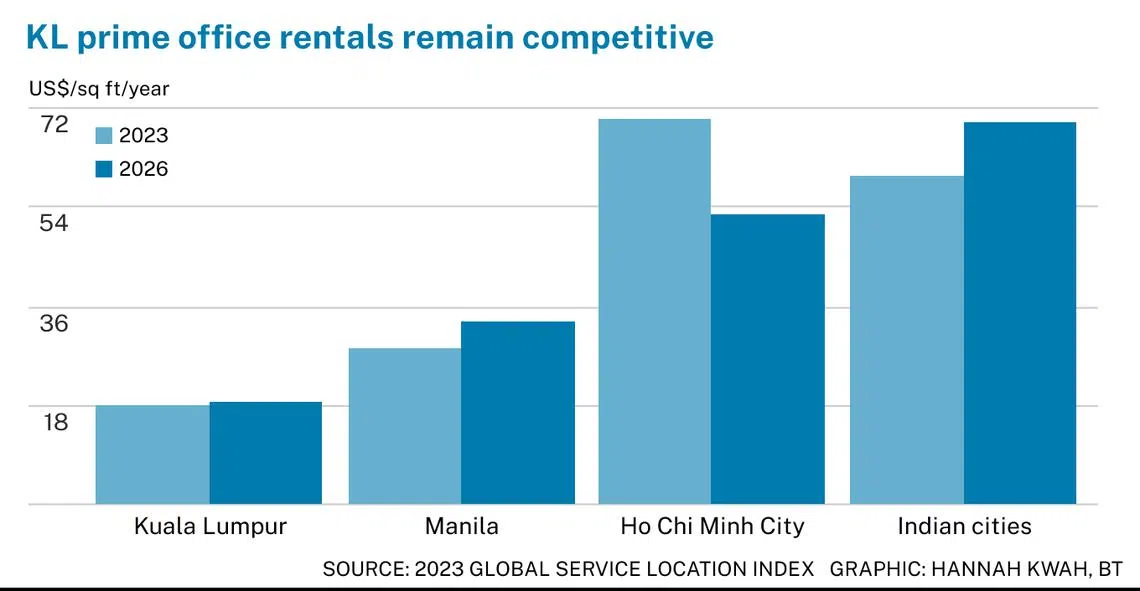
Office rentals in these established locations remain competitive, with per square foot monthly rental rates ranging from US$1 to US$1.50.
In the near term, Malaysia Digital Economy Corporation aspires to establish “five-km concentric GBS hubs” throughout the country. In Kuala Lumpur, for example, the Tun Razak Exchange has been identified as a GBS hub for finance-related players; Cyberjaya remains the focal point for IT-related players.
Vietnam: Cost-effective labour force
Vietnam has emerged as a promising destination for outsourcing in recent years. Its offshoring revenue was estimated at US$530 million in 2023, with a 2016-to-2023 CAGR of 12.7 per cent.
The demand for services such as customer support, data entry and software development in Vietnam’s offshoring market has notably risen. This surge is credited to the nation’s proficient workforce, cost-effective services and conducive business atmosphere.
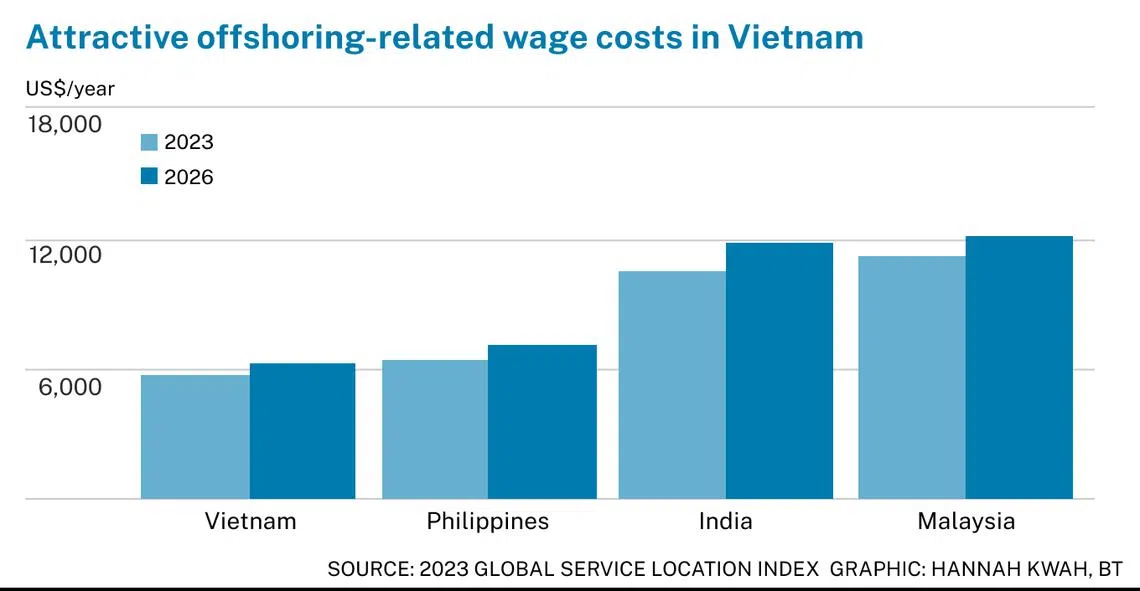
In addition, the country’s strategic location near key markets such as China and Japan adds to its appeal for businesses seeking outsourcing solutions. A distinctive feature of Vietnam’s offshoring market lies in its abundance of small and medium-sized enterprises specialising in various services.
These businesses often concentrate on specific niches such as gaming, animation and e-commerce, enabling them to deliver customised solutions to their clients.
The Philippines: An all-rounder
The Philippines is deemed a trusted outsourcing hub, holding about 10 to 15 per cent of the global market share. Its appeal includes talent availability, infrastructure, cost-effectiveness and a conducive business environment.
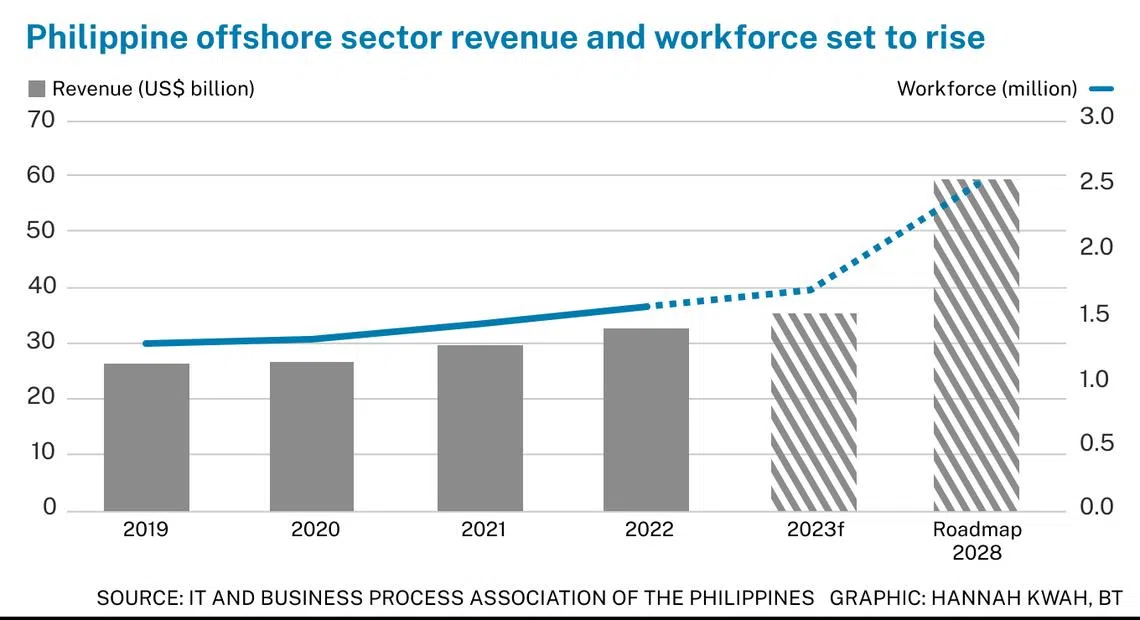
The offshoring sector has been the primary source of office space demand in the Philippines since its rise in the early 2000s. About 1.6 million Filipinos are employed in more than 1,000 firms offering offshoring services.
The sector posted double-digit growth in 2021 and 2022, recording revenue of US$29.5 billion and US$32.5 billion, respectively. Revenue for 2023 is expected to reach US$35.4 billion.
The IT and Business Process Association of the Philippines’ industry road map estimates revenues to hit US$59 billion and a 2.5 million-strong workforce by 2028.
The healthcare, banking and finance sectors, as well as contact centres, are expected to see the most offshoring activity this year.
TRENDING NOW

Inside Jensen Huang’s last hours as Nvidia CEO

Higher rates, weaker spending: Is the Philippines entering stagflation?

‘I’ll be buying more’: Singapore investors pour into Nvidia shares on Jensen Huang’s exit

Demand, tech capabilities position Apac and AI as Skyscanner’s next growth frontiers: CEO Bryan Batista

