



South-east Asian currencies hit fresh highs against US dollar post-Powell speech; strength set to last till year-end
Ringgit leads the charge trading at 18-month high; Singapore dollar hits decade-high; baht and rupiah erase YTD losses against greenback

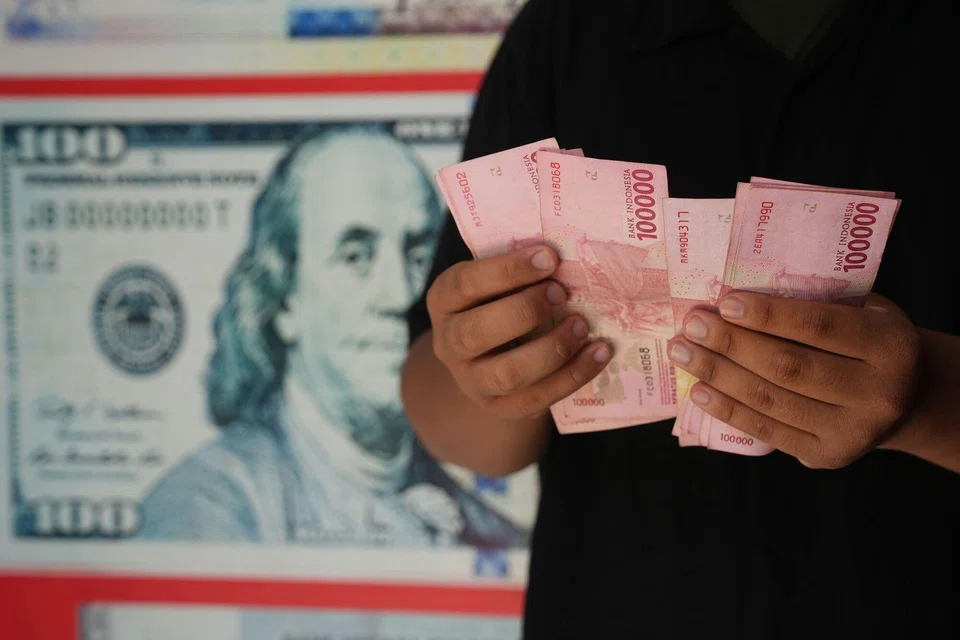
REGIONAL currencies strengthened on Monday (Aug 26), buoyed by US Federal Reserve chair Jerome Powell’s dovish remarks last Friday at the Jackson Hole symposium that cemented market expectations of a September rate cut.
The Singapore dollar gained 0.4 per cent against the US dollar to trade at around 1.3026 on Monday evening, from 1.3082 before Powell’s address. The local currency is now trading at around a decade-high, after briefly breaching by a whisker the 1.3 threshold on Monday morning.
Another star performer is the ringgit which had been crowned the worst-performing currency in emerging Asia last year. The Malaysian currency was charting an 18-month high at 4.3488 against the US dollar on Monday evening, gaining 0.6 per cent from 4.3748 before Friday’s remarks.
Like its Singaporean and Malaysian peers, the Thai baht also erased its losses for the year against the greenback. Powell’s speech lifted it further to 33.963 per US dollar on Monday evening, which translates into a 0.8 per cent gain from 34.245 before the address.
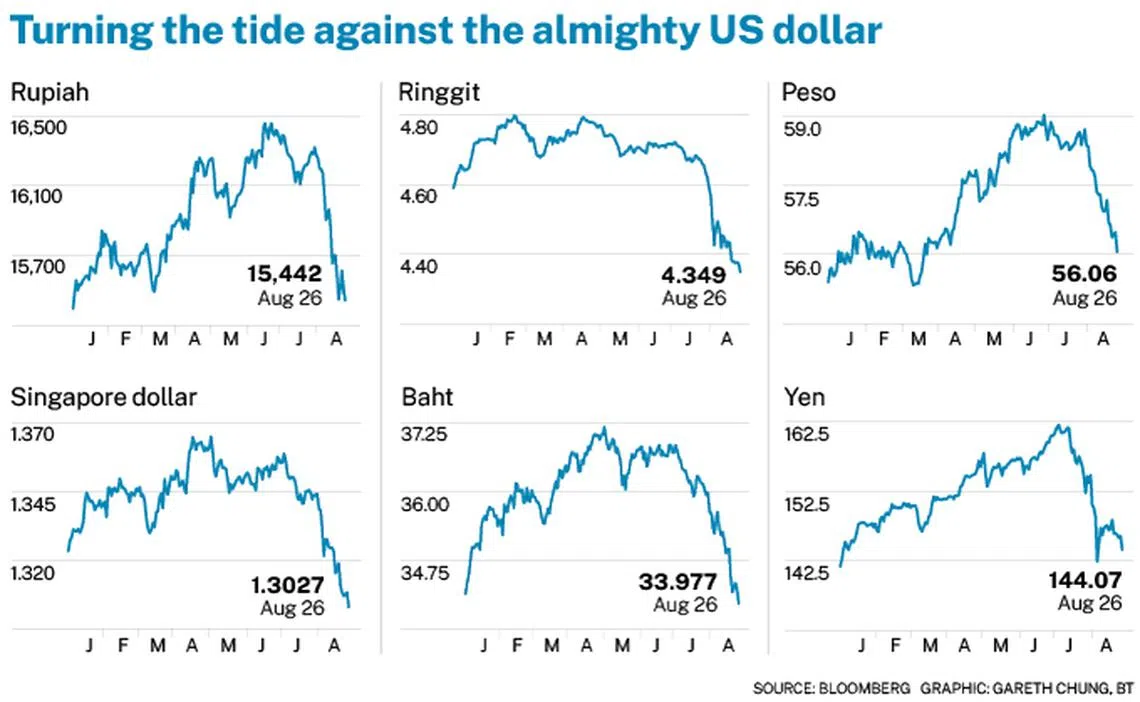
Also on course to reverse its losses for the year against the greenback is the rupiah. The Indonesian currency was trading at 15,448 per US dollar on Monday evening after gaining 0.5 per cent from 15,520 before the speech.
Separately, the yen – with Japan a major trading partner of regional economies – extended its gains against the greenback post-Powell remarks, climbing 1.4 per cent to 143.93 per US dollar on Monday evening, from 146.02 before the speech.
Over the past several weeks, South-east Asian currencies have broadly turned the tide against the greenback on the back of a multitude of factors, such as weak data and recession fears in the US, as well as domestic efforts by local central banks.
This comes after a rocky start to the year that saw the ringgit teetering near its record low, the rupiah at a four-year low and the baht losing more than 8 per cent against the US dollar at the peak of its weakness.
Sunny forecast to end the year
This recent strengthening is set to last into the year end, noted economists.
Specifically, the ringgit could close the year as one of the region’s stronger performers, said Maybank’s head of foreign exchange research, Saktiandi Supaat.
“We do still see some room for further strengthening in line with most Asian currencies on the back of the US dollar softness and narrowing yield differentials, as well as strengthening or stability in the yuan and yen which tend to be quite closely correlated with the ringgit,” he remarked.
The way the house sees it, the ringgit will maintain a gradual strengthening trend against the US dollar till the third and fourth quarters of the year.
“On balance, US dollar trajectory aside, assuming an improvement in growth outlook, fiscal position and a stable political environment ahead, we believe it is still generally ringgit positive into the year end,” added Saktiandi.
Maybank expects the ringgit to end the year at a range of 4.4 to 4.45 per US dollar, and at 3.3 to 3.35 against the Singapore dollar.
A point of caution: Malaysia’s reserves accumulation could be a catalyst to watch, said an Aug 25 JPMorgan report, though its analysts maintain that the longer-term case for the ringgit’s strength could continue if fundamental reforms woo back investors.
The bank’s Asia FX strategists added that against high-yielding currencies such as the rupiah and the Philippine peso in particular, US dollar valuations “continue to look rich” following the recent rally.
But MUFG Bank’s senior currency analyst Michael Wan believes the domestic-oriented Indonesian and Philippine currencies may underperform.
“For Indonesia, there are some uncertainties around the incoming administration’s priorities,” he explained. “For the Philippines, we think a wider trade deficit should imply that the peso weakens gradually over the medium term.”
Nevertheless, he is of the same view that Asean currencies should strengthen into the end of this year, but maintains that it will “certainly not (be) at the sharp pace and magnitude” as seen in the past two months.
Beyond Powell’s remarks, he noted that currency strengths of export-oriented countries such as Singapore, Malaysia, Thailand and Vietnam will also be bolstered by gradually improving exports as global growth picks up, lifted in part by the fading of inflation and rates shock.
Following in the Fed’s footsteps
Economists across the board broadly expect regional central banks to begin cutting rates from the first quarter of 2025.
The most dovish of them all? Bangko Sentral ng Pilipinas (BSP), said MUFG Bank’s Wan.
Recall that the Philippine central bank was the first regional player to move ahead of the Fed, having cut on Aug 15 its key interest rate to 6.25 per cent from 6.5 per cent for the first time since November 2020, citing robust domestic demand prospects and projections of headline inflation trending downwards.
MUFG Bank analysts expect a pause in the October meeting, followed by another quarter-point cut in December, and further cuts of 50 basis points next year.
Bank Indonesia (BI) and Bank of Thailand (BOT) kept their rates unchanged at their policy meetings the week after BSP’s cut, as expected.
Wan believes that the more stable rupiah, if sustained, should offer the Indonesian central bank room to cut rates earlier.
MUFG Bank analysts project a quarter-point cut each in the first and second quarters of 2025 from BI, while Maybank analysts foresee an earlier cut in the fourth quarter of 2024.
Economists broadly believe that BOT and Bank Negara Malaysia will hold steady the rest of this year.
TRENDING NOW

Singapore bars Alice Huang, woman tied to affair with Nvidia’s Jensen Huang, for misleading police

Nvidia prepares to oust Jensen Huang after news of second affair, with executive: reports

Higher rates, weaker spending: Is the Philippines entering stagflation?

Demand, tech capabilities position Apac and AI as Skyscanner’s next growth frontiers: CEO Bryan Batista

