



The steel squeeze: Asean at risk of becoming world’s steel dumping ground
As the US tightens trade barriers and China struggles with oversupply, the region’s steel industry faces pressure to protect its markets from a flood of cheap imports

[SOUTH-EAST ASIA] A potential steel glut could hit South-east Asia as US tariffs on Chinese imports upend global trade flows, reviving fears of a 2020-style price crash that forced governments to slap anti-dumping measures to shield their domestic industry.
Local industries are bracing themselves as pressure mounts with the US government’s 25 per cent steel tariff – primarily targeting China – flooding South-east Asia with surplus Chinese steel, raising the threat of a price war – unless governments step in with protectionist measures.
This is unfolding as steel demand in South-east Asia’s major economies is still struggling to recover after the pandemic while utilisation rates are well below the global average, leaving the region vulnerable to overcapacity.
“China is not going to reduce production overnight,” said Yeoh Wee Jin, secretary-general of the South East Asia Iron and Steel Institute (SEAISI).
“If they can’t export to the US, the excess steel will need to go somewhere else – South-east Asia is a prime destination,” he added.
Australia is bracing for the impact of US President Donald Trump’s proposed tariffs while seeking an exemption, as hopes for a reprieve fade. Trade Minister Don Farrell has urged exporters to explore alternative markets in Asia and South-east Asia.
The US, which buys about A$1 billion (S$838 million) of Australian steel and aluminium annually, is a significant export destination for these products.
“We’re seeing history repeat itself,” Yeoh told The Business Times, referring to the crisis five years ago, as Asean economies scrambled to contain the fallout.
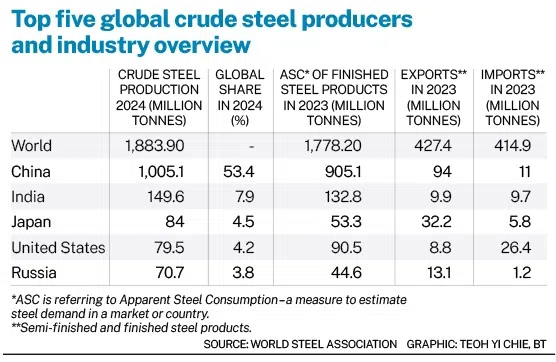
China, the world’s largest steel producer, churned out over one billion tonnes of steel in 2024, matching its 2020 peak when a supply glut triggered a price collapse, forcing Asean governments to impose anti-dumping measures to protect their industries.
Mysteel, a Chinese commodity information portal, forecasts that China is expected to reduce steel output to 990 million tonnes in 2025 – down 1.3 per cent from 2024 – but this level is still above what the market can absorb.
While some industries from construction and infrastructure to automotive may benefit in the short term from lower material costs, Yeoh warned that the long-term impact on Asean’s steel industry could be severe.
“Local producers, already struggling with high costs and low economies of scale, may be forced to cut production, further weakening the region’s steel supply chain,” he added.
Under pressure
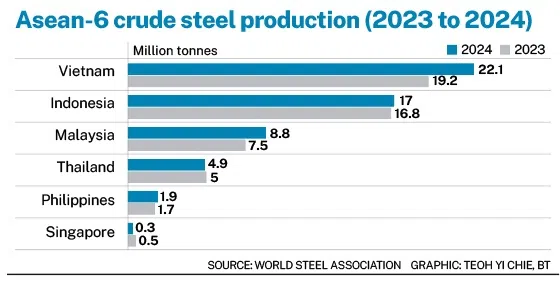
The Asean-6 nations – Indonesia, Malaysia, the Philippines, Thailand, Vietnam and Singapore – collectively accounted for 2.9 per cent of global crude steel production in 2024, according to data from the World Steel Association.
A June 2023 report by the Malaysian Iron and Steel Industry Federation (Misif) highlighted the region’s steel overcapacity, with utilisation rates at 61 per cent, well below the global average of 75.7 per cent.
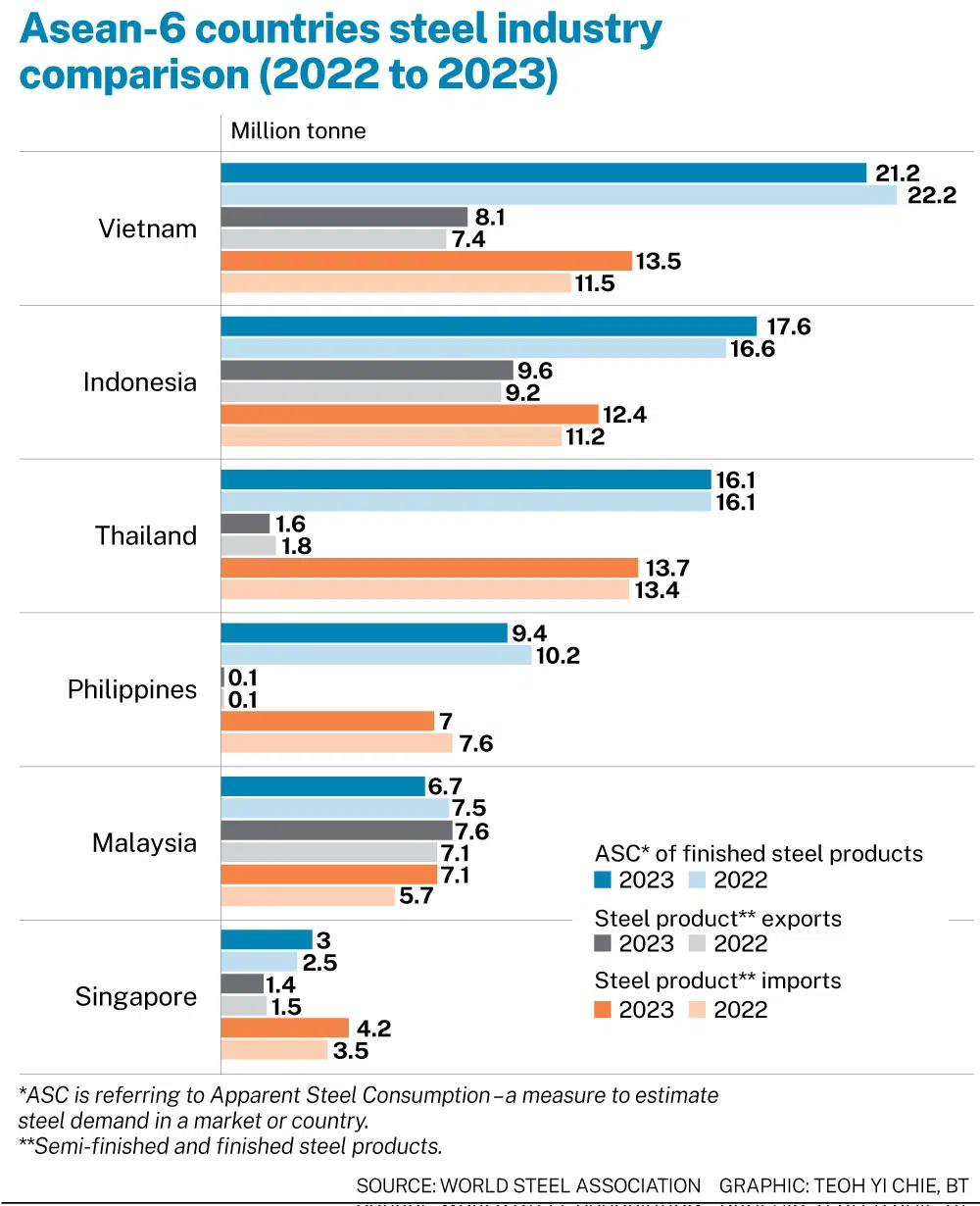
Steel demand in the Asean-6 has struggled to rebound since the pandemic, falling 1.9 per cent year on year to 73.5 million tonnes in 2023.
Vietnam’s steel industry is at a critical crossroads, balancing the potential gains from recent US tariff changes against the looming challenges of anti-dumping investigations and market adjustments. This delicate situation follows a year of explosive export growth, highlighting Vietnam’s rising prominence in the global steel market.
In Indonesia, an industry leader warned that the country could be flooded with cheaper Chinese automotive steel plates as a result of US tariff hikes. This influx will threaten domestic manufacturers due to Indonesia’s rapidly expanding automotive sector and inadequate trade regulations.
Beyond the immediate impact of US tariff changes, Malaysia’s steel industry is looking towards a future shaped by evolving trade policies and sustainability standards. As the potential for a flood of cheap steel imports intensifies, stakeholders are advocating for innovative solutions, including the adoption of green steel standards and carbon border adjustment mechanisms, to ensure long-term competitiveness.
Thailand’s steel sector, already burdened by high costs and resource constraints, now faces intensified pressure from newly imposed US tariffs.
This confluence of factors threatens to further destabilise the industry, prompting calls for urgent government intervention and strategic adaptation.
Oversupply dilemma
With Asean tightening trade measures and the US boosting domestic steel production, the global steel market is shifting, says SEAISI’s Yeoh. He notes that steel producers in the region must adapt through policy, innovation, or consolidation to survive rising protectionism.
On Mar 10, Trump threatened to raise tariffs on Canadian steel and aluminium to 50 per cent, up from 25 per cent, over Ontario’s electricity surcharge on US exports. However, the decision was reversed within 24 hours after negotiations led Ontario to suspend the surcharge.
Misif president Roshan Mahendran Abdullah noted that at the heart of the issue is China’s steel overproduction, which led to a record export of 110.7 million tonnes of steel products in 2024, and Beijing has yet to announce any major reductions.
With traditional export destinations such as South Korea, Vietnam and India imposing higher tariffs, China may find fewer markets for its surplus steel. Japan is also initiating anti-dumping measures, further limiting China’s options.
Roshan stressed that if Asean does not take stronger measures, the region could be overwhelmed by a flood of cheap Chinese steel, triggering a supply glut that would drive prices down and force local mills to idle capacity.
“The issue is not that Asean steel producers are uncompetitive… We are operating on an uneven playing field. Many Chinese producers are state-owned and can sustain multibillion-dollar losses, while private companies like ours do not have that luxury,” he said.
He stressed that the next three to six months will be crucial for seeing the real impact of the US’ tariff policy, which was implemented on Mar 12. “If Asean doesn’t act, we risk being the world’s dumping ground for excess steel.”
TRENDING NOW

Singapore bars Alice Huang, woman tied to affair with Nvidia’s Jensen Huang, for misleading police

Nvidia prepares to oust Jensen Huang after news of second affair, with executive: reports

Higher rates, weaker spending: Is the Philippines entering stagflation?

Demand, tech capabilities position Apac and AI as Skyscanner’s next growth frontiers: CEO Bryan Batista

