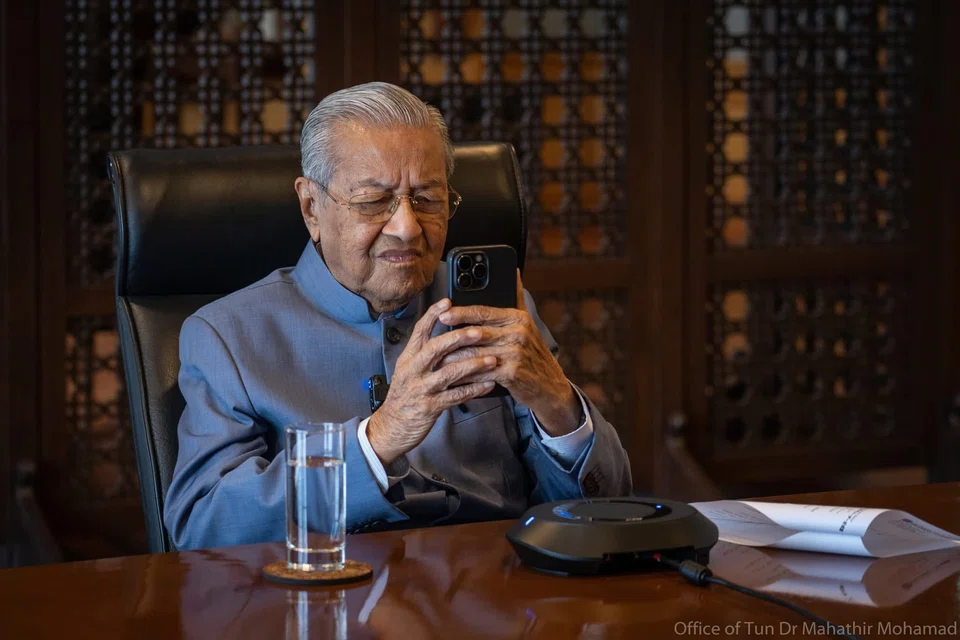
Still sharp at 100: Dr Mahathir’s century of power, provocation and vision
The man who served as Malaysia’s longest-serving prime minister continues to engage and remain relevant in a country he helped shape

[KUALA LUMPUR] Just weeks ago, Dr Mahathir Mohamad, 99, was zipping through city streets in Proton’s first electric vehicle, the eMas 7. Then he went online to share his thoughts, turning his test drive into a car review that quickly made the rounds and drew praise on social media.
Not long after that, he got behind a microphone to dissect the Iran-Israel conflict on his self-launched podcast, which draws nearly 150,000 views within a week.
His frame has thinned, and his gait, slowed, but his gaze remains steady and his remarks, pointed.
In his trademark caustic style – one that many have grown used to and even fond of – he delivered his comments on the US’ involvement in the Middle East conflict elliptically: “Hooray. Now we know who is fighting whom in the Middle-East. We know who is attacking Iran, and who is defending Israel. Need we say more?”
Related story: A visual timeline: Mahathir Mohamad’s rise from humble beginnings to Malaysia’s political titan
Dr Mahathir, who turns 100 on Thursday (Jul 10), continues to show up five days a week at his office in Putrajaya, writing the latest chapters in the life of Malaysia’s longest-serving prime minister. It is a milestone birthday for the man who continues to engage, provoke, and remain relevant in a country he has helped shape.
In June, he joined forces with opposition parties – Parti Islam Se-Malaysia (PAS) and Parti Pribumi Bersatu Malaysia (Bersatu) – to form the Malay People’s Secretariat. Framed as a “big umbrella to save Malays”, the initiative aims to address issues affecting the Malay community.
He has also criticised the United States President Donald Trump’s foreign policy and tariffs, describing the American leader as “irrational and living in an old world”.
Father of modernisation and controversy
Over the decades, Dr Mahathir has been many things to many Malaysians: visionary, authoritarian, reformer, power broker.
His achievements include vast infrastructure projects, among them the North-South Expressway, Kuala Lumpur International Airport (KLIA), Putrajaya and the Petronas Towers. He is also credited with the bold economic reforms that ushered in industrialisation and lifted the country into middle-income status.
Critics decried cronyism when he doled out lucrative concessions to those he hand-picked – figures such as Robert Kuok, Syed Mokhtar Albukhary, Berjaya’s Vincent Tan, the late Ananda Krishnan and Genting’s Lim Goh Tong – many of whom went on to build regional and global empires.
Professor Wong Chin Huat, a political scientist at Sunway University, said: “Under his watch, industrialisation and the service sector gained momentum, infrastructure such as highways and airports flourished, and Malaysia became a regional hub for affordable higher education.”
Prof Lau Zhe Wei, associate professor at the International Islamic University Malaysia, called him the “father of modernisation”, crediting his authoritarian style for pushing through mega-projects and policy shifts that redefined Malaysia’s economy and standing.
But Dr Mahathir’s record is deeply contested. He was premier during the 1988 judicial crisis, during which he dismissed top judges. He also pushed through a sweeping constitutional amendment that curbed the monarchy’s powers.
Then there was 1987’s Operation Lalang, under which more than 100 activists and opposition figures were detained without trial, leaving a deep scar on Malaysia’s democratic institutions.
Prof Wong, referring to Dr Mahathir’s tendency to centralise power and sideline rivals to achieve his political aims, said: “He perfected Machiavellianism in Malaysia.”
His critics say that his willingness to bend institutions and break norms compromised the integrity of Malaysia’s political system. To contain the rising influence of the Islamist party PAS, he expanded bureaucratic Islamisation – despite identifying as a modernist.
Still, many credit him for setting the stage for Malaysia’s economic take-off. His Vision 2020 blueprint, which aimed to turn Malaysia into a developed nation by 2020, catalysed industrial growth and liberalised private education. The country did not make it to the ranks of developed nations on time, but his push for it nonetheless left an enduring impact on national aspirations.
Geopolitical defiance
Dr Mahathir’s defiance wasn’t confined to domestic politics. On the international stage, he routinely clashed with Western powers, often championing developing nations. In one memorable example, he called financier George Soros a “moron” for his role in the 1997 Asian financial crisis.
He also forged a new foreign policy path by pivoting to Asia. His “Look East” policy encouraged Malaysians to emulate Japan and South Korea, rather than the West – a vision that shifted trade patterns, corporate culture and diplomatic alignment. In Tokyo and Seoul, he remains a respected statesman.
His often-tense relationship with Singapore’s founding leader Lee Kuan Yew was part rivalry, part mutual admiration. The two frequently clashed on race, trade, water rights and regional politics – but always from positions of equal intellectual standing. The unresolved feud over the Johor-Singapore bridge became symbolic of their broader push-pull dynamic.
The national car ambition
Dr Mahathir’s industrial dreams took physical form in Proton, Malaysia’s first national carmaker. Launched in the 1980s, the brand became a symbol of self-sufficiency and national pride.
But the car company was unable to compete with international carmakers and required multiple state-led rescues – until China’s Geely acquired a controlling stake in 2017.
Today, Proton still ranks second in Malaysian car sales, with over 150,000 units sold in 2024 alone; the name is buoyed by popular models like the Saga sedan and X50 compact SUV.
With the brand no longer fully Malaysian, it is a reminder that Dr Mahathir’s ambitions have sometimes been outpaced by market realities. Proton’s story mirrors his broader legacy – bold nation-building, but not without cost.
Crisis management
Many Malaysians view the political titan as the figure who successfully navigated the nation through challenging periods, notably the 1997 Asian financial crisis.
As currencies collapsed and capital fled, Dr Mahathir stunned the world by rejecting the International Monetary Fund’s (IMF) prescription and imposing capital controls. He pegged the ringgit, restricted foreign exchange and banned the trading of Malaysian shares on Singapore’s Clob counter.
His unconventional strategies, though widely condemned by foreign investors and the IMF, were instrumental in stabilising Malaysia’s economy, giving it the necessary space to recover.
Comeback king
He stepped down on Oct 31, 2003, after having served for 22 years. But in 2018, at age 92, he returned to power, leading the opposition Pakatan Harapan to a shock election victory that ended Barisan Nasional’s 61-year rule.
Teaming up with long-time foe Anwar Ibrahim and former allies like Muhyiddin Yassin and Lim Kit Siang, he pledged to reform the system he once built.
But the unity proved fleeting. Internal power struggles, especially over his promise to hand power to Anwar, unravelled the coalition. In 2020, Dr Mahathir resigned from the prime ministership and from party leadership, citing betrayal within his own camp.
At 97, in the general election in 2022, he suffered his first defeat in 53 years, securing just 6.8 per cent of the vote – below the threshold needed to retain his deposit. It was a dramatic end to his long political career.
“Had Mahathir bowed out in early 1997 or before May 2020 to make way for Anwar, he would have been widely respected for his contributions,” said Prof Wong.
Still stirring the pot
Even now, his comments remain influential, if also controversial. In a social media post in 2024, he criticised the signage in a Kuala Lumpur mall where the Chinese characters appeared larger than the Malay text. “Have we become part of China?” he asked.
The backlash prompted businesses to revise their signage, and local councils conducted compliance inspections.
His comments show a growing focus on race and religion. Once seen as practical, he is now viewed by many as sowing division.
Prof Wong quipped that Dr Mahathir’s unrelenting pursuit of political relevance may be “the secret to his longevity”.
With his 100th birthday approaching, the elder statesman’s contributions to Malaysia are still a big topic of discussion.
While many praise him for modernising the country, he is also criticised for harming democratic institutions. He is viewed as a significant leader, but also as someone who represents Malaysia’s ongoing challenges with democracy.
His continued relevance today underscores his unique place in Malaysian history. As a centenarian leader, his vision, determination and controversies have undeniably shaped the nation. His legacy, however, remains a topic of debate.
“He will forever be remembered as the architect of modern Malaysia and a figure whose influence transcends generations,” said Prof Lau.