



Stronger ringgit helps Malaysia’s KLCI narrow losses to 1.3% in 2025
The benchmark FBM KLCI loses steam in the third quarter of 2025, although construction and Reits outperform

[KUALA LUMPUR] The Malaysian stock market has had a year to forget, with its benchmark index one of only three in the region that is in the red in 2025.
The only consolation, according to analysts, is that the benchmark FBM KLCI has managed to keep above 1,600 points – a level closely watched by investors to gauge market confidence – after wobbling in the mid-year amid global trade tensions.
A turnaround may be on the cards. The index narrowed its losses to 1.3 per cent by end-September. With foreign outflows slowing and domestic demand firming up, analysts expect a steadier close to the year and a more resilient 2026 ahead.
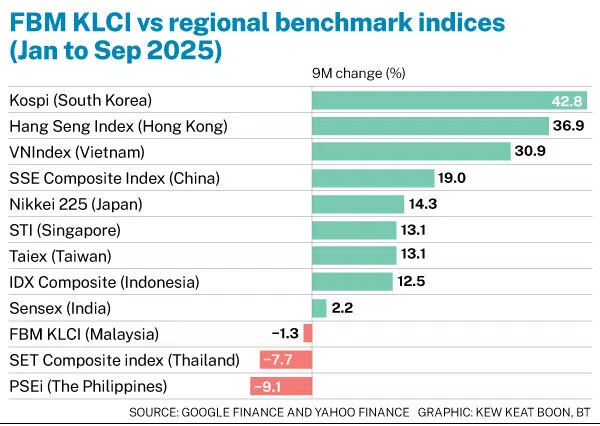
The Malaysian stock market is a notable underperformer in Asia in the year to September, with only Thailand (minus 8 per cent) and the Philippines (minus 9 per cent) faring worse, MBSB Research has noted.
By contrast, South Korea’s Kospi has advanced nearly 43 per cent and Hong Kong’s Hang Seng gained about 37 per cent, reflecting strong tech and China-linked rebounds elsewhere in the region.
The FBM KLCI opened 2025 at its year-high of 1,632.87 points but plunged to a low of 1,400.59 on Apr 9, shortly after the US imposed a 24 per cent reciprocal tariff on Malaysian exports. Despite ending the third quarter at 1,611.88 – holding above the 1,600-point level – it has yet to reclaim its January starting point.
As at Tuesday’s (Oct 21) closing, the index was trading marginally higher than its end-September level and settled at 1,616.83, showing tentative strength in the early weeks of the final quarter.
Construction stocks, Reits defy the gloom
Beyond the blue-chip index, the weakness expanded to mid and small-cap companies. The FBM Top 100 index (which focuses on the largest 100 stocks) fell 4 per cent, while the FBM Emas index – which includes a broader range of companies covering large, mid and some smaller caps – dropped 4.4 per cent.
Meanwhile, the FBM Small Cap index, tracking smaller companies outside the top 100 or 200 by market capitalisation, tumbled 7.3 per cent in the first nine months of 2025.
Amid the weakness, several sectors stood out.
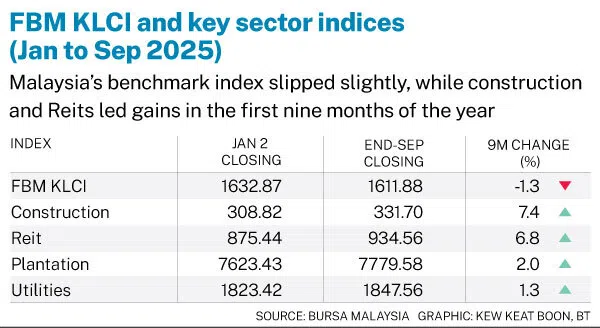
The construction index rose 7.4 per cent, buoyed by domestic infrastructure momentum and the steady rollout of data-centre projects.
Real estate investment trusts (Reits) gained 6.8 per cent, while plantation and utilities indices climbed 2 per cent and 1.3 per cent, respectively.
In contrast, healthcare and technology were the biggest casualties, down 33.5 per cent and 11.5 per cent, as investors rotated out of pandemic beneficiaries and export-oriented counters exposed to tariff risks.
Winners and laggards
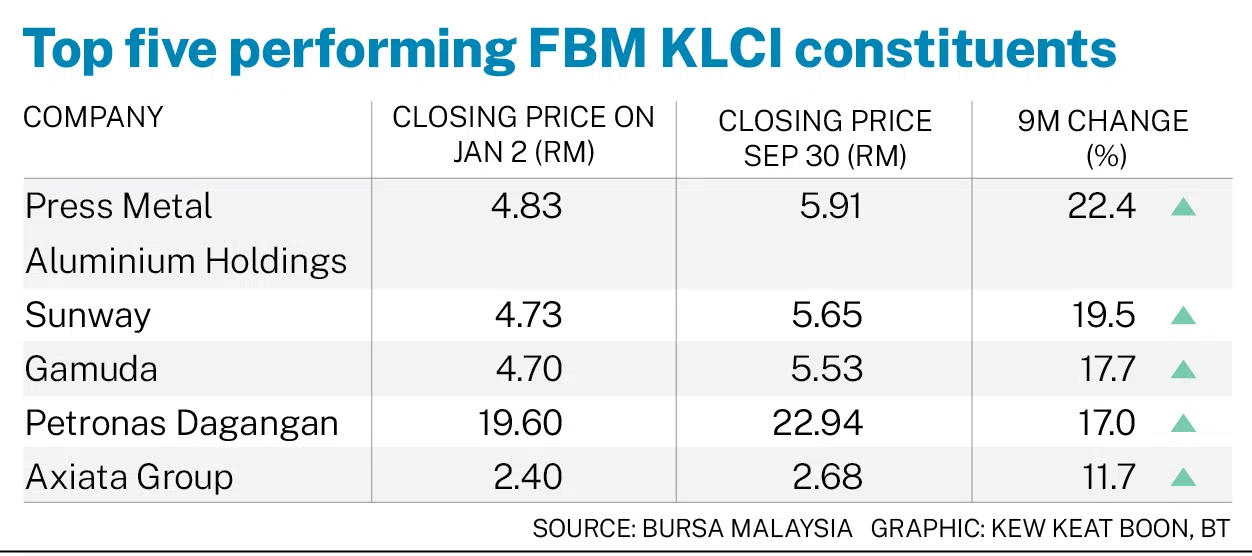
Integrated aluminium producer Press Metal Aluminium Holdings led gainers with an over 22 per cent jump to RM5.91. This is followed by integrated real-estate conglomerate, Sunway, which was up nearly 20 per cent, and construction stalwart, Gamuda, up nearly 18 per cent.
South-east Asia telco leader Axiata Group and 99 Speed Mart Retail Holdings also posted double-digit advances.
Agribusiness conglomerate PPB Group, petrochemical producer Petronas Chemicals Group, home improvement retailer MR DIY Group, and Malaysian utility company Tenaga Nasional were among the biggest laggards, falling between 10 and 18 per cent.
Foreign outflows near pandemic levels
Foreign investors remained net sellers for most of the year, withdrawing RM16.4 billion (S$5 billion) as at Sep 30 – the largest outflow since 2020.
Despite this, MBSB said it was encouraged by September’s net inflows, hinting at a possible turnaround.
“With expected US rate cuts, we may see foreign funds returning to our shores,” it said, adding that the KLCI’s relative stability despite heavy outflows reflected underlying resilience.
On the FBM KLCI forecast, MBSB, Kenanga and Maybank Investment Bank are maintaining their projections, expecting the benchmark index to end the year between 1,640 and 1,660 points.
Budget buzz – or lack thereof
Prime Minister Anwar Ibrahim’s Budget 2026, tabled on Oct 10, was widely viewed as voter-friendly yet fiscally prudent.
Chan Jit Hoong, acting head of research at Hong Leong Investment Bank, said “no news is good news”, and added that while the Budget may lack excitement, the absence of negative surprises is constructive.
In a report co-authored by Chan and fellow economist Felicia Ling, they expect KLCI valuations – now inexpensive relative to regional peers – and a narrowing interest-rate gap between Malaysia and the US to attract renewed foreign participation.
“Furthermore, sentiment remains firmly risk-on, with investors increasingly looking through short-term noises and posture ahead of a calmer 2026,” they wrote.
Chan and Ling also expect the traditional December window-dressing effect, which has seen a 90 per cent positive hit rate since the global financial crisis, could lend further support to end the year on a firmer footing.
Ringgit strength to support capital flows
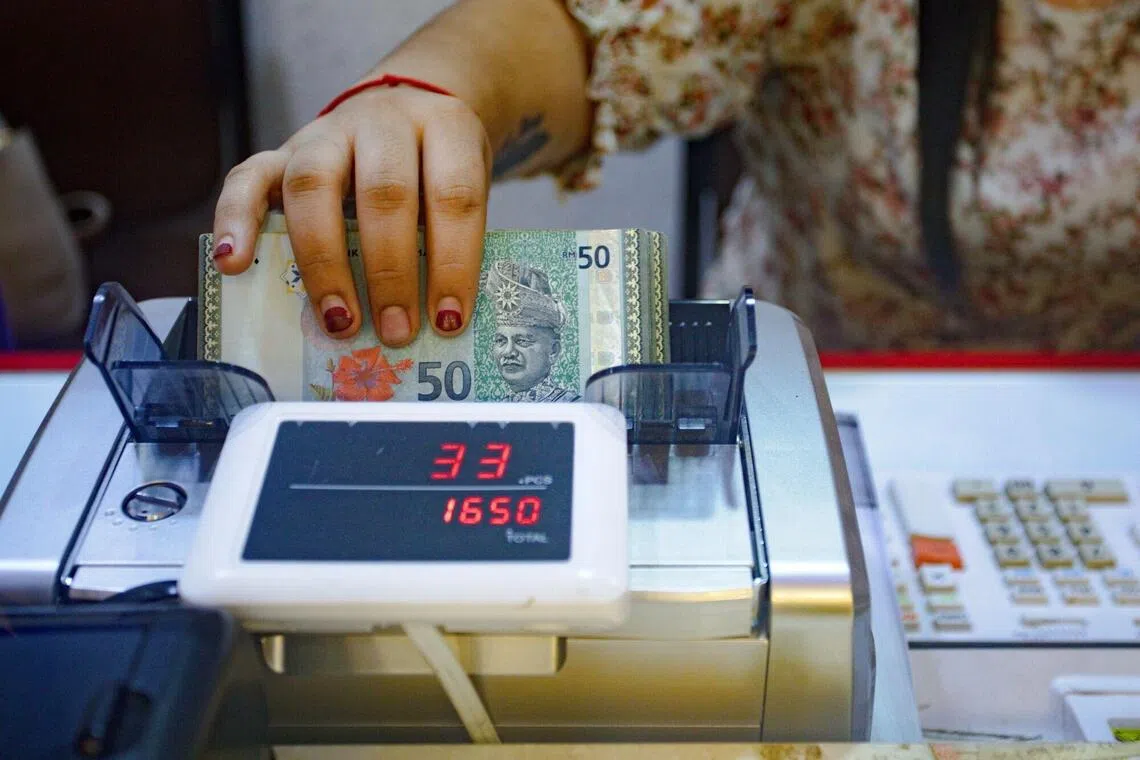
MBSB expects the ringgit to continue strengthening into 2026, supported by narrowing rate differentials as the US Federal Reserve cuts rates by another one to two times by year-end.
The firm projects an average RM4.25 per US dollar in 2025 and RM4 in 2026, from RM4.56 in 2024. “The forecast reflects Malaysia’s solid economic growth, firm commodity prices, and a continued current-account surplus,” said MBSB.
Earlier, Malaysia’s Second Finance Minister Amir Hamzah Azizan said the ringgit may strengthen to “just below” RM4 versus the US dollar in 12 months, supported by healthy fundamentals.
As at 5.30pm on Tuesday, the ringgit traded at 4.2288 against the US dollar. This represents an appreciation of nearly 5.5 per cent for the Malaysian currency since the start of the year, when it stood at 4.4728.
Maybank Investment Bank’s Lim Sue Lin notes a firmer ringgit presents mixed implications for local equities.
While a stronger ringgit generally improves the FBM KLCI’s value in US dollar terms, it could pressure export-oriented sectors such as technology, plantations, oil and gas, and gloves, she added.
“Conversely, domestic-centric sectors – including aviation, consumer, construction, and media - stand to benefit,” she said.
Focus sectors: Infrastructure, tech and renewables
Following Budget 2026’s focus on infrastructure, technology, and renewable energy, analysts see selective opportunities ahead.
Maybank Investment Bank’s Lim said construction led sector performance in the first nine months of 2025, supported by robust project activity and government spending.
Reits also performed well, boosted by stable yields and improving occupancy, while healthcare lagged amid continued weakness in glove makers.
MBSB attributed Reits’ strength to investors’ search for stability and highlighted construction optimism driven by data-centre growth and infrastructure projects.
Kenanga is bullish on technology, especially front-end semiconductors and outsourced assembly, citing Malaysia’s resilience to tariff pressures and renewed global demand.
Analysts also see opportunities in automotive-linked semiconductors and LED manufacturers, supported by recovering demand in China, Europe, and the US, although a stronger ringgit could limit earnings growth.
Both MBSB and Kenanga remain positive on consumer, construction, healthcare, Reits, and renewable energy sectors.
MBSB also noted easing cost pressures, resilient private demand, and improved government project execution in construction as key drivers going forward.
TRENDING NOW

Government to bring forward raising of retirement age, give employers more financial support to create flexi-load jobs

If Europe goes to war, the fallout will be felt in East Asia

Indonesia stocks suffer worst plunge in nearly 30 years as MSCI proposes standalone status

Vietnam’s northern provinces, not Hanoi or Ho Chi Minh City, are powering near 10% GDP growth

