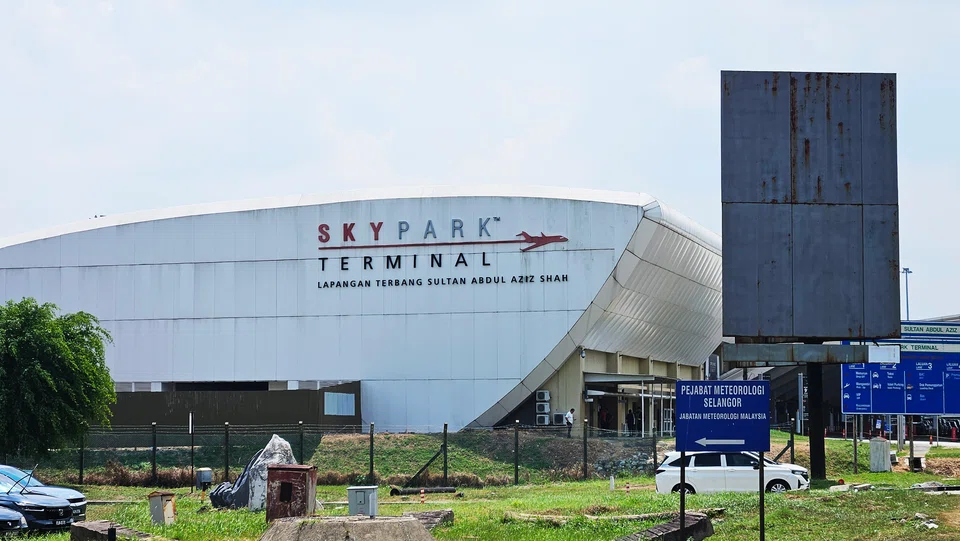
Subang Airport’s bold upgrade: A boost or backfire for Malaysian aviation?
Concerns raised over potential competition with KLIA, which is located 50 km away

[KUALA LUMPUR] The long-overdue expansion of Malaysia’s Subang Airport has excited airline operators and travellers, but concerns remain that overdevelopment could backfire, potentially siphoning business from larger hubs such as Kuala Lumpur International Airport (KLIA).
The six-year, RM3.7 billion (S$1.1 billion) regeneration plan led by Malaysia Airports Holdings aims to transform Subang Airport into a premium city airport, boosting its annual capacity from 1.5 million to eight million passengers by 2030, and making it a more competitive option for both domestic and international flights.
Transport consultant Wan Agyl Wan Hassan expressed concerns about potential competition between Subang Airport and KLIA in Sepang, which are located just over 50 km apart.
He cited a report by Netherlands Airport Consultants, which suggests that KLIA could lose up to two million passengers annually as traffic shifts to Subang Airport, located just 27 km from Kuala Lumpur city centre, compared to 60 km from KLIA.
“This situation poses a considerable risk not only to KLIA’s business but also to Malaysia’s overall aviation strategy. If Subang Airport attracts too much traffic away from KLIA, it could weaken both airports and diminish Malaysia’s competitiveness in the region,” he told The Business Times.
Subang Airport, which has a nostalgic significance for many Malaysians and Singaporeans as a gateway for travel and reunions, turned 59 last month and had served as the country’s main airport till the late 90s when KLIA was opened.
In early years, Subang Airport boasted the longest runway in South-east Asia, measuring about 3,700 metres long and 45 metres wide.
Proximity to city centre
Daniel Ma, deputy managing director of real estate advisory firm Nawawi Tie, said despite its smaller size and ageing facilities, Subang Airport remained as the preferred choice for domestic travellers for its easy accessibility and shorter travel times.
“The city airport is surrounded by mature neighbourhoods such as Petaling Jaya, Shah Alam and Klang, which are located around a 30-minute drive away,” he said.
Frequent traveller Jeremy Teng, who works in Singapore, described Subang Airport as akin to a “bus stop” since his parents’ home is just a stone’s throw away.
“Its compact size is ideal for short trips. In less than 10 minutes, I can walk from the plane to the pick-up point and head straight home,” he said. In KLIA and KLIA 2, the same clearance process in KLIA or KLIA 2 may take over 30 minutes.
Teng expressed his excitement about the introduction of more airlines connecting Subang Airport to other countries, as this will increase flight frequencies, enhance competition and potentially reduce flight delays.
Return of jet operations
Revitalisation efforts are already under way. Since the plan’s announcement in February 2023, Subang Airport resumed narrow-body aircraft operations with up to five airlines in August, marking the return of jet operations after a 22-year hiatus.
The airlines that are operating from Subang include AirAsia, Firefly, Indonesia’s TransNusa Airlines, Batik Air Malaysia, and Singapore’s Scoot.
Bernard Francis, group CEO of TransNusa Airlines, is optimistic about the regeneration plan and future demand for flights from Subang Airport, noting that the airline has experienced a healthy load factor over the past one month.
Currently, TransNusa operates one scheduled daily flight from Subang Airport to the Soekarno-Hatta International Airport in Jakarta. According to him, the route has registered an average load factor of about 65 per cent, which increases to 85 per cent during long weekends.
Although the airline already has a presence in KLIA, Francis emphasised that the target markets for both airports differ. KLIA focusses on international connectivity, while Subang Airport caters to point-to-point travel.
“Through Subang Airport, we are targeting travellers who are seeking a hassle-free experience, such as business travellers, health tourists and students,” he explained.
Crowded neighbourhoods, noise pollution
Subang Airport’s strategic location offers convenience for business travellers and airline companies. However, increased operations may lead to traffic congestion and noise pollution, impacting local communities.
Shukor Yusof, founder of aviation consultancy Endau Analytics, pointed out that significant investment is necessary for a complete revamp, otherwise, the nearly six-decade-old airport will remain as “merely an airport near Kuala Lumpur’s city centre” without achieving its premium status.
He pointed out that the upgrade plan lacks vision and is unrealistic, providing little benefit to the average flyer while potentially increasing noise pollution for nearby residents. “As a relic of the past, it requires significant investment for any meaningful transformation.”
Another aviation analyst who requested to stay anonymous noted that consumers will be the winners of increased competition between airports as it means there will be more options available at competitive price points.
“The cannibalisation would be minimal given that there are capacity or operation restrictions, but by allowing more international routes, it will offer opportunities for foreign carriers to win market share,” he added.
Wan Agyl noted that while Subang aims to establish itself as a business aviation and aerospace hub, it faces tough competition from established players in the region such as Singapore’s Seletar Airport.
“While Subang’s redevelopment holds promise, it comes with considerable risks. Its success will depend on how well the authorities can manage these overlapping interests in the market,” he added.