Superbank, Merdeka Gold and Prajogo-linked IPOs jolt Indonesia’s equity market back to life
Around 13 companies are in the listing pipeline next year

[JAKARTA] A rush of heavyweight initial public offerings (IPOs) in the second half of 2025, led by the likes of SuperBank and Merdeka Gold Resources, could help Indonesia’s equities shake off a year of volatility and get back in the game.
The deals could help revive liquidity and restore risk appetite – a tantalising prospect in a market where retail investors account for more than half of trading.
Analysts expect the listings of big groups, strongly favoured by retail investors, to remain a key driver of market optimism despite lingering macro and political uncertainties.
Amit Singh, partner and head of South and South-east Asia capital markets at Linklaters in Singapore, said that given Indonesia’s broader economic backdrop, “standalone firms outside conglomerate groups” face steeper challenges in scaling up and building market credibility.
By contrast, he noted, conglomerate-backed companies benefit from stronger financing, synergies and reputational support.
“Natural resource and infrastructure companies (and those adjacent to them) will likely continue to lead the next wave of Indonesian IPOs,” he said, adding that financial and consumer service companies are also poised to join the bandwagon.
Around 13 companies are in the listing pipeline next year, spanning sectors from energy and finance to transportation and logistics, noted the Indonesia Stock Exchange.
Indonesia had recorded 26 IPOs this year as at Dec 17, raising more than 17 trillion rupiah (S$1.3 billion). This compares with 41 IPOs in 2024 that collectively raised 14.35 trillion rupiah, reflecting a shift towards fewer but higher-value offerings rather than a higher deal count.
Tay Hwee Ling, capital markets services leader at Deloitte South-east Asia, pointed out that Indonesia’s IPOs in 2025 were led by the industrial, energy, consumer and healthcare sectors, with investors favouring firms with strong fundamentals, long-term prospects and government backing.
Retail frenzy
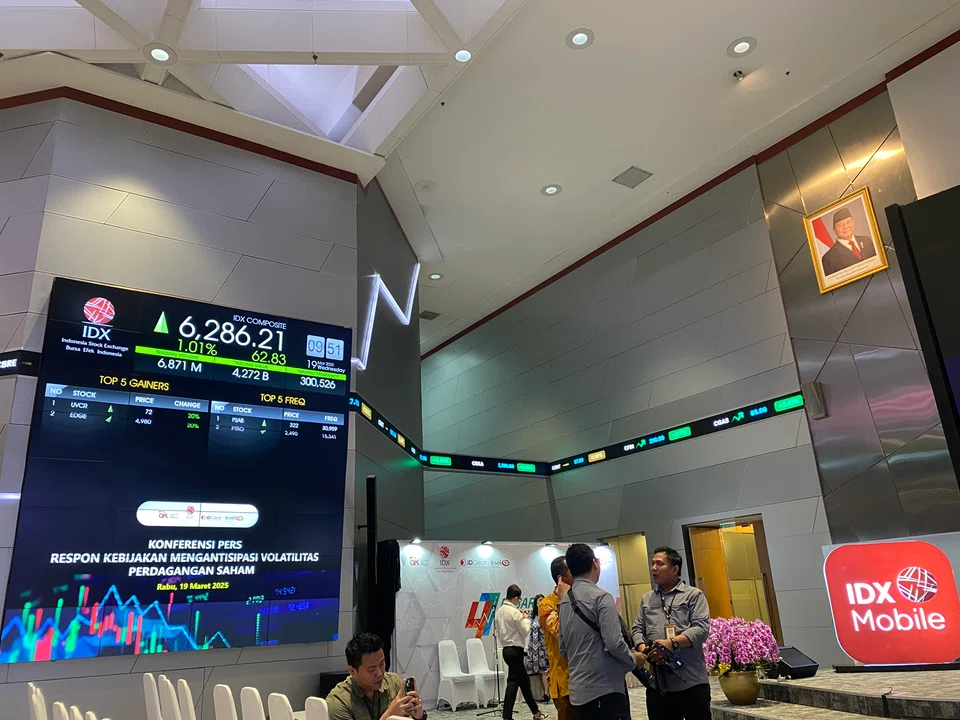
The Jakarta Composite Index (JCI) has traced a dramatic arc over the past 12 months. After suffering a sharp sell-off in March 2025 amid global risk aversion, currency pressure and domestic political transition, the benchmark rebounded strongly to reach record highs above 8,700 points in early December.
On a 12-month basis, the JCI has emerged as one of Asia’s stronger equity performers, rising about 22 per cent in the year to date as investor risk appetite rebounded, trailing only the benchmark indices in Vietnam and Singapore, among major regional markets.
Analysts say the rebound has been underpinned by a structural rise in retail participation, a trend that began during the Covid-19 pandemic. The number of registered capital market investors has surged from just 2.5 million in 2019 to 19.2 million as at October 2025.
Retail investors continue to dominate the bourse, accounting for 58 per cent of average daily volume in October this year – the highest since 2021– as trading activity was driven by a surge in low-free-float conglomerate stocks amid speculation over their inclusion in the MSCI index.
Retail daily trade hit a record 14.5 trillion rupiah in October, surpassing the pandemic-era peak.
Big-group buzz
This retail surge has been most visible during IPOs: When several “lighthouse” companies debuted on the bourse this year, they drew heavy oversubscription despite market volatility.
Defined by a minimum market capitalisation of three trillion rupiah and a free float of at least 15 per cent, many of these listings were backed by Indonesia’s leading conglomerates, offering reassurance to investors in an uncertain environment.
Among the standout deals was Chandra Daya Investasi, supported by companies linked to tycoon Prajogo Pangestu, the owner of Chandra Asri Group. The company’s 2.4 trillion rupiah IPO on Jul 9 was oversubscribed an extraordinary 563 times.
The 4.66 trillion rupiah IPO of gold miner Merdeka Gold Resources, backed by coal magnate Garibaldi “Boy” Thohir, also attracted strong demand, with the offering oversubscribed 148 times.
More recently, Superbank, supported by Singapore-based Grab and Indonesian conglomerate Elang Mahkota Teknologi, saw its IPO oversubscribed by 318 times.
Silver lining
Indonesia’s economic outlook has been weighed down by weaker household demand and a challenging global trade environment, and occasionally compounded by political uncertainty following the leadership transition.
Yet market professionals argue that macro headwinds do not necessarily derail IPO activity.
“Historically, even in markets facing headwinds, IPOs can remain robust as investors seek opportunities to monetise and re-direct capital,” said Singh from Linklaters.
“While broader macro factors influence timing decisions, the more important indicators are the individual company’s financial condition and its ability to convince investors that its growth story outweighs any country-specific considerations.”
Analysts at JPMorgan expect a brighter outlook for Indonesian equities in 2026, supported by higher government spending from both the state budget and Danantara, Indonesia’s sovereign investment vehicle, alongside improving global macro conditions and easing geopolitical tensions.
The bank has set a base-case target of 9,100 by the end of 2026 for the JCI, based on assumptions of 8 per cent earnings growth.
Meanwhile, bull and bear-case targets stand at 10,000 and 7,800, respectively, with rupiah volatility flagged as the key downside risk.
JPMorgan’s preferred sectors for next year include industrials, materials, consumer staples, consumer discretionary and property.
Analysts believe that conglomerates such as Elang Mahkota Teknologi have multiple growth catalysts ahead. For the technology giant, this includes a potential IPO for its streaming platform Vidio, following Superbank’s successful listing.
Oktavianus Audi, vice-president of equity retail at Kiwoom Sekuritas, said that easing interest rates, improving liquidity and relative macro stability should support stronger demand for new listings.
He added that successful IPOs would continue to hinge on two factors: strong backing from established conglomerates and a credible growth narrative. Sectors such as energy, metals and electric vehicles are seen as potential candidates.
Joseph Wolpin, capital markets counsel at Linklaters in Singapore, noted that Indonesia’s IPO landscape is expanding beyond the green energy and nickel plays of the early 2020s. With companies across industries now viable enough to be listed, the country is poised to become a multi-faceted market offering opportunities across the economy.
TRENDING NOW
Three ex-employees of Envy group join Ng Yu Zhi in bankruptcy
He built the Vingroup empire. Now South-east Asia’s richest man is handing some key roles to his sons
Grab CEO’s wife Chloe Tong on life with Anthony Tan and finding her purpose
Incidence of civil servants buying property near unannounced MRT stations ‘a concern’, but may not establish misconduct: PSD