



Taiwan’s Delta Electronics banks on expanded EV production in Thailand amid slowing market
The electronics company is one of five Singapore Depository Receipts that will debut on the SGX on Apr 1
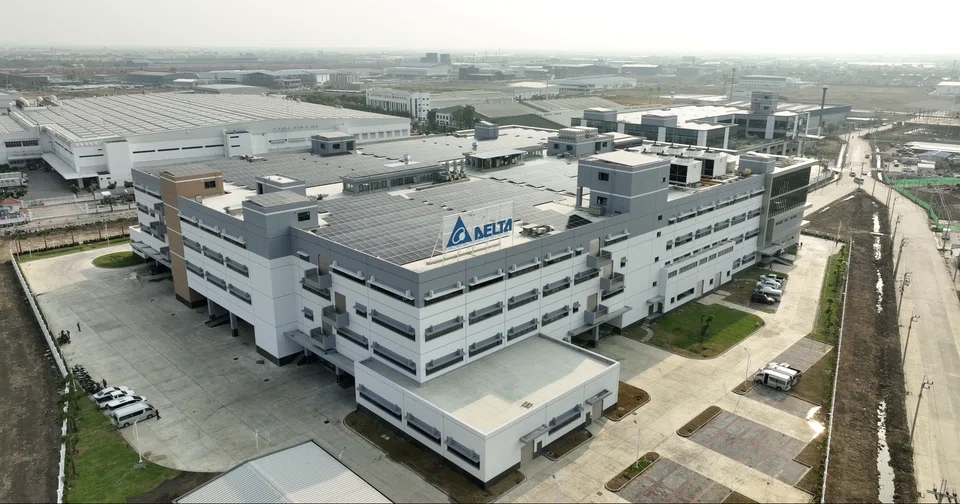
[BANGKOK] Delta Electronics – the largest manufacturer of electric-vehicle (EV) power electronics products in Thailand – has launched a new research and development (R&D) centre and another plant largely dedicated to expanding its EV business.
The moves come at a time when the EV car market has been waning in the West.
The Taiwanese electronics company, which has been listed on the Stock Exchange of Thailand since 1995, has been one of the most actively traded stocks on the local bourse.
This is due to its strong play in the EV sector, which is beginning to take off in Thailand, where such vehicles accounted for 16 per cent of the passenger cars sold last year.
Ironically, the EV parts locally produced by Delta Electronics (Thailand) are almost 100 per cent for the export market – chiefly Europe and North America.
The company is hence not directly affected by the growing market for EVs in South-east Asia or China, where EVs accounted for 25 per cent of car sales in 2023.
Delta Group has several factories in China which supply EV-related parts to various Chinese EV makers.
“Our coverage (in Thailand) is mainly the European and American markets, and unfortunately, both markets saw some downside last year,” said Victor Cheng, the chief executive officer of Delta Electronics (Thailand).
While EV-related electronic components account for about one-fourth of Delta’s Thailand revenues, the sector is closely watched by local securities companies.
“There has been a slowdown in new orders since late (in the third quarter of 2023), leading to a cautious demand outlook for the EV industry,” said Bualuang Securities in its Q4 2023 results report on Delta in Thailand.
Although Delta reported robust revenues of 146.4 billion baht (S$5.4 billion), with a profit of 18.4 billion baht, the outlook for 2024 was a cautious one.
“We anticipate the second quarter of 2024 to be a pivotal quarter, potentially marking a decisive break, one way or the other,” Bualuang Securities predicted.
The slowdown in EV orders in the US last year was blamed on the joint labour strikes by the “Big Three” automakers (General Motors, Ford and Chrysler parent Stellantis) that slowed production of both EV and internal combustion engine models.
With the strikes and semiconductor shortage now over, prospects are beginning to brighten for 2024 – but not during the winter months in the US and Europe.
“In the winter, the cold weather will cause some problems for new EV sales, so people will go back to the plug-in hybrid types,” said Cheng, who predicted that first-quarter revenues would expand mildly.
“Overall, Q1 2024 core earnings are projected to increase by 40 per cent year on year, but be flattish quarter on quarter,” said Bualuang Securities.
In general, the prospects for EVs remain bright in light of the rise in regulations pushing for environmentally friendly products that would help governments achieve their carbon-emission reduction goals, such as EVs.
Delta Thailand, which has been producing EV automotive parts such as power-management products, on-board chargers, and AC/DC converters since 2010, is well positioned to ride the EV wave.
Last week, the company opened its latest factory in Thailand – the eighth in the country – and a new R&D centre at Bangpoo Industrial Estate, Bangkok. Both facilities are dedicated to expanding the company’s EV-related products production and enhancing its EV customer-based solutions. Nearly three billion baht was invested into the sites.
“Previously, the majority of our R&D was located in Germany for European customers, and Taiwan for US customers,” said Jackie Chang, the president of Delta Thailand.
“Now, we are putting more resources in Thailand to enhance our capability to support all our customers.”
The new factory will double Delta’s EV-related products output, he added.
Attracting investments
Delta, which employs some 400 Thai engineers at its R&D centre, has been cooperating with Thai universities for years to cultivate local talent, which is somewhat lacking in the electronics sector.
The company has also pledged to expand Thailand’s supply chain in the EV industry by attracting investments into Thailand from its suppliers in China and Taiwan.
“At the moment, the local supply of materials is around 50 per cent, and our target is to push it up to 80 per cent in the next couple of years,” said Chang. “Some parts, like semiconductors, cannot be made locally, but the rest of the materials are achievable in the next couple of years.”
EV-power electronics is not the only sector to benefit from Taiwanese foreign direct investment in Thailand.
Last year, the Board of Investment (BOI) granted tax privileges to 30 manufacturers of printed-circuit boards – vital computer components – most of them from Taiwan.
“If you look at the investment figures, Thailand is No 1 for Taiwanese (foreign direct investment) in South-east Asia, especially in the electronics sector,” said Narit Therdsteerasukdi, secretary-general of the BOI, at a recent function in Bangkok.
Delta Electronics is one of five Singapore Depository Receipts (SDRs) that track the performance of Thailand-listed stocks that will make their debut on the Singapore Exchange on Monday (Apr 1).
SDRs are instruments that represent beneficial interest in an underlying security listed on an overseas exchange. According to SGX, investors can gain access, via SDRs traded on the Singapore bourse, to an underlying security which is currently listed on an overseas exchange.
TRENDING NOW

If Europe goes to war, the fallout will be felt in East Asia

Stocks to watch: Seatrium, MIT, Keppel Reit, Clint, UI Boustead Reit, Digital Core Reit, ST Engineering

Chairman’s role in spotlight with raft of proposed new rules for Singapore boards

Mapletree Industrial Trust posts 6.6% drop in Q2 DPU to S$0.0297

