



Thai court case risks election rerun, renewed political turmoil
An adverse ruling could force the country back to the polls within months
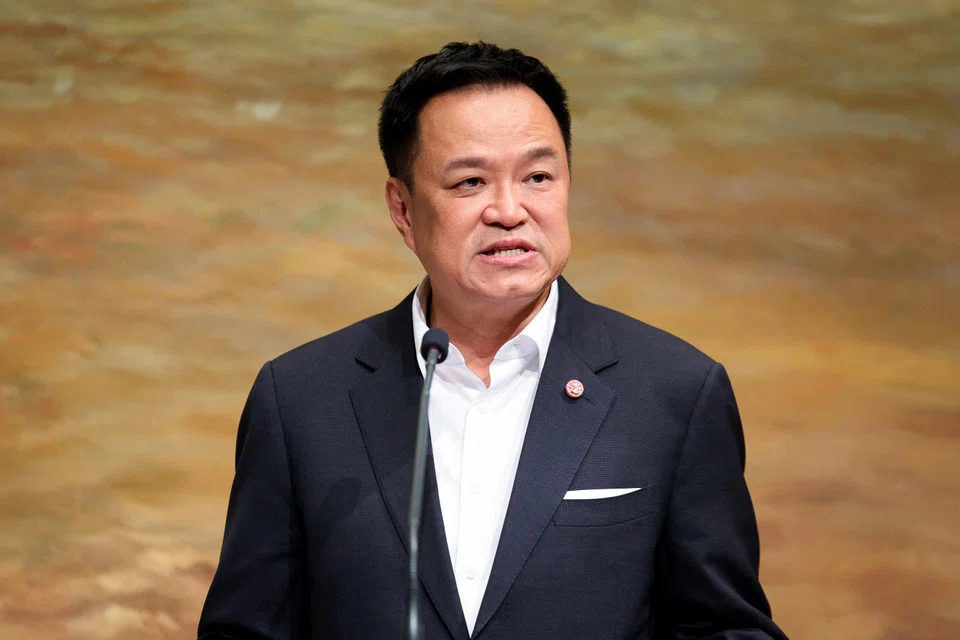
THE government of Thailand’s Prime Minister Anutin Charnvirakul will face its biggest survival test yet on Monday (Sep 28), when one of the country’s top courts rules on a case that could invalidate the election that brought it to power.
The Constitutional Court will decide whether unique barcodes used on ballots in the Feb 8 election made votes traceable, violating constitutional guarantees of ballot secrecy. The court accepted the case in March after several complaints by civil-rights groups.
The stakes extend far beyond ballot design. An adverse ruling could force Thailand back to the polls within months, ending a period of unusual political stability and delivering another shock to an already fragile economy.
Thailand is projected to grow only about 2.5 per cent this year, constrained by high household debt and under-investment.
The International Monetary Fund warned last year ahead of the February vote that renewed political uncertainty could further weigh on the economy. It could also test a rally in Thai stocks in which the benchmark SET Index has gained some 30 per cent in 2026.
“This case carries high stakes. It’s certainly the most significant challenge since the government was formed,” said Dr Purawich Watanasukh, a political science lecturer at Thammasat University. “In the worst case, we’re looking at the entire election being declared void.”
Anutin’s conservative Bhumjaithai Party won a decisive victory in February and went on to form one of Thailand’s most politically secure governments in years, breaking with a period in which elected administrations were repeatedly destabilised by court rulings, protests and military intervention.
If the court nullifies the election, his government would remain in office in a caretaker capacity, potentially delaying major policy decisions and investment approvals until a new one is formed.
“The resulting political vacuum and transition would not bode well for the economy” in the final quarter of 2026 and early 2027, said Standard Chartered economist Tim Leelahaphan. “It is also uncertain whether any new election would go through smoothly.”

The Election Commission said that the barcodes and QR codes used in the February vote were intended to prevent fraud and account for ballots.
It has acknowledged that ballots could theoretically be matched with stubs containing voter information, but said that is unlikely to happen in practice because the records were stored separately.
Various outcomes, high stakes
The court could rule in several ways. The most disruptive outcome would be a finding that the possibility of tracing ballots breached the constitutional requirement for secret voting and was serious enough to invalidate the election.
Judges could also find fault with the ballot system but conclude that no actual harm occurred, or that any violation was insufficient to overturn the nationwide result.
At the other end, the court could dismiss the case, removing the most immediate legal threat to Anutin and strengthening his grip on power.
For the prime minister, the danger of a rerun goes beyond temporarily leading a caretaker government. A new election would reopen a political contest his party decisively settled only seven months ago.
There have been signs lately that political pressures on his administration are building, with veteran protest leader Sondhi Limthongkul mobilising supporters against the government over corruption allegations and the cost of living.
Same same but different
Thailand’s courts have voided national elections before.
In 2006, the Constitutional Court annulled an election partly over ballot-secrecy concerns and other irregularities. The military ousted then prime minister Thaksin Shinawatra four months later, beginning another period of political upheaval.
The circumstances today are markedly different. Anutin has assembled broad support across Thailand’s conservative establishment, giving his government a degree of political security rarely enjoyed by elected administrations in recent decades.
“In the last 20 years, no government has ever been able to organise all the elite groups within the same structure, whether it be the traditional elite, the capitalist class, the military, the bureaucracy,” said Dr Olarn Thinbangtieo, a political scientist at Burapha University.
“All these actors now all fall in line,” he added. “But one thing that’s absolutely uncontrollable is a new election.” BLOOMBERG
Decoding Asia newsletter: your guide to navigating Asia in a new global order. Sign up here to get Decoding Asia newsletter. Delivered to your inbox. Free.
Share with us your feedback on BT's products and services
TRENDING NOW

Once staunchly pro-China, Malaysian Chinese businesses are now distancing themselves from Beijing
Stocks to watch: HPL, Aims Apac Reit, Zico, Advanced Systems Automation, ComfortDelGro
‘How many will survive?’: Bubble fears arise as China’s humanoid robotics face reality check
Smaller board lots can’t fix a market run by three banks

