Thai election raises hopes for stability, economic reforms
[BANGKOK] Business leaders are notoriously fond of political stability and predictability – two commodities that are rare in the hurly-burly of Thai politics, and which could prove even more elusive than usual after this Sunday’s (May 14) general election is over.
There are about 70 political parties competing for the votes of over 52 million citizens, as the candidates jostle for 500 seats in Parliament’s Lower House.
Then there is a group of 250 senators, appointed by the military regime that staged that last coup in May 2014, that will have a big say in who becomes the next prime minister.
The prime minister is voted on by both elected members of parliament and the senators, and he or she will get the job and head the government by obtaining at least 376 votes.
In the aftermath of the last election in 2019, the senators’ vote helped to return former army chief Prayut Chan-o-cha as prime minister, even though the Palang Pracharath Party – which he led that year – did not win the most seats. Prayut now heads the United Thai Nation Party.
This time round, however, things are likely to be quite different.
After nine years in power, the 69-year-old Prayut’s appeal of restoring law and order – after nearly a decade of street protests and political turmoil – has diminished. The focus has instead shifted to the need for change, both on the political and economic fronts.
According to data from the World Bank, Thailand’s economy grew by an average of 3.6 per cent per annum between 2010 and 2019. Comparatively, Vietnam’s average gross domestic product growth was 6.6 per cent during the same period.
Thailand has become a regional laggard, both in terms of economic growth and in attracting foreign direct investment.
These are trends that most economists blame more on the country’s flagging competitiveness due to rising wages, an ageing population, the increasing influence of monopolistic groups and a sub-par education system, rather than on political instability, although coups and disruptive street protests don’t help the business climate one bit.
“The real need is to enhance the competitiveness of the nation, and for that you need many long-term strategies such as reskilling, upskilling and education,” said Stanley Kang, the former chairman of the Joint Foreign Chambers of Commerce in Thailand.
“Other than political stability (in the post-election period), we would also be happy to see some good policies kicked off and make sure they are implemented. We hope that (the next government) will have a long-term view to look at all these reforms – ensuring digital transformation, and transitioning to the next generation of public service (bureaucracy reform),” he added.
He noted that populist policies might win elections, but they might not enhance Thailand’s long-term competitiveness.
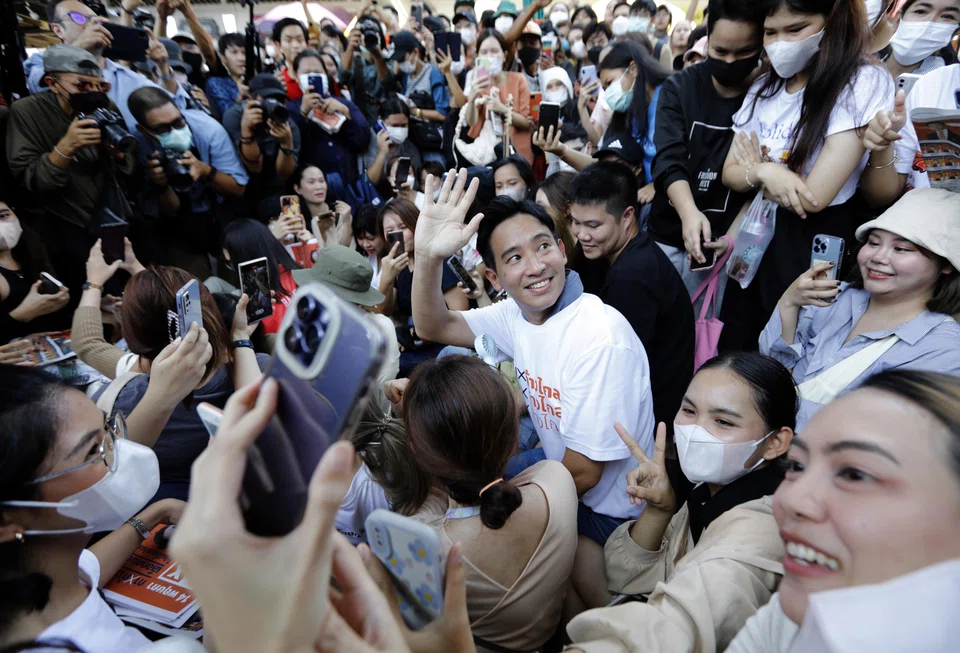
While the initial stage of the campaign period saw the parties place a greater emphasis on populist schemes, the latter part has seen a shift to reform platforms that has given a fillip to the popularity of the Move Forward party led by Pita Limjaroenrat, a 42-year-old businessman who’s a graduate of Harvard and MIT in the US.
According to a recent poll conducted by the National Institute of Development Administration, Pita is now the most popular contender for the prime minister’s seat with a support level of 35.4 per cent.
Next on the list is Paetongtarn Shanawatra (29.2 per cent), a 36-year-old who is one of the prime minister candidates for the Pheu Thai Party. This party is backed by Paetongtarn’s father Thaksin Shinawatra, a former prime minister who lives in self-exile abroad but remains a popular figure among voters.
While Pheu Thai has stressed populist policies in its election campaign, Move Forward has stressed what it calls the three Ds – demilitarise, demonopolise and decentralise.
“The main difference between Pheu Thai’s and Move Forward’s economic policy is that while the former focuses more on expanding the economic pie through financial stimuli and subsidies, Move Forward wants to address structural issues that have hampered the Thai economy to unlock its potential economic growth,” said Pavida Pananond, an international business professor at Thammasat University.
Move Forward has recently downplayed its promise to reform Thailand’s contentious lese majeste law, apparently in a bid to make the party more politically acceptable as a future coalition partner post-election.
Some form of coalition government is expected after the election as no single party is likely to win by a landslide. Political stability in the post-election period will thus depend on which coalition rules, analysts say.
Among the most likely coalition scenarios, an anti-military coalition led by Pheu Thai and Move Forward could usher in a spate of reforms and promote economic growth. This might, however, result in another coup or party disbandment by the judiciary if the Thailand’s political elites – military and pro-monarchists – feel threatened.
A Prayut-led coalition, on the other hand, might assure political stability in the short term but could also lead to street protests and a stagnant economy.
A Pheu Thai-Palang Pracharath Party coalition – which would bring an estimated 100 senators on board and has campaigned on a platform of bridging political divides – might offer a compromise.
“Under the circumstances, (this coalition) would be the best possible way forward for both stability and a more competent economic performance,” said Thitinan Pongsudhirak, a professor of political science at Chulalongkorn University.