



Thai PM Srettha confident US$28b land bridge will be built, but project faces many hurdles
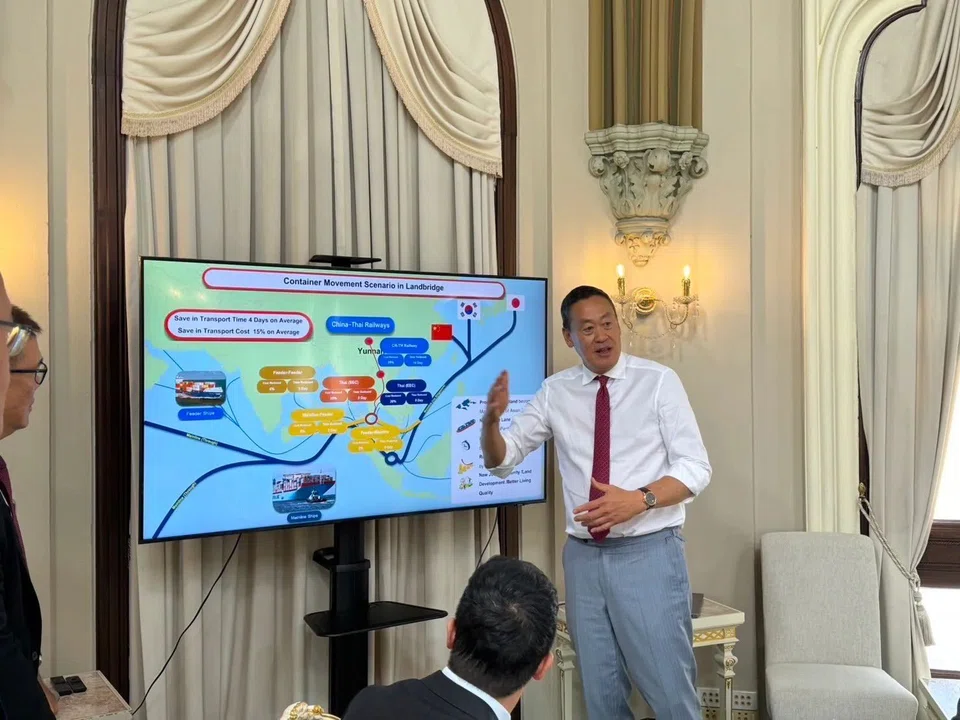
[BANGKOK] WHEN Thai Prime Minister Srettha Thavisin visited San Francisco recently for the Asia-Pacific Economic Cooperation summit, he had other plans on his agenda too.
Known by his peers as a top salesman, the 61-year-old former property tycoon spent time in the US to make a business pitch to a group of deep-pocketed investors in the form of a 100-km land bridge.
This massive US$28 billion infrastructure project would see a bridge built between the Indian and Pacific Oceans that would open up an alternative route to the Strait of Malacca, and give ocean liners options other than the likes of Singapore and Malaysia.
If it comes to fruition, there will be two new ports built in Thailand – in Chumphon in the east, and Ranong in the west – that will be connected by road or rail.
Srettha, who has been aggressively selling this project to investors on his numerous overseas trips since he took office in August, said he believed the land bridge would offer a “cheaper, faster and safer” route for ships and vessels. Travel time for ships can be reduced by up to four days, with cost savings of as much as 15 per cent.
“The government will push for this project to be formed during our term,” he said. His coalition government’s four-year term ends in 2027. “I believe this project will be able to attract investors, and elevate the development of Thailand to another level.”
He added that the project could create some 280,000 jobs and enable Thailand’s economy to grow by 5.5 per cent a year when the land bridge is fully operational. South-east Asia’s second-largest economy grew 2.6 per cent last year and is forecast to expand by between 2.5 per cent and 3 per cent in 2023.
Such a land bridge project has been on the drawing boards of many Thai governments for the past 40 years or so, with not much success.
The original concept was to cut a canal across the isthmus of Thailand, but this was eventually dropped out of security concerns. Thailand’s three southernmost provinces – Pattani, Yala and Narathiwat – are home to an active secessionist movement that has claimed hundreds of lives over the years.
Some of Srettha’s predecessors, including Prayut Chan-o-cha and Thaksin Shinawatra – also explored the idea of a land bridge but these were also axed because of concerns about the impact on local communities and wildlife.
The latest version of the land bridge project will not have a canal, but instead there will be a pipeline for oil and gas; a 100 km motorway; and an accompanying 100 km dual track railway between two new deep-sea ports in Chumporn and Ranong. These two ports will need to be built under public-private partnership (PPP) contracts.
Government sources have said that construction of the land bridge could start as early as early as 2025, with the first phase done by 2030 and the entire project complete by 2039. However, not everyone remains convinced that the land bridge can become a reality during Srettha’s first term in office, or even at all.
Many details have yet to be worked out, and the scheme will also have to pass the appraisals of the Bank of Thailand and the National Economic and Social Development Council before it becomes a “formal” project, sources told The Business Times.
The land bridge, which will cut through villages and parts of Ranong’s famous mangrove reserves, is likely to face some strong opposition from local communities and environmentalists.
Sumet Ongkittikul, the research director of transportation and logistics policy at the Thailand Development Research Institute (TDRI), said the project’s viability will depend greatly on what other economic activities might be generated in the southern corridor to attract ships to the new route.
TDRI predicted that the detailed study of the project would take at least two years before it is formalised, and another two or three years to organise the PPP bids for all the major infrastructure plans. While the government will be responsible for land expropriation, it hopes to finance the rest of the project via PPPs.
“If the project ever materialises, the start of construction will not happen within the next five years,” said Sumet. “All mega-projects in Thailand take time. When you have a very big and unique project like this, the government agencies will need even more time to prepare.”
TRENDING NOW

South-east Asia has lost Nvidia’s best salesman

Higher rates, weaker spending: Is the Philippines entering stagflation?
Who is Leo KoGuan, the Singapore-based billionaire backing Nvidia’s Jensen Huang?

Demand, tech capabilities position Apac and AI as Skyscanner’s next growth frontiers: CEO Bryan Batista

