



Thai tech startup Amity to use Singapore as a hub for its global expansion ambitions
The city-state will be the group’s regional headquarters and house its AI research centre

[SINGAPORE] Amity Group, a South-east Asian enterprise artificial intelligence technology firm founded in Thailand, announced on Monday (Jun 29) the launch of its Singapore office and AI Research & Application Center (ARAC).
Founder and executive chairman Korawad Chearavanont said at a briefing in Singapore that the city-state will be the global home of Amity’s AI research capabilities as it targets US$200 million in annualised revenue by the end of this year.
The group surpassed US$100 million in annualised revenue in 2025.
“When we started Amity, we believed that Asian enterprises deserved AI that is built for their reality, not tools designed for other markets and retrofitted for ours,” said Korawad. “Singapore is where that belief comes to life.”
The decision to set up a presence in Singapore stemmed from the city-state’s connectivity and tech ecosystem.
“The US and China,” said Amity’s group CEO Keng Teik Koay, “are basically now two camps that have been established as a result of the decoupling, and they’ve built the most powerful models. We see ourselves as being a player that could be leading the third camp.”
Amity’s strategy is based around building vertical AI models and services for companies.
Vertical AI models are applications that are designed to perform specific tasks or functions within a particular industry or area of expertise.
Amity’s ARAC in Singapore will be used to build these vertical AI models, which will also cater for operational complexities of Asian enterprises and language variations.
SEE ALSO


Keng revealed that Amity has already hired two researchers and aims to expand that to five by the end of this year. The group is targeting 60 roles to be created for both technical and non-technical roles in the next three years.
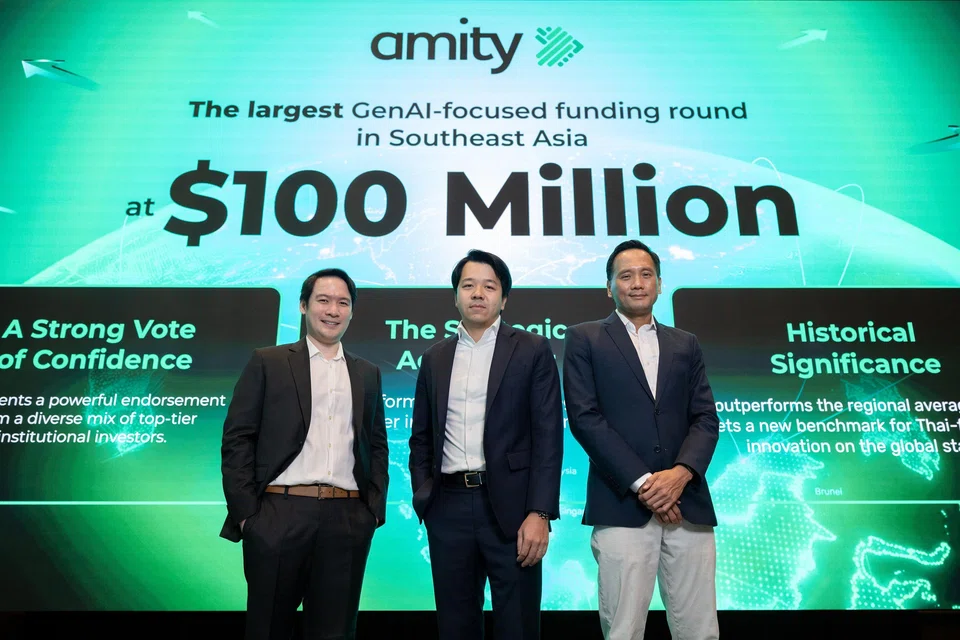
Amity’s Singapore office follows its landmark US$100 million Series D funding round announced on Mar 25.
The funding round was led by EDBI, the investment arm of SG Growth Capital, alongside Asia Partners and SMDV, with participation from existing and new investors, including CMLIM Capital.
Keng said that almost all of the money raised from that round will be used for acquisitions in Europe and South-east Asia as part of Amity’s “build-buy-bridge” strategy.
What Amity targets for acquisition are companies that deal with a lot of data but may not be fully leveraging it. The group then acquires these companies and comes in to provide its relevant generative AI (GenAI)-driven solution to optimise that data.
The UK-based call analytics company Tollring is an example of this strategy. Amity acquired the company in 2024 and integrated its GenAI-backed applications to help Tollring power its voice analytics software solutions.
Keng told The Business Times that about 20 per cent of Tollring’s annual recurring revenue now comes from AI solutions that Amity helped build. Tollring is a UK-based call analytics company that serves over 20,000 businesses across the UK, Europe, the US and Australia.
Future acquisitions are likely to be similar to the Tollring acquisition; the group is looking at companies in the telco and retail sectors in Europe and South-east Asia.
Keng declined to reveal more specific details, citing confidentiality agreements.
Amity is also building an AI application in its Singapore hub that can better predict consumer purchase preferences in Singapore; it will look to sell that solution to retail players in Thailand, Malaysia and elsewhere in South-east Asia.
Decoding Asia newsletter: your guide to navigating Asia in a new global order. Sign up here to get Decoding Asia newsletter. Delivered to your inbox. Free.
Copyright SPH Media. All rights reserved.






