



Thailand holds key rate at 2.5%, cuts growth outlook
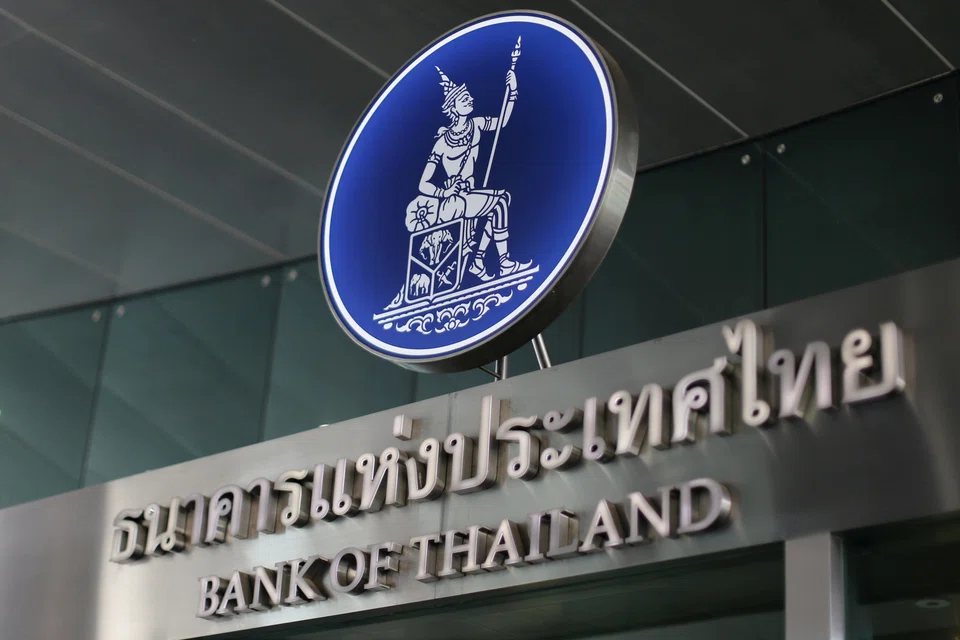
THAILAND’S central bank left its key interest rate unchanged on Wednesday (Nov 29), as expected, ending a year-long tightening cycle amid a slowing economy and below-target inflation, while lowering its growth outlook.
The Bank of Thailand (BOT) also said it had factored in uncertainty over the potential impact of the government’s controversial signature policy of giving away 500 billion baht (S$19.09 billion) to 50 million Thais to stimulate sluggish spending.
“Rates are considered low, but were suitable for the Thai economy in the medium-term,” assistant central bank governor Piti Disyatat told reporters after a policy meeting, adding that rates were at a level that would be able to handle risks that may arise from the government’s “digital wallet” policy.
The handout plan, slated for May, could face legal challenges and a staunch opposition in parliament. Economists and some former central bankers have said it could result in fiscal strains and stoke inflation.
But last week, Prime Minister Srettha Thavisin said the economy was in “crisis”, stressing the need to forge ahead with the plan.
In a unanimous vote, the BOT’s monetary policy committee ended a year-long tightening cycle, keeping its one-day repurchase rate at 2.5 per cent, the highest in a decade, after hiking rates by 200 basis points since August last year to curb inflation.
But the BOT also cut its 2023 and 2024 economic growth forecasts, raising speculation it may start to cut borrowing costs from the second half of next year if domestic and global demand do not pick up.
The bank lowered its growth forecast for this year to 2.4 per cent from 2.8 per cent seen earlier, and cut its 2024 growth outlook to 3.2 per cent from 4.4 per cent. The economy expanded 2.6 per cent last year.
However, in a scenario where the digital wallet policy is implemented, the BOT said it sees next year’s growth at 3.8 per cent.
SEE ALSO






South-east Asia’s second-largest economy grew 1.5 per cent in the third quarter from a year earlier, its slowest pace this year.
The current interest rate is appropriate and ensures sufficient policy space “in light of an uncertain outlook,” the BOT said in a statement.
All 28 economists in a Reuters poll had predicted the BOT would stand pat on Wednesday, with median forecasts showing no policy change until at least July 2025.
“Risk between growth and inflation is roughly balanced,” said Kobsidthi Silpachai of Kasikornbank, adding that rates would be held steady for a year.
Capital Economics, however, said “with inflation low and the recovery likely to underwhelm, we think policy cuts are likely in the second half of next year”.
Thailand’s headline consumer price index in October declined 0.31 per cent on-year.
The BOT predicts headline inflation of 1.3 per cent this year, versus 1.6 per cent projected earlier, while 2024 inflation was seen at 2 per cent, not factoring in the impact of digital wallet spending, compared with 2.6 per cent projected earlier. The BOT targets headline inflation in a range of 1 per cent to 3 per cent.
The BOT expects foreign visitor arrivals at 28.3 million this year and 34.5 million next year, versus a pre-pandemic record of 39.9 million arrivals, whose spending accounted for more than 11 per cent of gross domestic product.
Exports, another key growth driver, are expected to fall 1.5 per cent this year due to softening global demand, but are projected to increase 4.3 per cent next year, versus a previous projection of a 1.7 per cent drop and a 4.2 per cent rise. REUTERS
Decoding Asia newsletter: your guide to navigating Asia in a new global order. Sign up here to get Decoding Asia newsletter. Delivered to your inbox. Free.
Share with us your feedback on BT's products and services
TRENDING NOW

He built the Vingroup empire. Now South-east Asia’s richest man is handing some key roles to his sons

Grab CEO’s wife Chloe Tong on life with Anthony Tan and finding her purpose

What role can Japan play in Asean’s future?

From folding clothes to factory work: Why China is sending humanoid robots to school

