



Thailand parties’ populist policies pit fiscal stimuli against economic stability
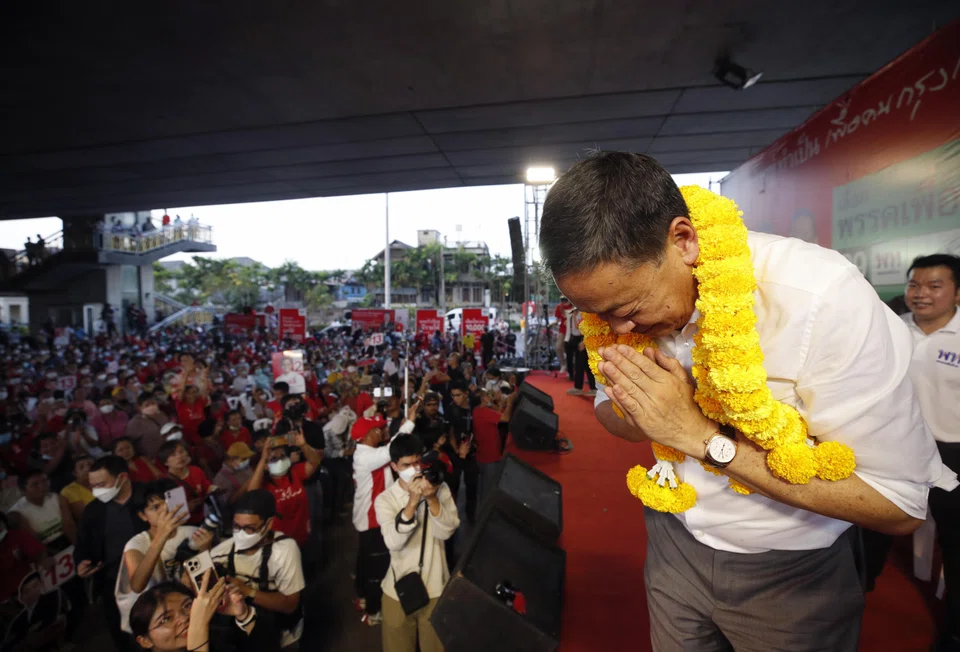
[BANGKOK] Populist policies have been all the rage in the campaign period leading up to Thailand’s general election on May 14, raising worries about the country’s fiscal stability should many of these policies end up getting implemented after the polls.
Thai politics is no stranger to populism, having been first introduced to the election equation in a big way in 2001 by the former Thai Rak Thai Party helmed by telecom billionaire-turned-politician Thaksin Shinawatra.
That year, the party introduced a universal healthcare scheme and provided one million baht (S$39,010) in handouts to every village nationwide, which ultimately helped them clinch the election and won Thaksin instant popularity among the poor and neglected rural communities – a reputation that he still holds to this day, despite living in self-imposed exile since 2008 to avoid a jail term for corruption and abuse of power.
A series of Thaksin-backed parties went on to win every general election since 2001, introducing new populist schemes that distributed the government budget to the masses that won votes, but were not necessarily sustainable templates for economic growth or fiscal stability. According to official data, Thailand has run budget deficits for 18 of the past 20 years.
While all of Thailand’s contesting political parties have jumped on the populist bandwagon this year – with all sorts of promises to boost welfare payments, old-age benefits and other forms of handouts – the Thaksin-linked Pheu Thai Party has arguably surpassed the pack.
Pheu Thai has launched a unique scheme to provide every Thai citizen aged over 16 with 10,000 baht a month between January and June next year, to be disbursed via a digital wallet. Pheu Thai hopes to win the election by a landslide and secure 250 to 310 seats of the contested seats.
While the 10,000 baht scheme is obviously designed to win votes, Pheu Thai’s prime minister candidate and property tycoon Srettha Thavisin insists that it is also an economic stimulus project that should boost Thailand’s gross domestic product (GDP) growth to 5 per cent next year and beyond.
The scheme will require a massive budget of 560 billion baht to carry out. As things stand, Thailand’s public debt is already close to 10 trillion baht, or a whopping 61.1 per cent of GDP.
The Election Commission may yet scuttle the programme, and possibly disband the Pheu Thai Party, for failing to fully divulge where the budget to finance it will come from, which is required under election laws. But it has arguably stirred a heated debate about stimulus versus welfare schemes, and fiscal stability verses GDP growth.
“Stability, particularly fiscal stability, is more critical than stimulus right now for Thailand’s economy,” Bank of Thailand governor Sethaput Suthiwartnaruput told a recent press conference.
“Thailand needs economic policies that support economic fundamentals and promote sustained growth in the long term,” he added.
Thailand’s GDP grew 2.6 per cent last year. Official estimates show the economy is projected to grow 3.6 per cent in 2023 and possibly 4 per cent next year.
While an injection of 560 billion baht would no doubt spur spending and help Thailand reach as high as 5 per cent growth next year, economists question if the scheme can create a “multiplier effect” that leads to sustainable GDP growth in the future.
“There have been programmes in the past to inject cash directly into people in the rural areas but this is short term,” said Charl Kengchon, executive chairman of the Kasikorn Research Institute.
“If you give them money, they are going to be happy but it is not going to improve the competitiveness of the country.”
Thailand’s GDP has slowed to 3-4 per cent since 2013, primarily due to the country’s declining competitiveness in terms exports and attracting foreign direct investment thanks to rising labour costs, a swiftly ageing population and the growing competitiveness of neighbours such as Vietnam, Charl noted.
Populist stimuli are not likely to reverse these trends. Thailand also faces a real need to provide safety nets for the poor and its rapidly ageing society.
“Handouts and social welfare are not the same,” said Pavida Pananond, professor of international business at Thammasat Business School.
“While sustainable investment in social welfare, like healthcare and pensions, should be welcome, short-term financial stimuli and handouts without the ability to improve longer-term livelihood should be viewed with caution,” she said.
Thailand’s first welfare card system was launched in 2016, with only 7.7 million eligible members. By January 2023, there were 13.2 registered applicants out of a pool of 18 million.
While the benefits are tiny, at only 300 baht in cash a month and a 700 baht transport subsidy, the programme has proven extremely popular.
“But this policy is not permanent so it could be discarded by the next government,” said Thi Noi, a 45-year-old disabled former motorcycle taxi driver who receives both welfare and disability benefits.
“I hope the next government doesn’t end the welfare card and they increase the monthly amount. That would be best.”






