



Thailand’s auto crown under threat as Indonesia eyes Asean’s top spot
A perfect storm of slipping domestic sales and shrinking exports threaten its reign as South-east Asia’s leading car production hub
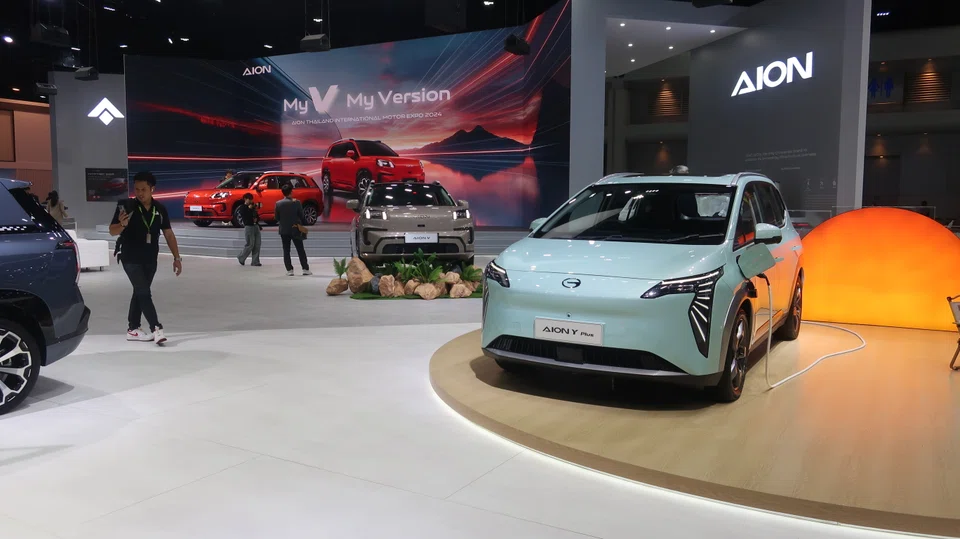
[BANGKOK] Thailand’s automotive sector, which contributes approximately 10 per cent of the kingdom’s gross domestic product, is this year grappling with dual blows – plunging domestic sales and flagging exports – which threaten its long-held status as South-east Asia’s largest car production hub.
The Federation of Thai Industries slashed its 2024 production target to 1.5 million units, down from 1.7 million, marking an 18 per cent year-on-year decline – the steepest since 2020.
It cited a stagnating domestic market, with about 600,000 units expected to be sold locally, and the rest exported.
Indonesia produced 1.4 million units in 2023, says macroeconomic data provider CEIC Data, and this year’s figures are likely to surpass that, which puts it on track to overtake Thailand as Asean’s largest car production base.
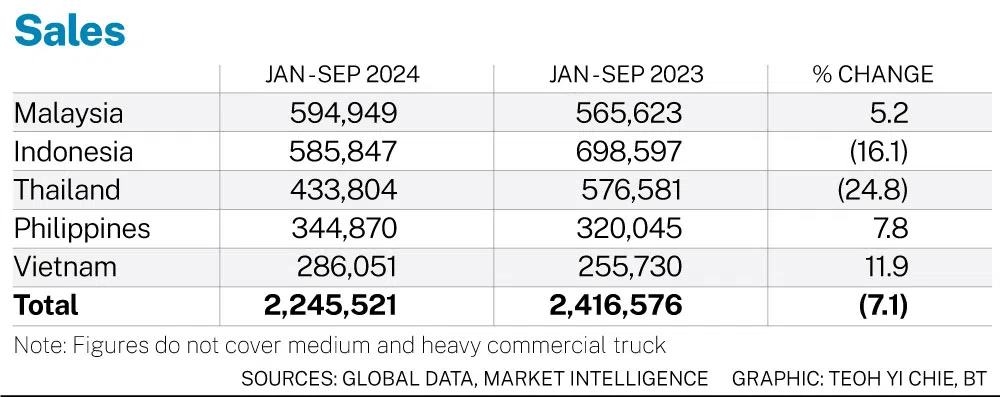
In terms of domestic vehicle sales, Indonesia recorded 585,847 sales from January to September this year, reported Global Data, a UK-based market intelligence company. This was higher than Thailand’s 433,804 units sold during that period. Malaysia led with 594,949 units.
Malaysia is unlikely to expand into car exports, even as it leads Asean in domestic car sales this year. National brands such as Proton and Perodua dominate the country’s manufacturing, and rely on the technology of major shareholders Zhejiang Geely and Daihatsu, which likely have their own export strategies.
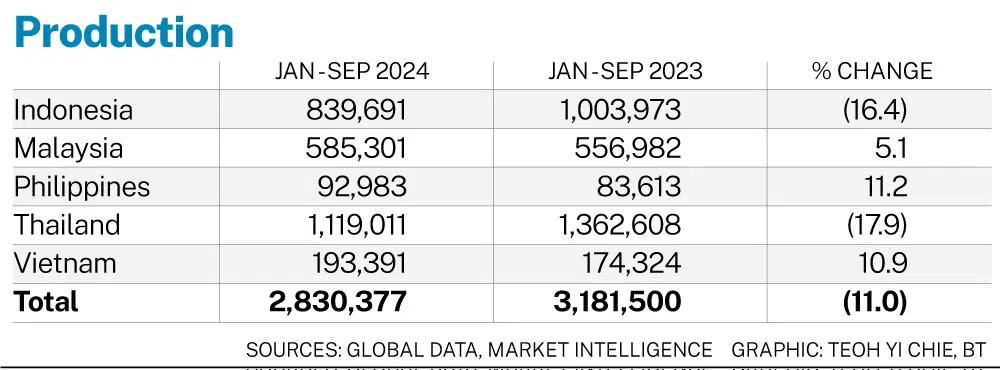
Indonesia rising
Indonesia, however, presents a contrasting picture: Its car sector is increasingly focused on producing global and regional models.
South-east Asia manager for Global Data/Thailand, Titikorn Lertsirirungsun, noted that Indonesia has gained in exports.
He added: “Ten years ago, Indonesian car brands were all geared for the local market, but now they are starting to produce more global or regional models, so Indonesia has started to increase its export volume. This will affect Thailand’s position as a regional production hub.”
For more than four decades, Thailand solidified its position as a leading automobile production base, particularly for Japanese brands, driven by its strong domestic market.
One-tonne pickups, which make up half of domestic sales, have been a cornerstone of this success, with these versatile commercial vehicles plugging the high demand from the kingdom’s agricultural sector.
Most Japanese carmakers, including Toyota, Isuzu and Nissan, have over the years relocated their pickup production from Japan to Thailand.
Thai car sales on downhill slope
President of Toyota Motor Thailand Noriaki Yamashita said: “The domestic market for vehicles has dropped significantly this year to an estimated 600,000 units.
“And pickup sales have fallen the most; they may not reach 200,000 units this year,” he told a press conference at the International Motor Expo in Bangkok from Nov 28 to 30.
Pickup sales volumes, typically around 400,000 units annually, have taken a significant hit due to stricter lending conditions on car loans imposed by Thai banks. This move, driven by the Bank of Thailand’s (BOT) efforts to curb household debt – now at 90 per cent of GDP – has dampened demand.
The requirement that borrowers provide proof of a monthly salary has been particularly burdensome for farmers and rural workers – the primary market for pickups – because these individuals are mostly self-employed and rely on seasonal earnings.
Meanwhile, Thailand’s pickup exports, primarily to the Middle East, have been hit by escalating tensions in the region.
EV lining
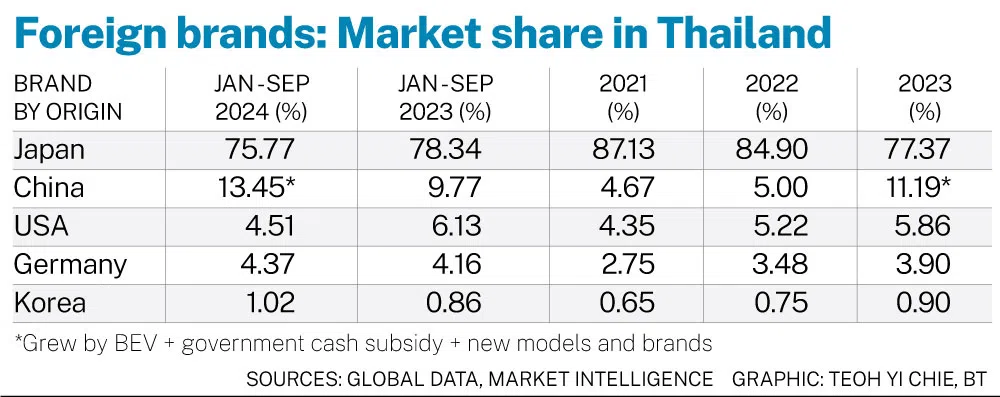
A bright spot for Thailand’s car industry this year has been the entry of several Chinese carmakers, which are setting up local assembly plants for battery electric vehicles (BEVs) to cater to domestic and export markets.
The wave of new openings by brands such as BYD, GAC Aion, Hozon Auto’s Neta, and Great Wall Motors sparked a price war that at first boosted sales in 2023 and this year, but later caused buyer hesitation, driven by fears of missing out on further price cuts.
Between January to September this year, BEVs accounted for 13.5 per cent of Thailand’s domestic sales, up from 11.2 per cent in the same period in 2023, Global Data reported.
GlobalData’s Titikorn said: “The share of Chinese brands has grown in Thailand because they took aim at a segment where there were no Japanese brands – BEVs.”
Japanese carmakers have been slow to launch their own models of BEVs, partly because Japan lacks the raw materials needed to produce the batteries. Down the road, they are likely to focus on hybrids, or other technologies such as hydrogen.
Toyota’s Yamashita added: “Hybrid EV car sales grew by 42 per cent, reaching 100,000 units in the January-to-October period in 2024, while BEVs went up by only 1 per cent.
He noted that it shows that Thai customers choose hybrids.
Breakneck competition
It remains uncertain whether Thailand will continue to be the preferred production base for Chinese BEVs.
For instance, Aion opened its BEV factory in Thailand in July, and has also set up a joint venture in Indonesia to produce this type of vehicles there.
South-east Asian general manager for Aion, Ma Haiyang, said: “Besides the population advantage, Indonesia also has a lot of minerals such as nickel, which is used to make batteries.”
“In Thailand, the supply chain is better, and the charging station infrastructure is better,” he added.
Another advantage that Thailand enjoys comes from the generous tax incentives offered to BEV manufacturers by the country’s Board of Investment (BOI).
On Dec 4, the BOI further improved these benefits by reducing the annual production quota required for BEV producers to qualify, and temporarily lowering the excise tax on locally produced hybrid electric vehicles, giving Japanese brands a significant boost.






