



Thailand’s food delivery sector edges towards consolidation
Financial group SCB X’s decision to close its loss-making Robinhood platform, which was quickly reversed, signals potential restructuring as the sector faces mounting pressures

[BANGKOK] When SCB X – the largest financial group in Thailand – decided recently to reverse plans to shut down the loss-making food delivery platform Robinhood due to interest from potential buyers, the move suggested that some consolidation could be in store for the sector.
However, it still remains to be seen if a knight in shining armour will show up to rescue Robinhood.
Industry players expect the sector might be headed for some restructuring and mergers as more companies vie for dominance.
“I believe firmly that the market will consolidate for food delivery, and once it does all the major players will be quite profitable,” said Yod Chinsupakul, chief executive of Line Man Wongnai Company, one of the top food delivery service providers in Thailand.
He told The Business Times in an interview that only two or three food delivery platforms are likely to survive due to the strong network effect.
“If you have more market share, there are more orders, which enables you to have lower costs. The (biggest expenditure) of food delivery is logistics costs, so if you have greater density, it’s a shorter distance to pick up and send food,” he explained.
In late June, SCB X – the holding company of Siam Commercial Bank – revealed its intention to cease operations of Robinhood in end-July, following more than four years of losses estimated at over five billion baht (S$186.6 million).
On deadline day, however, the banking group decided to soldier on, citing interest from several suitors to take over the unprofitable app.
Robinhood is one of the four major food delivery platforms that grew exponentially in Bangkok during the stay-at-home Covid-19 period from 2020 to 2022, and continues to play a major role in Thailand’s vast and fast-changing restaurant industry.
The boom in food delivery services in fact began before the pandemic in 2019 when GET Food – a joint venture between Thai investors and Indonesia’s leading motorcycle delivery service Gojek – entered the online food fight. It was at a time when the Thai public were growing more accustomed to online delivery services.
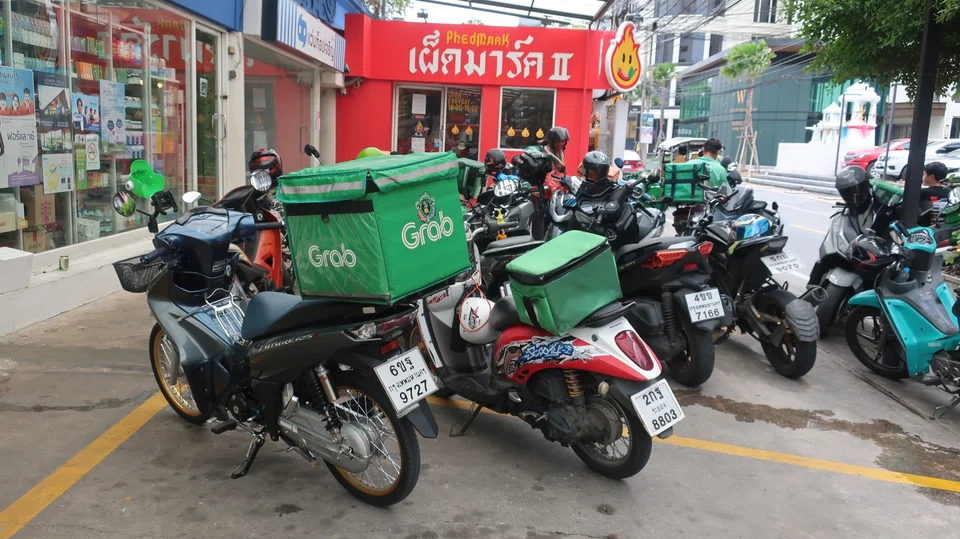
Drivers on motorcycles, sporting uniforms and delivery boxes with all sorts of company logos, were one of the few signs of economic activity during the lockdown for much of 2020.
Competition was fierce, and Robinhood, which launched in late 2020 with the unique business model of not charging gross profit fees to restaurants, quickly joined the fray.
In July 2021, Gojek sold its share in GET Food to Malaysia’s AirAsia Group, which announced big plans of venturing into the food delivery business, but has since gone quiet.
Singapore-owned Grab (Thailand) is currently the only profitable food delivery platform in Thailand, although analysts say this is likely due to its taxi service rather than the food delivery arm.
In 2023, Grab (Thailand) achieved a profit of around 1.3 billion baht, up 126 per cent from 576 million baht in 2022, while revenue rose 4 per cent to 15.6 billion baht.
According to data provider Creden.co, foodpanda’s losses narrowed to 596 million baht in 2023 from 3.6 billion baht the previous year, while Robinhood’s losses widened from 1.99 billion baht in 2022 to 2.16 billion baht in 2023.
Line Man Wongnai, meanwhile, has significantly cut its losses, from 3.7 billion baht in 2022 to 407 million baht last year, while revenue grew 4.2 per cent to 17.5 billion baht, according to DBD Data Warehouse.
Wongnai started out as a restaurant advisory application in 2010, which in 2016 began partnering Line Man, the food delivery app of the Line Thailand app.
In 2020, Line Man merged with Wongnai after receiving a US$110 million investment from BRV Capital Management. The merger raised an additional US$265 million in Series B funding, led by Singapore’s GIC and Line, in 2022.
Last year, Line Man Wongnai acquired Line’s shares in Rabbit Line Pay, a prominent digital wallet.
Line Man claims to have 500,000 restaurants on its platform with some 10 million users, covering all 76 provinces in Thailand with a fleet of 100,000 motorcycles.
While the pandemic helped Line Man and other food delivery platforms to take off, Yod still sees growth for the service in the post-Covid era.
“Food delivery has become part of people’s lifestyles,” said Yod. “We are actually seeing a growing trend this year.” These days, whenever a new restaurant opens in Thailand, nearly 95 per cent of them will offer a food delivery option, he added.
Chalee Kadar, an entrepreneur who has opened four restaurants since the reopening from the pandemic, said: “At the end of the day, food delivery is not too bad a deal. Rather than having to open another restaurant to get another 60 seats, if we can have 60 deliveries being done by food delivery services, why not?”
All but one of his four restaurants have a food delivery service, the exception being Wana Yook, a fine dining establishment.
“We couldn’t do food delivery at Wana Yook because it is fine dining with a 10-course menu. When you are selling an experience, it is really difficult to do deliveries,” he said.






