



Thailand’s pitching US$28 billion land bridge to the world, but foreign investors not ready to bite
The absence of a full-scale feasibility study, a lack of transparency, and uncertainty over the project’s profitability are some key concerns, say experts

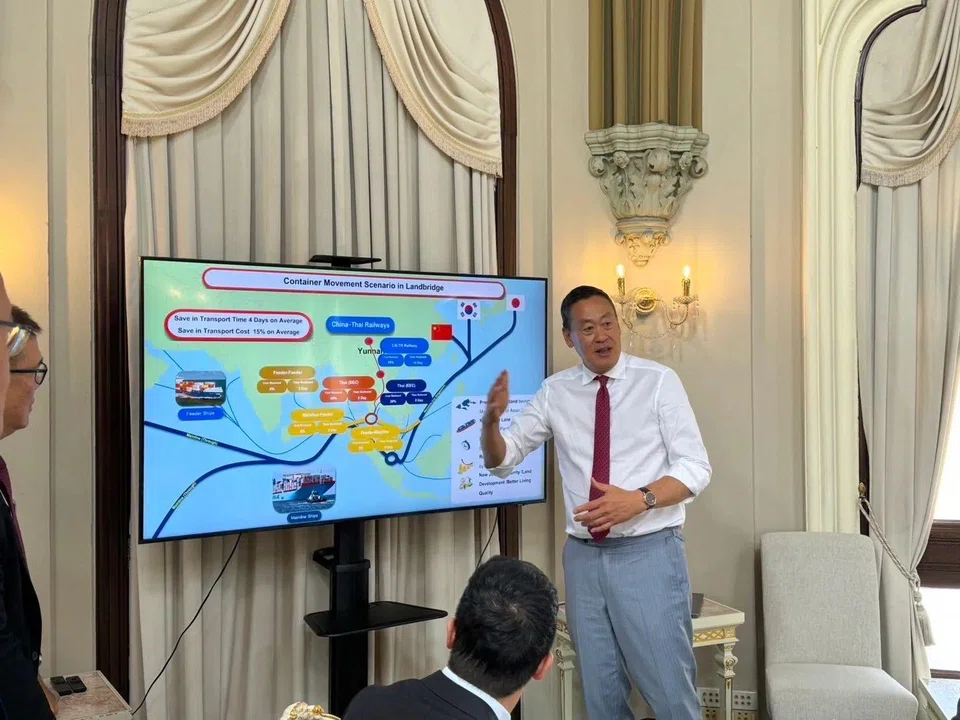
IN THE roughly five months or so since he took office, Thai Prime Minister Srettha Thavisin has wasted little time in traversing the globe with a multibillion-dollar sales pitch.
The former property tycoon has flown to the US and China as well as to different parts of Europe and the Middle East, to drum up interest in the age-old proposal of a land bridge designed to open up a new trade route between the Pacific and Indian Oceans.
But even as the 61-year-old dangles the carrots of job creation and economic growth, there has been little, if any, firm interest from public and private investors in the massive US$28 billion project so far.
Observers cited the absence of a proper feasibility study, a lack of transparency, and uncertainty over the project’s profitability as some of the main reasons investors have shown lukewarm interest.
Last December, Thailand’s Transport Minister Suriya Juangroongruangkit gave some details about a planned international bidding process for the land bridge.
He said a 50-year concession will be granted to the winning consortium that could comprise shippers, logistics operators, port managers, property developers and industrial investors. The project could take as little as 24 years to break even, he said.
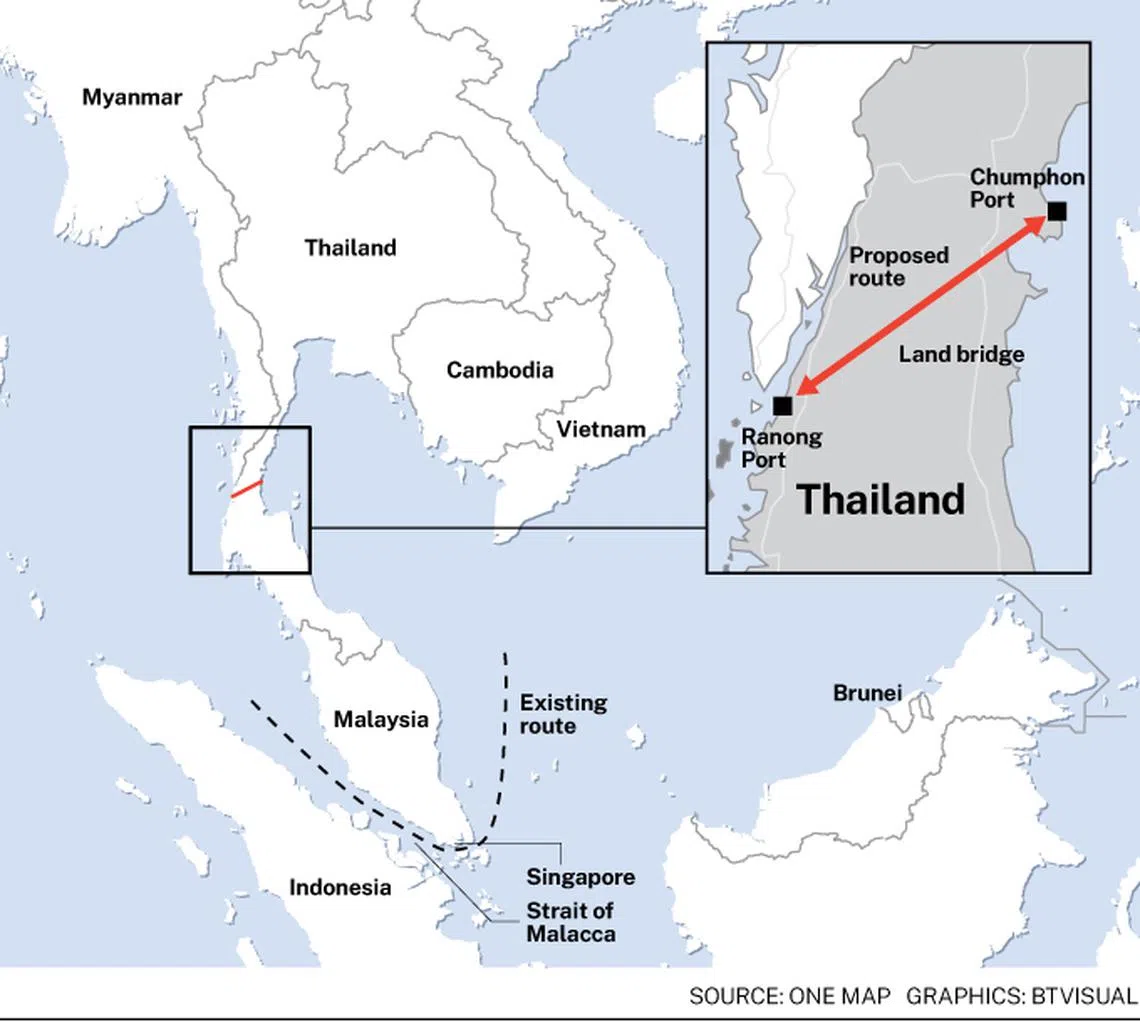
If brought to fruition, the ambitious project will see the construction of deep-sea ports in Chumphon in the Gulf of Thailand and Ranong by the Andaman Sea, connected by a rail and highway network.
The proposed 100 km land bridge will cut across the narrowest part of the Malay Peninsula, or the Kra Isthmus, effectively allowing ships to bypass the Strait of Malacca, where about a quarter of the world’s traded goods currently pass through.
It has been reported that using the land bridge can cut travel time by about five days, compared to sailing through the narrow sea lane between Singapore and Malaysia.
Prospective investors
In late-2023, Srettha pitched the project to investors in China, Japan, Saudi Arabia and the US.
His audience included representatives from Japan’s MUFG Bank, China Harbour Engineering, China Railway Rolling Stock Corp, and the manager of Saudi Arabia’s Public Investment Fund, according to a report by Thai news website The Nation.
When Srettha was in Switzerland for the World Economic Forum in January this year, he pitched the project to Emirati logistics giant DP World, Swiss market-expansion services provider DKSH and Indian ports-to-power conglomerate Adani Group.
The political neophyte also regularly updates his 365,000 followers on X, the platform formerly known as Twitter.
DP World has a 34.5 per cent stake in Laem Chabang International Terminal, which operates two container terminals at Thailand’s busiest port. The Laem Chabang Port is ranked among the world’s top 20 busiest ports.
Back in 2008, DP World’s parent company, Dubai World, awarded the Thai government 200 million baht (S$7.5 million) to conduct a feasibility study on a bridge linking a port on the coast of the Andaman Sea to the Gulf of Thailand, one of Srettha’s advisers was quoted as saying.
The prime minister also said that DP World would send representatives to Thailand for further discussions and location surveys related to the land bridge.
Earlier this month, Srettha posted on X that he had spoken with the Beijing-headquartered Asian Infrastructure Investment Bank on infrastructure investment in Thailand. He wrote that the bank was willing to finance Thailand’s mega-projects, such as the land bridge.
Bursting the bubble
Although Srettha is adamant that the land bridge has attracted strong interest from investors, experts maintain that it is unlikely that foreign investors will commit – at least, for now.
Termsak Chalermpalanupap, a visiting senior fellow and coordinator of the Thailand Studies Programme at the Iseas – Yusof Ishak Institute, believes it is “premature (for Thailand) to go for any international bidding for any operations concessions”.
“Thailand has not done any actual full-scale feasibility study,” he cautioned. “All it has is some preliminary study by a group of consultants hired by the Ministry of Transport.”
Ruth Banomyong, chairman of the Advisory Board to the Thai Minister of Commerce, also called out this initial study for a lack of transparency in methodology, raising that its forecast scenarios are based on assumptions that the Thai private and shipping sectors disagree with.
Local shipping lines and the private sector are reluctant to believe that shippers will choose to use the proposed land bridge to transport more than 20 million twenty-foot equivalent units of containers just to save a few days, when the handling cost involved in the transfer of containers is now double, he explained.
“When a port is developed, it is important to discuss with shipping lines first as they are the main customers,” said Prof Ruth. “Exporters and importers are indirect customers of ports, so it is a bit of a non-starter when shipping lines are reluctant or not really excited about this project.”
There are also questions on how the land bridge project will be able to make a profit, given its extremely hefty price tag.
Amid the scepticism, fears abound that bids from foreign state-linked entities may be made to gain strategic or political advantages rather than to profit, said Gregory Poling, a senior fellow and director of the Southeast Asia Program and Asia Maritime Transparency Initiative at the Center for Strategic and International Studies.
“The Thai government has a difficult task convincing the private sector that a route requiring more vessels (one on each side), more complicated logistics, and additional time for loading and unloading could compete with simply sailing through the Strait of Malacca or other passages,” he said.
“I don’t know who will bid on the project, if anyone (will at all).”
TRENDING NOW

Once staunchly pro-China, Malaysian Chinese businesses are now distancing themselves from Beijing

Looking beyond looming CEO succession, should UOB potentially pursue a transformative merger?

Could stablecoins be the future of money?

Grab CEO’s wife Chloe Tong on life with Anthony Tan and finding her purpose

