



Thailand’s proposed 100 km land bridge poses little threat to Singapore, Malaysia ports: analysts
Singapore could benefit from the project as an investor by selling some of its excess crane equipment for Thailand, analysts say

Goh Ruoxue
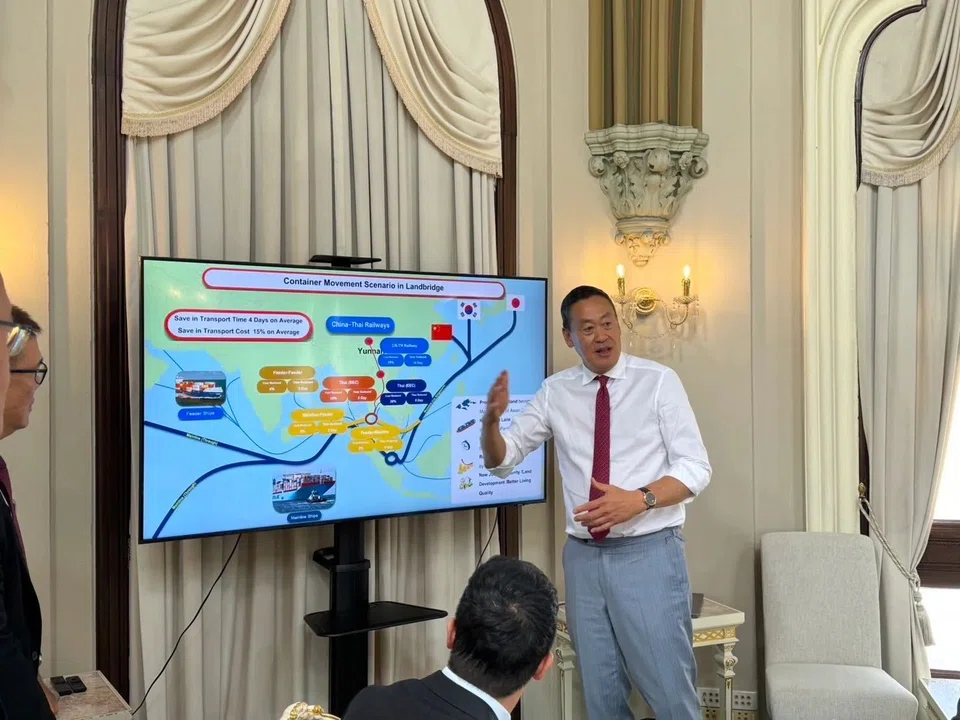
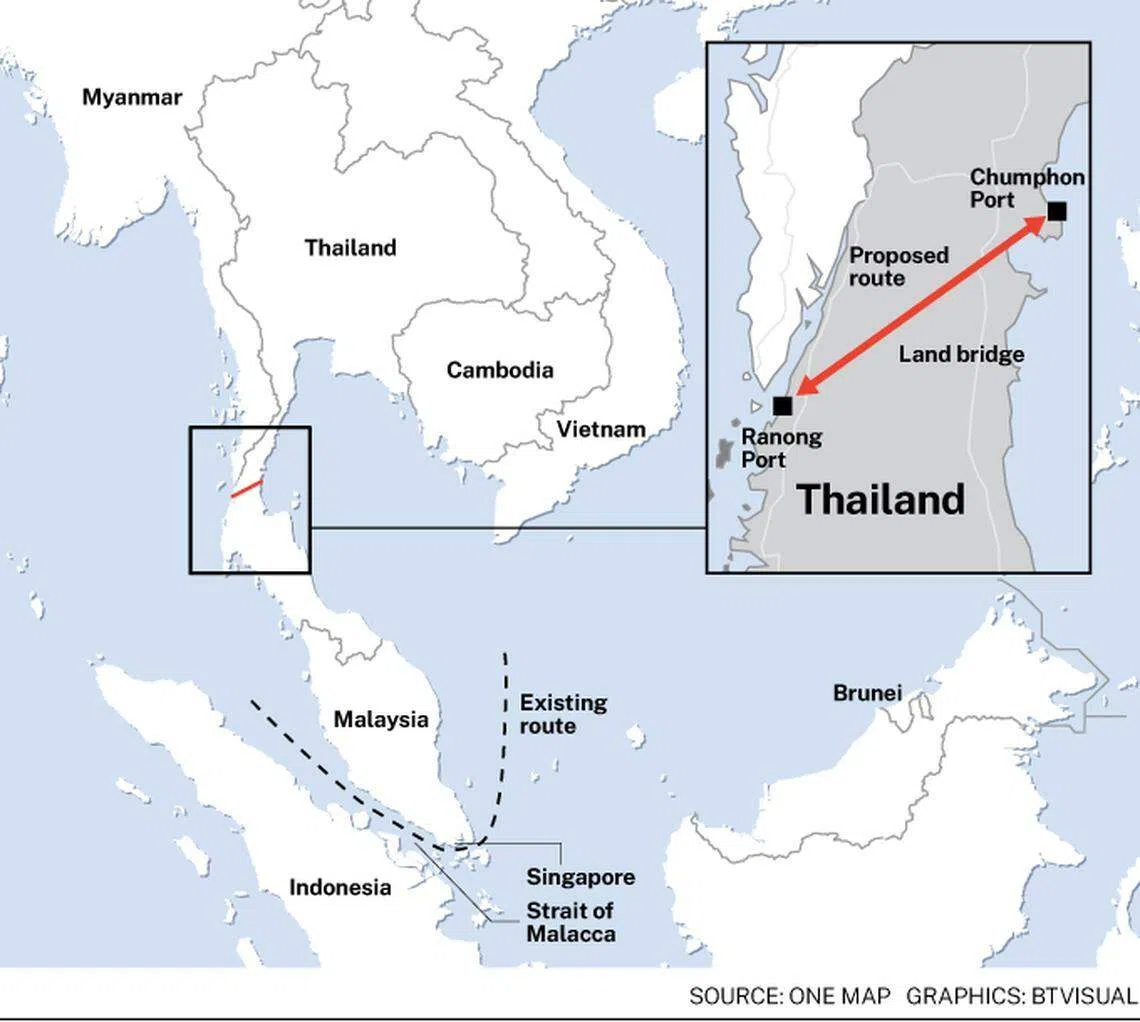
THAILAND has again resurrected a proposal to build a 100 km land bridge that, if eventually built, will offer an alternative trade route that effectively allows ships to bypass Singapore and Malaysia.
But should the project come to fruition, experts whom The Business Times spoke to said this does not necessarily spell trouble for the region’s two major international seaports.
The proposed bridge cuts across the narrowest part of the Malay Peninsula, or the Kra Isthmus, connecting the Pacific and Indian oceans.
This means ships will be able to bypass the Strait of Malacca, where about a quarter of the world’s traded goods pass through. This narrow sea lane between Singapore and Malaysia is a hotbed of piracy, congestion, collisions, as well as environmental and territorial disputes.
“The land bridge will be an additional important route to support transportation and an important option for resolving the problems of the Malacca Strait,” Thai Prime Minister Srettha Thavisin told potential investors in San Francisco last month. “This will be a cheaper, faster and safer route.”
Costs versus benefits
Fielding questions in Parliament on Nov 7 about Thailand’s proposal, Singapore’s Acting Transport Minister Chee Hong Tat acknowledged that a land bridge could save vessels time but noted that it would come at a price.
“The exact time saving will depend on many factors… (which) would likely incur additional expenses for shipping companies, so they need to consider the overall costs versus benefits,” he said.
As for Malaysia, Prime Minister Anwar Ibrahim said recently that he was confident his country would benefit from Thailand’s land bridge.
He told reporters on Nov 27, after he returned from a trip to Thailand, that Srettha had assured him of Malaysia’s involvement in the project, particularly in the northern peninsula.
Mark Cogan, associate professor of peace and conflict studies at Japan’s Kansai Gaidai University, said that Thailand will be playing catch-up with Singapore and Malaysia, at least for a few more decades.
The first phase of the land bridge is expected to be completed in 2030 and would see container shipment capacity of 10 million twenty-foot equivalent unit (MTEU). The full capacity of 40 MTEU could be reached in 2039.
The Port of Singapore handled 37.5 MTEU in 2021. Tuas Port, which opened in September 2022, will have a handling capacity of 65 MTEU when it is completed in the 2040s.
Likewise, Malaysia is building a RM28 billion (S$8 billion) port to boost the handling capacity at the main shipping hub of Port Klang.
“The development of the ports are almost as important as the land bridge itself. The capacity has to be higher than the potential demand or ships would default to the typical route through the Strait of Malacca,” said Prof Cogan.
He added: “(Thailand’s land bridge) really isn’t that much of a threat unless the two ports on either side of the Isthmus are not only operating at capacity, but there are (also) no bottlenecks on the massive land superhighway between them.”
Termsak Chalermpalanupap, a visiting senior fellow and acting coordinator of the Thailand Studies Programme at the Iseas-Yusof Ishak Institute, thinks that Singapore’s ports are less likely to see a potential fallout than Malaysia’s.
Not many international shippers would want to go through the trouble of unloading and reloading their shipments when using the land bridge, said Dr Termsak, who had previously worked at the Asean Secretariat for 19 years.
“It’s still much quicker and more cost-effective to let container ships carry goods and sail on in one go, instead of resorting to using the multi-modal shipment,” he added.
Dr Termsak felt that Singapore could even benefit from the project as an investor by selling some of its excess crane equipment for Thailand to use in the construction of its deep sea ports.
Walking the diplomatic tightrope
So far, Srettha has pitched the ambitious project to investors in China, the US and Saudi Arabia. The Germans reportedly have also shown some interest.
Analysts said that what’s at stake is Thailand’s geopolitical balancing act among the world’s superpowers.
Said Prof Cogan: “If Thailand chooses to accept Chinese investment and, to a certain degree, greater Chinese leverage over Thailand because of its incurred debt, other South-east Asian countries with disagreements with China over the South China Sea, fishing, or maritime boundaries will be in an uncomfortable position.”
He added that it is unlikely that European Union countries would want to invest, given their stricter adherence to human rights norms and demand for greater transparency.
“In short, the land bridge would make Thailand’s current balancing act much more difficult, amplifying yet another reason why this project is not worth the risk,” he said.
Shaky prospects
While Srettha continues to sell the idea wherever he goes, not everyone is convinced.
Experts noted that such major projects resurface every time the Thai economy is in the doldrums, in a bid to attract foreign investments, or when political parties are looking for a boost.
Ian Storey, a senior fellow at the Iseas-Yusof Ishak Institute, said: “It’s seen as a magic bullet to revitalise the economy by attracting investment, creating jobs and generating toll (revenue). In reality, it’s economically unviable. The (land bridge) was first suggested 300 years ago. If it hasn’t been built by now, it never will.”
TRENDING NOW

Government to bring forward raising of retirement age, give employers more financial support to create flexi-load jobs

If Europe goes to war, the fallout will be felt in East Asia

Indonesia stocks suffer worst plunge in nearly 30 years as MSCI proposes standalone status

Vietnam’s northern provinces, not Hanoi or Ho Chi Minh City, are powering near 10% GDP growth

