Thailand's Sri Trang Gloves ready for the next pandemic
Bangkok
WHEN many companies suffered during the Covid-19 pandemic, Sri Trang Gloves - the largest manufacturer of medical rubber gloves in Thailand - was doing a roaring trade.
The glove producer, which has a secondary listing on the mainboard of the Singapore Exchange (SGX) - reported net profit of 23.7 billion baht (S$952.4 million) in 2021.
This was a 64.4 per cent increase compared to the previous year, on the back of a 55.6 per cent year-on-year surge in revenue.
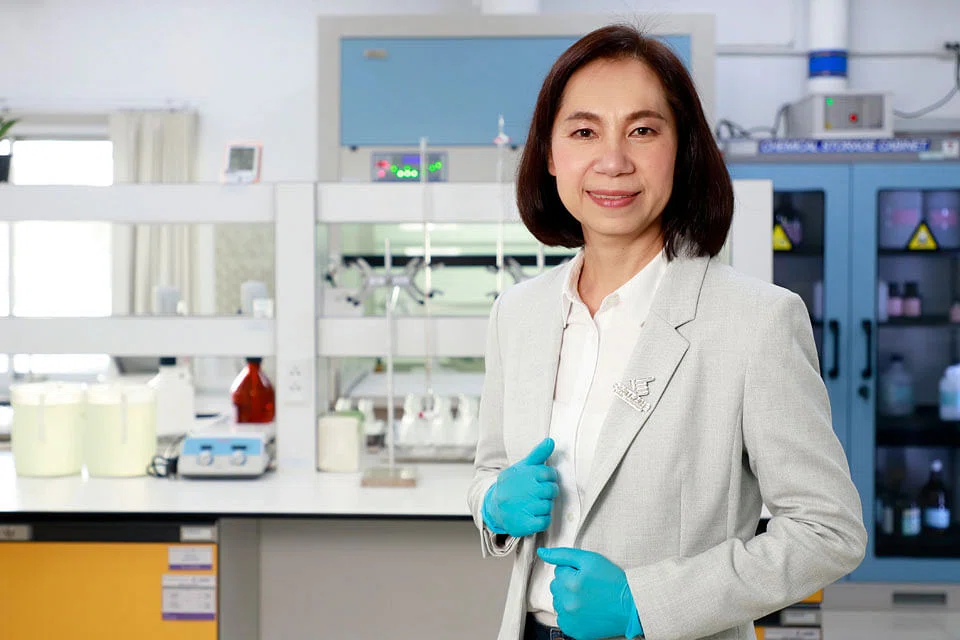
"Last year was a super cycle for the rubber glove business but I think we cannot expect this cycle to last for a long time," said chief executive officer Jarinya Jirojkul.
"The demand is still growing but the profit margin is normalised," she told The Business Times in a recent interview.
She noted that profit margins in 2022 will be hit by rising fuel and transporation costs, as well as the soaring price of rubber and latex - the main raw materials in the company's glove production.
For Sri Trang Gloves, which was established over 30 years ago in 1989, Covid-19 was not the first pandemic it had to endure, and nor will it be the last.
"We have survived the HIV/AIDS pandemic in the 1990s, SARS in 2002, H1N1 in 2009, and Covid-19 today," said Jarinya.
"I think we have learned a lot about running this business through these many pandemics and the changing business environment. After every pandemic, we became bigger and stronger," she added.
Sri Trang Gloves got its primary listing on the Stock Exchange of Thailand (SET) in July 2020 - a few months after the pandemic hit - and managed to raise 14 billion baht. This was followed by a secondary listing on the SGX in May 2021.
This secondary listing was partly to access another pool of capital market investors, but also to raise the company's visibility on the international stage, said Jarinya.
"Many of our peers in the rubber glove business are listed in Singapore, so we can compare the global value of our company with our peers," she added.
The company's current market capitalisation is now about 130 billion baht.
With its earnings from the initial public offering on the SET, and the company's profits in 2020 and 2021, Sri Trang Gloves has a target to produce 48 billion gloves by end-2022 and 80 billion by 2024. This is up from 40.3 billion in 2021.
Jarinya said the company will not need to seek new financing until after 2024, when it hopes to increase the annual production capacity to 100 billion pieces.
Sri Trang Gloves currently has 13 factories operating in Thailand's 4 southern provinces of Songkhla, Surat Thani, Trang and Chumporn, all of which are close to the country's rubber plantation belt and the latex producing factories of Sri Trang Agro-Industry (STA), the parent company of Sri Trang Gloves.
STA, which is also listed on SET and SGX, is Thailand's leading producer of rubber sheets and rubber latex with exports of 1.3 million tonnes last year, when its net profit was 15.9 billion baht, a jump of 13.4 per cent year-on-year.
With its rubber plantations, rubber latex making factories and downstream operations at Sri Trang Gloves, the STA Group is the largest integrated rubber operation in Thailand and one of the biggest in the world.
Sri Trang Gloves has an office in Singapore to handle international distribution, as well as a research and development centre to look into innovative products.
The company has also set up distribution offices in Vietnam and Indonesia, which it ranks among its markets with the greatest growth potential, along with the Philippines.
Sri Trang Gloves hopes to grow its footprint in these Asean countries, as more people use gloves beyond just medical reasons, as has become the norm in a post-Covid environment.
"We can see demand growing from non-medical markets, such as restaurants, hotels and shops. Nowadays you can see people everywhere wearing gloves," said Jarinya.
Sri Trang Gloves faces stiff competition from rubber glove manufacturers in Malaysia, which claim about 65 per cent of the global market, followed by China (20 per cent), Thailand (10 per cent) and other countries (5 per cent).
The company hopes to outshine its peers through its ESG (environmental, social and governance) best practices.
For example, it claims to have achieved 100 per cent use of renewable energy, with 95 per cent derived from biomass (using old rubber trees to produce energy for production facilities) and 5 per cent from solar to power its offices.
On the labour front, it has adopted a policy of only hiring Thai nationals for its new factories after many were laid off during the pandemic, and following "social compliance" standards for its existing migrant workers, who account for 29 per cent of the labour force.
Sri Trang Gloves is also pursuing new product lines, such as high-quality surgical gloves and "rubber dams" - protective sheets used in dentistry - which were formerly the domain of its Malaysian competitors, said Jarinya.