Asean Business logo
SPONSORED BYUOB logo
CRAZY RICH ASIANS

Thailand’s wealthy Chearavanont siblings aim to take CP Group conglomerate to new heights
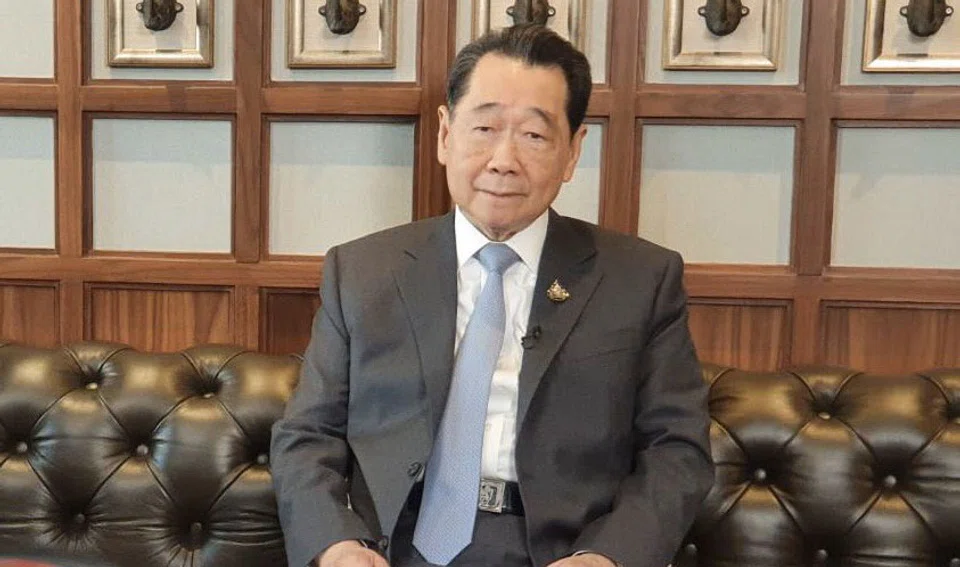
    • CP Group senior chairman Dhanin Chearavanont set a long term direction three decades ago when he pinpointed retail and telecoms as growth sectors of the future.
    • CP Group senior chairman Dhanin Chearavanont set a long term direction three decades ago when he pinpointed retail and telecoms as growth sectors of the future. PHOTO: CP GROUP
    Published Sat, Jan 27, 2024 · 05:00 AM

    [BANGKOK] The Chearavanont brothers of Thailand’s Charoen Pokphand (CP) group had a memorable year in 2023 as they completed a merger between CP’s telecoms unit True and Norway’s Telenor-owned Total Access Communications (DTAC).

    That mega-deal played some part in beefing up their combined wealth to a record US$34 billion – an amount nearly 7 per cent of Thailand’s gross domestic product – and placing them firmly at the top of Forbes’ annual list of the richest people in Thailand.

    The four Chearavanont brothers – Dhanin, Sumet, Jaran and the family of their late sibling, Montri – saw their combined wealth grow by US$7.5 billion from the 2022 ranking.


    In a separate Forbes ranking of the world’s top billionaires, the 84-year-old Dhanin – who was CP’s chairman and CEO for 48 years until he stepped down in 2017, and is its senior chairman today – placed 116th with an estimated net worth of US$14.9 billion.

    The Chearavanont brothers are not unique in Thailand’s top-heavy economy, where the richest 10 per cent of the population held half the country’s total income and wealth in 2021. That year, Thailand’s Gini coefficient – a measure of income equality – was 43.3 per cent, making it the 13th most unequal of 63 countries surveyed by the World Bank.

    Even the Covid-19 pandemic, which devastated Thailand’s tourism-reliant economy and led to flaccid GDP growth of just 1.1 per cent in 2021 and 2.6 per cent in 2022 – did little to impoverish the Chearavanont clan.

    In fact, in the early stages of the pandemic, the group invested US$3 million in a factory just outside Bangkok that made 100,000 face masks a day. It also provided free food delivery to dozens of hospitals in Thailand.

    A century of history

    CP Group is one of the largest conglomerates in Thailand with some US$65 billion in revenue. It is one of the world’s largest producers of animal feed and livestock, and is also active in other areas such as e-commerce, insurance, healthcare, real estate and automotive.

    The company’s Thailand roots date back to 1921 when the siblings’ father Chia Ek Chor, an immigrant from China, and his brother opened a shop that sold seeds imported from their family’s seed business in China to Thai farmers.

    As CP Group grew to be the largest agro-conglomerate in Thailand with vast holdings in feed meal, chicken, shrimp and pork processing, Dhanin set a long-term direction for the group three decades ago when he pinpointed retail and telecoms as growth sectors of the future.

    In October 2022, the regulators gave the go-ahead for True and DTAC – which had a combined market capitalisation of 294 billion baht (S$11 billion) – to merge.

    The deal, completed in March last year, left Thailand with a duopoly in the country’s vital telecoms and mobile phone sector that is now dominated by True (the name of the merged entity) and Advance Information Service. The True/DTAC merger resulted in True having an expanded market of 55 million mobile subscribers.

    Among the many major acquisitions by CP Group over the years was one in 2013 in which the conglomerate snapped up Thai retailer Siam Makro for US$6.6 billion.

    In March 2020, CP Group purchased British grocer Tesco’s hypermarket chains in Thailand and Malaysia for US$10.6 billion.

    Dominant players

    Analysts in Thailand have expressed concerns about CP Group’s immense hold over Thailand’s emerging digital economy.

    “Its dominant control in retail, and now telecoms, allows the group to have access to the golden egg of business – access gateways to customers in both the brick-and-mortar segment and the digital economy,” said Pavida Pananond, a professor of international business at Thammasat University.

    “Any digital business that needs to reach their customers via mobile phones or the Internet will need to go through the networks controlled by either True or AIS,” she added.

    It hasn’t been all smooth-sailing – financially, at least – for True since the merger, however. The company said it expects to make a loss of 7.44 billion baht due to the high costs of the merger integration, and a further loss of 4.37 billion baht this year.

    Prasit Sujiravorakul, a telecom analyst at Bualuang Securities, said the key business strategy for both True and AIS in 2024 will be to churn out the loss-making lower-end customers and place more attention on the profit-making high-end segment.

    “Because Thailand is now a duopoly market for the mobile phone segment, it will be easier for the two players to manage their pricing strategies,” he noted.

    This is the third of a five-part series in BT on the wealthiest people in South-east Asia