Trump, Indonesia’s Prabowo finalise trade deal slashing tariff rate to 19%
Agreement eliminates higher duties on some of the Asian country’s exports, including palm oil, spices and pharmaceuticals
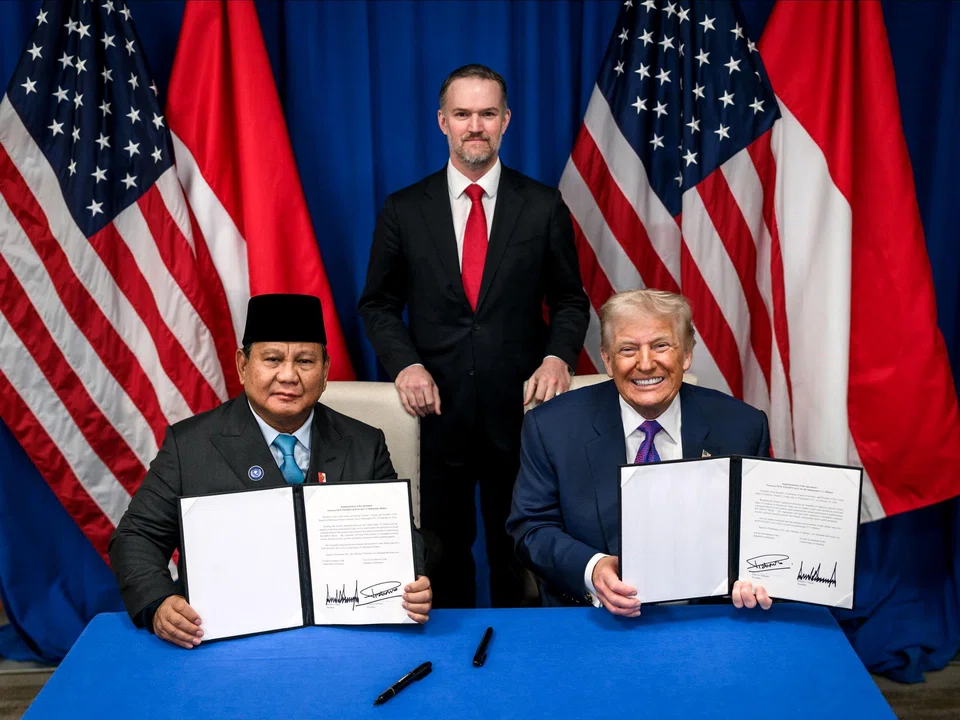
[JAKARTA] US President Donald Trump and Indonesian President Prabowo Subianto finalised a trade agreement on Thursday (Feb 19), ending months of uncertainty with an accord that is expected to lower US tariffs and see Jakarta facilitate the purchase of an estimated US$33 billion in American goods.
The leaders “confirmed their strong commitment to implementing” the deal, and instructed their teams to “take further steps for a new golden age of the ever-growing US-Indonesian alliance” as they met on the sidelines of the Board of Peace’s inaugural meeting in Washington, according to a White House statement.
Under the deal, Indonesia – a Group of 20 nation that counts the US as its second-biggest export destination – will avoid the threatened 32 per cent tariffs and instead face a 19 per cent rate for most goods.
The agreement also eliminates heightened duties on some of Indonesia’s exports, including palm oil, spices, and pharmaceuticals. It creates a mechanism for certain textiles and apparel to earn tariff exemptions – boosting a key Indonesian industry.
For the US, the pact aims to expand access to a fast-growing consumer market of more than 280 million people, and bring Indonesian companies to source more from the US.
Indonesia will eliminate levies on more than 99 per cent of US goods and remove non-tariff barriers, while Indonesian businesses are expected to buy more US energy, agricultural products and other goods – steps meant to narrow Indonesia’s roughly US$16 billion trade surplus with the US.
Those deals include the import of US$15 billion in US energy, including US$3.5 billion of liquefied petroleum gas, US$4.5 billion of crude oil and US$7 billion of refined petrol.
Indonesia is also expected to procure US$13.5 billion in commercial aircraft, in what should be a boon for Boeing. And Jakarta has agreed to import US$4.5 billion in US agricultural commodities, including cotton, soybeans, wheat, beef, rice and corn, as part of the agreement.
Indonesia will also reform its pre-shipment inspection processes to address concerns raised by US exporters, and eliminate tariffs and fees on digital services.
Indonesia has said it will “endeavour to facilitate” US$10 billion of outbound direct investment to the US, including engineering and construction projects as well as energy initiatives, including the development of blue ammonia.
“President Trump is unlocking Indonesia’s market of over 285 million people to create commercially meaningful opportunities for American farmers and manufacturers,” said US Trade Representative Jamieson Greer.
“This landmark agreement breaks down trade barriers while advancing the economic and national security interests of the American people.”
Beyond tariffs, the agreement touches critical minerals, as the US seeks to reduce supply chain dependence on China and secure inputs for electric vehicles, defence and manufacturing.
Indonesia said that it would allow US companies to extract critical minerals on terms similar to those for domestic investors, while Washington promised to consider offering investment financing through the Export-Import Bank and US International Development Finance Corporation.
The nations reached a framework last July, under which Indonesia agreed to eliminate tariffs on more than 99 per cent of American goods and remove non-tariff barriers, while the US slashed duties on Indonesian products to 19 per cent from the threatened 32 per cent rate.
The deal helps preserve trade relations between the two countries, whose annual bilateral trade totals more than US$40 billion.
For the US, the agreement lowers barriers to selling into the world’s fourth-most populous nation, and could give American companies a more level playing field in a market that is trying to attract manufacturing and other investment from firms considering diversifying China-focused supply chains.
Trump said in July that he had reached a deal with Indonesia, but a signing stalled in late 2025, with US officials saying Indonesia was back-pedalling on some commitments. Indonesian officials attributed the delays to the US government shutdown and said talks were proceeding smoothly.
For Indonesia, the deal also comes as the country is facing market headwinds after MSCI warned about the stock market’s attractiveness and Moody’s lowered its sovereign credit outlook, citing policy uncertainty and weak governance under Prabowo’s administration.
Questions about a possible government takeover of one of the country’s largest gold mines have added to investor concerns.
Lower duties could help support foreign-exchange inflows at a time when the rupiah is trading near an all-time low against the US dollar and economic growth remains tepid.
The signing comes during Prabowo’s third visit to Washington since assuming power in October 2024.
Prabowo also attended the Board of Peace gathering, a body organised to help rebuild and stabilise Gaza. Indonesia, the world’s largest Muslim-majority nation, has said that it is preparing up to 8,000 troops for a possible peacekeeping mission to the territory. BLOOMBERG
Decoding Asia newsletter: your guide to navigating Asia in a new global order. Sign up here to get Decoding Asia newsletter. Delivered to your inbox. Free.
Share with us your feedback on BT's products and services