Asean Business logo
SPONSORED BYUOB logo

Trump tariffs on North America hint at first stirrings of what’s to hit South-east Asia

Notwithstanding short-term gains, the export-dependent region is likely to face an economic blow from a broader trade war, analysts say

Summarise
Goh Ruoxue
Published Thu, Feb 27, 2025 · 05:00 AM
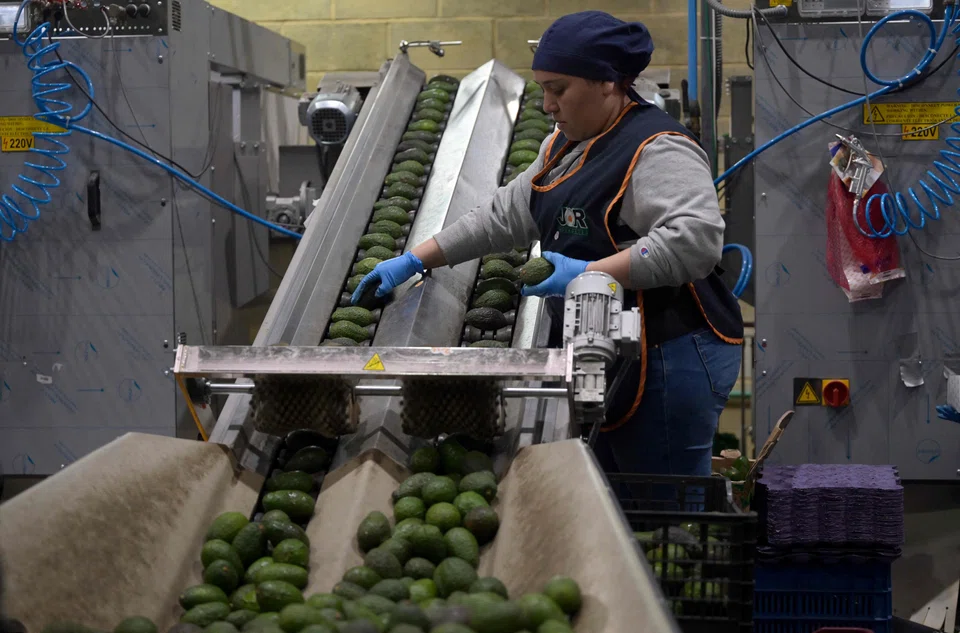
    • A worker selects avocados at a packing plant in Mexico. End-users in the automotive, agri-commodities, energy and packaged foods sectors would be hardest hit by heavier price tags, says Boston Consulting Group.
    • A worker selects avocados at a packing plant in Mexico. End-users in the automotive, agri-commodities, energy and packaged foods sectors would be hardest hit by heavier price tags, says Boston Consulting Group. PHOTO: AFP

    VIETNAM, Thailand and Malaysia could soon feel the brunt of escalating trade tensions as US President Donald Trump’s tariff moves on its two largest trading partners mark the opening act of a gathering storm.

    While the North American levies in themselves will not have a dramatic impact on South-east Asia directly, pundits cautioned against secondary shockwaves percolating through the US and warned of disrupted trade flows dampening regional growth.

    These tariffs are but the first chapter in a broader “America First” policy, said Aparna Bharadwaj, global leader for the global advantage practice at Boston Consulting Group (BCG).


    She described Trump’s invoking of the International Emergency Economic Powers Act to impose tariffs as “an inflection point where (governments) embark on economic nationalism to intervene in commercial transactions on the basis of prioritising national interests”.

    Such a broader move towards protectionism and geopolitical fragmentation raises urgent questions, Bharadwaj told The Business Times.

    “If Canada and Mexico retaliate, as they’ve pledged, we could see rising costs and supply chain uncertainties that indirectly pressure South-east Asian exporters and alter global supply chain patterns,” explained the managing director and partner.

    Peanuts in the trade jar 

    Asean, Canada and Mexico are small-time trading partners.

    Although trade between the bloc and each of the two North American markets has grown at least 70 per cent last year from that in 2018, total exports to Canada and Mexico represent only around 2 per cent of Asean’s gross domestic product.

    “This is rather small, so there should be little direct negative effects on Asean,” noted Bank J Safra Sarasin’s emerging markets economist Mali Chivakul, who shared the figures.

    But she pointed out that Asean member nations would likely benefit over time from US importers shifting away from Mexican producers – if the South-east Asian countries can escape American tariffs.

    Compared with some US$350 billion worth of exports sent to the US last year, Asean exported US$47 billion worth of goods to Mexico and US$24 billion to Canada in 2024, noted the economist.

    Vietnam, Malaysia and Thailand accounted for most of the exports to Mexico, of which a sizeable portion was made up of electrical machinery and electronics, Chivakul added.

    Winning the battle…

    Mexico and Canada have been working with Asean to increase trade integration and cross-regional market access for goods, said South-east Asia lead analyst Harrison Cheng of Control Risks.

    Angela Mancini, partner at the global risk consultancy, noted: “Both Mexico and Canada are now re-evaluating the ultimate reliability of their trade relations with the US in the longer term, and we expect to see them pursue expanded relations with Asia, Europe and others.”

    Take, for instance, the Comprehensive and Progressive Agreement for Trans-Pacific Partnership (CPTPP).

    Signed in 2018, the 11-member free trade agreement – among Australia, Brunei, Canada, Chile, Japan, Malaysia, Mexico, New Zealand, Peru, Singapore and Vietnam – sees the elimination of 99 per cent of tariff lines once fully implemented.

    Though the CPTPP is a spectre of what could have been the world’s largest free trade deal – until Trump in 2017 pulled the US out of the Trans-Pacific Partnership – it is by no means insignificant.

    The grouping now accounts for about 15 per cent of global GDP with the UK’s accession last year.

    “Facing increased US protectionism, it is plausible that Mexico and Canada might ramp up trade with CPTPP member states in South-east Asia to compensate for reduced exports to the US,” noted Cheng.

    Cheng added that increased trade with North America would be welcomed by South-east Asian economies as they seek to diversify their trade relations in the light of the risks of overdependence on the US market.

    Moreover, fallout from the US-China trade war has propelled South-east Asia and Mexico to be among chief beneficiaries as companies relocate production facilities from China, continued the analyst.

    “Trump’s targeting of Mexico changes that calculus, and South-east Asian countries would likely welcome increased investment,” he noted.

    “Some South-east Asian countries may even view the tariffs on Mexico as providing a boost for the competitiveness of their own exports to the US, especially in goods like auto parts, computers, electronics and medical equipment.”

    …But losing the war 

    There is a catch.

    Notwithstanding the short-term gains, export-dependent South-east Asia is likely to experience a negative economic impact from a broader trade war, considering further escalation by the US and retaliatory tariffs, said Cheng.

    And the repercussions will trickle down to consumers.

    End-users in the automotive, agri-commodities, energy and packaged foods sectors in particular would be hardest hit by heavier price tags, said BCG’s Bharadwaj.

    “Company profits could be impacted significantly, depending on their supply footprint. No sector would be fully spared,” she noted.

    BCG modelling – based on sourcing footprints, tariff rates and import-demand elasticities – revealed that a medtech manufacturer with 50 per cent of its US sales derived from locally sourced products and the other half imported from Mexico and China could see up to a 4.2 percentage point drop in earnings before interest, taxes and amortisation (Ebita).

    A consumer packaged goods producer that is heavily reliant on imports from Canada, China and Brazil could likewise face Ebita erosion of around 4 per cent, highlighted BCG. As far as Bharadwaj is concerned, economic statecraft is back with a bang.

    “The global order driven by the World Trade Organization is getting supplemented, even replaced, by a complex mosaic of regional, multinational and sector-level free trade agreements,” she explained.

    Tools such as tariffs, investment screening and giga-incentives are among those used by nations to support local businesses and protect home industries deemed vital to national security, said Bharadwaj.

    She cautioned: “There is a domino effect here yet to be fully played out.”