



Trump’s pick of Rubio: trouble ahead for Asean’s economic powerhouse dreams?
Under the China hawk’s leadership, South-east Asia could now be seen as a political chess piece and less of an independent player valued for its economic potential

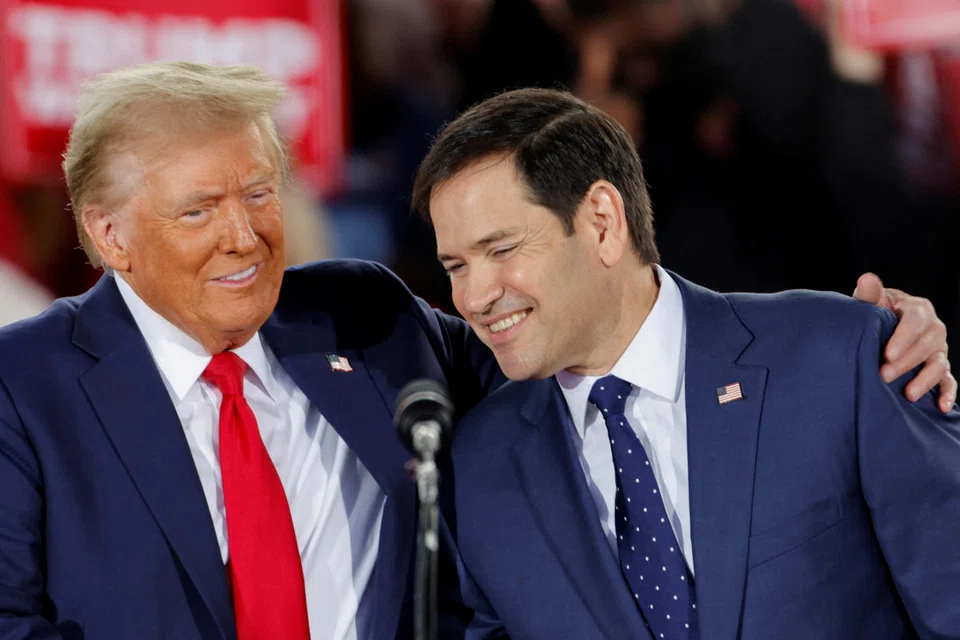
PRESIDENT-ELECT Donald Trump is setting the stage for season two of his White House saga, as he begins assembling his top-shelf picks for the 15 federal agencies that will form his Cabinet.
The world watches intently, as the decisions of the leader of the world’s largest economy send ripples across the globe. For South-east Asia, those ripples carry particularly high stakes.
The Association of Southeast Asian Nations has traditionally been seen as the golden child in the US-China trade war, and a green pasture for global behemoths seeking to diversify their supply chains and shift production away from Trump’s top tariff target.
But Trump’s official nomination on Thursday (Nov 14) of long-time senator Marco Rubio as his secretary of state – a position often regarded as the world’s most influential diplomat – could disrupt the status quo, judging by his past social media posts.
Rubio’s predecessor, Antony Blinken, has traditionally mirrored the attitudes of soi-disant Indo-Pacific-focused Joe Biden, who consistently touts darling South-east Asia as a key pillar of the US’ Indo-Pacific strategy.
On the sidelines of this year’s Asean Summit in October, Blinken told reporters that there exists a “profound understanding” in the US that its future lies in the region. Trade and investment ties between the US and the 10-member economic bloc stand central to its relationship with the Indo-Pacific region, he said.
But Rubio does not appear to think so.
Under the China hawk’s leadership, South-east Asia could now be seen more as a strategic chess piece in the US-China stand-off, and less of a standalone priority or an independent player that is valued for its economic potential and not wooed merely for political leverage.
This is not to say that South-east Asia was never seen by the West as a bargaining chip against the East.
But it would certainly benefit Asean more to be seen as an economic powerhouse and stronghold, rather than a political pawn.
A glance through Rubio’s social media posts reveals that most, if not all, of his public comments on X about South-east Asia are framed in the context of China.
The only commentary he penned about the Philippines – South-east Asia’s fastest-growing economy – regrettably begins with the standfirst: “There is no need for the Philippines to stand against China alone.”
Rubio goes on to reference China, the Chinese Communist Party (CCP), Beijing, communism and the South China Sea 26 more times.
Indonesia – South-east Asia’s largest economy – has also been a subject of mention for the Florida senator. He referenced a post on former president Joko Widodo’s visit to China last July, saying that the CCP “continues to expand its economic and political traps throughout South-east Asia and nations are falling prey to their promises”.
The only other publicly available social post of his on Indonesia is a call for the Muslim-majority nation to “stand up for persecuted Uyghurs and other Muslim minorities in Xinjiang (who are) suffering from horrific atrocities at the hands of the CCP”.
Rubio once praised Singapore’s telecommunications operators on their decision to select Finland’s Nokia and Sweden’s Ericsson to build its 5G networks, but ended on the point that more countries should “pursue these secure alternatives to Chinese state-directed Huawei”.
A more recent post on Singapore in 2022 warns about “CCP propaganda at the Shangri-La Dialogue” that is held annually in the Republic.
Rubio has frequently brought up Cambodia, mostly in the context of what he perceives as a crackdown on human rights and democracy. He has also raised concerns about “Chinese military activity inside the country” and the construction of a naval facility by the CCP on Cambodia’s coast.
“If completed, it would provide the CCP (with) an increased power projection in South-east Asia near the South China Sea and Strait of Malacca. Cambodia should halt construction immediately,” read the comment he posted in November 2022.
The US’ strategy towards South-east Asia is often likened to a three-legged stool held up by defence, economic and diplomatic relations. Taking Rubio’s social media presence into account, it would appear that the defence leg overshadows the others.
That leaves US-Asean relations off keel.
Perhaps the onus is on the 10-member regional alliance to reclaim the spotlight, rather than lamenting why the world’s largest economy is not offering it more attention than it merits.
South-east Asian economies should strike while the iron is hot, enhancing infrastructure, connectivity, labour markets and regulatory frameworks to remain attractive to American investors.
While progress has been made, Asean must do more – evolving from a supply chain sweet spot in the US-China battlefield into a strategic powerhouse prized for its vast economic potential.
TRENDING NOW

Britain’s mansion tax shows the difficulty of targeting wealth

Once staunchly pro-China, Malaysian Chinese businesses are now distancing themselves from Beijing

The only common thing in S-E Asia is that we all eat rice: Cisco’s Asean president

Singapore data centre operator DayOne opts for US IPO at likely US$20 billion valuation

