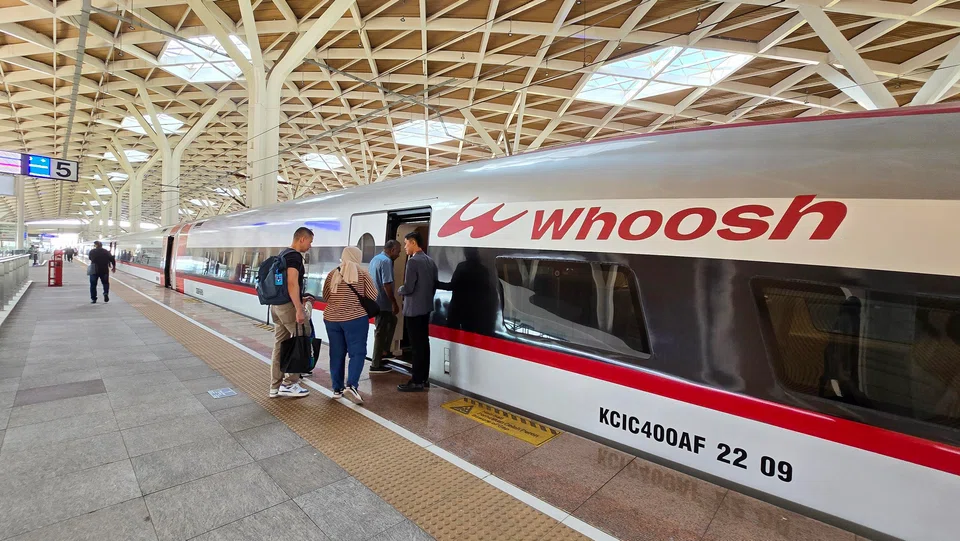
Two-year-old China-funded bullet train is fast becoming a fiscal time bomb for Indonesia
Losses amount to 4.2 trillion rupiah (S$325.8 million) last year and another 1.24 trillion rupiah in the first half of 2025

[JAKARTA] Indonesia’s multibillion-dollar high-speed rail project Whoosh, once celebrated as a symbol of deepening economic ties with China, is mired in debt – turning into a financial time bomb and a big headache for President Prabowo Subianto’s administration.
The project has racked up losses of 4.2 trillion rupiah (S$325.8 million) last year and another 1.24 trillion rupiah in the first half of 2025.
Weak passenger demand and ballooning debt have cast a long shadow over the rail project, raising fears of a growing strain on state coffers and its network of state-owned enterprises.
The project is also shaping up to be a potential stress test for Prabowo, said Zulfikar Rakhmat, director of the China-Indonesia Desk at the Center for Economic and Law Studies (Celios).
How the administration handles this inherited project will be a key indicator of whether Prabowo’s policies are consistent – or risk veering off course. The real challenge lies in containing the debt before it snowballs into a wider fiscal trap.
“This isn’t just about prioritising new or existing infrastructure,” Dr Zulfikar said. “It’s about the project’s legacy and the financial burden on the state. If left unchecked, its effects could ripple across public finances, state-owned enterprises and investor confidence.”
The Jakarta-Bandung bullet train, rolled out in October 2023 as South-east Asia’s first high-speed rail service, was a centrepiece of former president Joko Widodo’s infrastructure push.
The bullet train, hurtling along at a breakneck speed of 350 km/h, races along the corridor linking the nation’s bustling capital Jakarta with Bandung in West Java.
Mounting debt
Valued at US$7.3 billion and forming part of China’s Belt and Road Initiative, the project was hailed as a landmark in Indonesia’s drive to modernise its infrastructure.
However, its funding – heavily reliant on foreign loans and overly optimistic passenger projections – is rendering the project tenuous and unsustainable.
At the heart of the issue lies a staggering 116 trillion rupiah, or US$7.2 billion, in loans from China Development Bank, including US$1.2 billion earmarked to cover cost overruns.
The hefty debt has left state-owned railway operator Kereta Api Indonesia (KAI) and the consortium involving state-owned enterprises struggling to cover the mounting losses.
The Whoosh high-speed rail project is led by a joint venture company Kereta Cepat Indonesia China, which is majority-owned by Pilar Sinergi BUMN Indonesia (PSBI). PSBI is consortium led by KAI and state-owned construction firm Wijaya Karya, toll operator Jasa Marga and plantation company Perkebunan Nusantara I.
The Whoosh project is primarily funded through loans from China Development Bank, which cover about 75 per cent of the project’s total cost. The balance is covered by shareholder equity, split between Indonesian consortium PSBI with 60 per cent and Beijing Yawan HSR with 40 per cent.
As the debt is carried on KAI’s books, it has sparked concerns over the state-owned firm’s solvency, especially if the financial woes persist. This has led to calls for a prompt remedy.
Urging the government to act swiftly with a concrete rescue plan, Firnando Hadityo Ganinduto, a lawmaker overseeing state-owned enterprises, warned that KAI is in a precarious state owing to the bleeding rail project. Bankruptcy risk also looms, he warns.
The project is struggling with sluggish ridership. Since launch, Whoosh has carried only about 10 million passengers as at mid-year – way below the projected 31 million annually.
On regular days, the trains run at around 70 to 80 per cent capacity, reaching nearly full occupancy only during long holidays.
Unlike conventional Jakarta-Bandung trains that benefit from a government safety net, Whoosh is operating without support, selling tickets without any financial backing.
That partly explains Whoosh’s relatively high fares. On average, its economy and business class tickets cost 30 and 150 per cent more, respectively, making it a tough sell for price-sensitive travellers who value cost over speed.
With ridership falling short by more than two-thirds, Whoosh’s commercial viability, particularly in the absence of state support or subsidies, is in doubt. “Occupancy under the target levels is alarming,” Firnando said.
Danantara weighs in
Indonesia’s sovereign wealth fund, Daya Anagata Nusantara (Danantara), has stepped in to explore solutions for the troubled Whoosh project. In a move to strengthen state control over strategic assets, Prabowo is using Danantara as the key vehicle.
As part of this initiative, the government and parliament recently approved the dissolution of the Ministry of State-Owned Enterprises, a landmark restructuring that shifts oversight of state assets to Danantara. In other words, the fund has broad authority over restructuring and consolidation plans involving state-owned enterprises to help bolster their financial standing, as well as improve the state’s investments.
Danantara will likely have its work cut out to restore debt-hit Whoosh’s finances.
Danantara chief operating officer Dony Oskaria told reporters this week that Whoosh cannot be salvaged through debt restructuring alone and requires a “comprehensive resolution” to address its underlying financial woes.
“It’s not just about restructuring,” Dony told reporters in Jakarta. “Whoosh must be resolved comprehensively because it directly affects KAI’s financial health.”
He added that while Whoosh provides economic and social benefits – cutting travel time and boosting regional growth – its financial structure remains problematic.
“The train offers clear benefits for the economy and the public, but financially it’s still a burden,” he said. “That’s what we’re working to fix now.”
Reports say one option being considered is converting part of the debt into state equity participation.
But such a move would shift the burden from KAI to the national Budget, piling the pressure on Prabowo’s administration, already walking a fiscal tightrope with costly programmes such as the controversial free-meal initiative.
The reliance on Chinese funding adds another layer of complexity as any attempt to renegotiate repayment terms or interest rates would need to go through Beijing – a process, analysts say, could take time and require high-level diplomatic engagement.
Dr Zulfikar from Celios noted that Indonesia still has room to negotiate with China on debt restructuring and risk-sharing, provided it recognises that Beijing also has a vested interest in keeping the partnership intact.
TRENDING NOW
Grab CEO’s wife Chloe Tong on life with Anthony Tan and finding her purpose
HDB reviewing ‘jumbo’ flat scheme after Telok Blangah unit listed for sale at S$2.18m
He built the Vingroup empire. Now South-east Asia’s richest man is handing some key roles to his sons
Singapore judge raises doubts iron ore trader Radiant World is owed US$1 billion