



Umno’s internal conflict a test to stability of Malaysia’s unity government
Tan Ai Leng
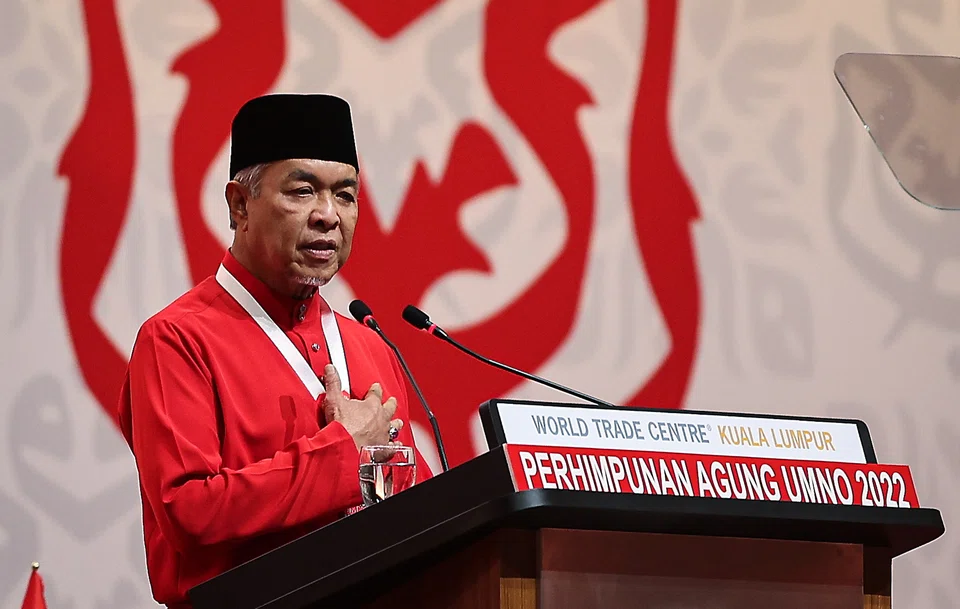
[KUALA LUMPUR] Given the outcome of the United Malays National Organisation’s (Umno) general assembly last month that saw a resolution passed on no-contest rules for the party’s two highest positions, political analysts feel there is now greater certainty for Prime Minister Anwar Ibrahim’s unity government and the direction it is headed.
Umno is the oldest and largest political party in Malaysia, and it’s significant that both president Ahmad Zahid Hamidi and his deputy Mohamad Hasan will remain in their posts in the lead-up to the next party election that must be held by May 19 this year.
With Zahid remaining a highly influential figure in the party for now, analysts say this has strengthened the foundation of the unity government and guarantees its stability for at least the next three years.
Liew Wui Chern, a lecturer at Universiti Tunku Abdul Rahman, told The Business Times that if Zahid ever lost his position in the party, it could lead to the collapse of the unity government.
Barisan Nasional, a multi-racial coalition led by Umno, suffered its biggest loss at the last general election in November 2022, securing just 30 seats in Malaysia’s 222-seat Parliament. Umno won only 26 seats, a poor showing that party leaders said was proof that the party was rejected by Malays in both the urban and rural areas.
The coalition lost more than half of its parliamentary seats to Pakatan Harapan (PH) and Perikatan Nasional (PN), which are led by Anwar and former prime minister Muhyiddin Yassin respectively. PH won 81 seats, while PN bagged 73.
Although they had the highest number of seats, neither PH or PN could form a government without a simple majority of 112 seats. With Muhyiddin rejecting the idea of working together with PH, it was Barisan Nasional’s support that became the key to resolve the political deadlock.
After days of negotiations, Barisan Nasional leader Zahid agreed to join Anwar’s pact that now consists of PH and Gabungan Parti Sarawak.
There have been some figures within Umno who disagree with Zahid’s decision to work with PH. One of them is Hishamuddin Hussein, the treasurer of Barisan Nasional and former Umno vice-president who stood firm on his stance of “no Anwar, no DAP”. The Democratic Action Party is a component party of PH.
Given the presence of these divisive voices, Liew noted that it makes sense for Zahid and Mohamad Hasan to break the tradition in having the top two Umno posts uncontested. This not only secures their own power within the party, but also helps to stabilise the unity government, he added.
Liew felt, however, that Zahid may continue to take action to marginalise those who are not aligned with him.
A week ago, Zahid expelled 42 Umno members including former youth chief Khairy Jamaluddin and former Selangor chief Noh Omar. He also suspended several top figures in the party, among them Hishammuddin and former information chief Sharil Sufian Hamdan.
Lau Zhe Wei, an associate professor at the International Islamic University Malaysia’s Department of Political Science, believed that the infighting within Umno will not affect the stability of Anwar’s government as the two major coalitions – BN and PH – have built a solid foundation in their two months or so in charge.
“There will be different voices within Umno against Zahid or Anwar’s government, but everything will remain status quo,” he said, noting that what will determine the long term success of the unity government will be the future policies and direction that are yet to be unveiled.
Oh Ei Sun, a senior fellow with Singapore’s Institute of International Affairs, warned that there are still threats to Malaysia’s unity government if the divided voices within Umno grow louder in the coming weeks and months.
“For the individual members of parliament who are unhappy with (the leadership of) Anwar or Zahid, they could still declare their support for the other side without relinquishing their party memberships. This could potentially bringing down the unity government,” he told BT.
He added that upcoming state elections will provide a somewhat clearer picture on Zahid’s influence and the people’s support for the unity government.
The state governments of Kelantan, Terengganu, Kedah, Selangor, Negri Sembilan and Penang – which chose not to hold elections together with last November’s general election – are now discussing when to have their elections this year.
“Those who oppose the idea of forming a unity government under the leadership of Pakatan Harapan will make their voices heard via the ballot box,” said Oh.






