US firms flock to South-east Asia amid tariff turmoil – record business missions eye Vietnam, Indonesia
The growing contingent sizes are ‘emblematic’ of firms’ China-plus-one strategies, says business council chief

AN UNPRECEDENTED wave of American companies is joining business missions to South-east Asia, spurred by President-elect Donald Trump’s escalating tariff threats that are piling the pressure on US firms with operations in China.
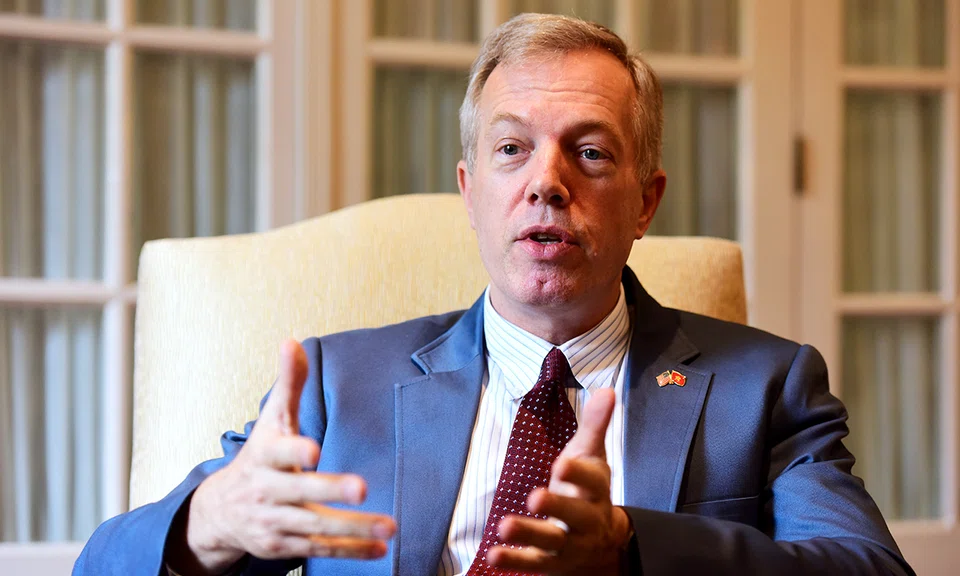
US-Asean Business Council president and chief executive officer Ted Osius said the council’s recent business missions have grown steadily, with major economies Vietnam, Indonesia, Thailand and the Philippines being “consistently highly subscribed”.
He noted that the growing size of business contingents reflects not only the US business community’s increasing eagerness to invest in a region he describes as a key driver of global economic growth, but also serves as a clear indicator of some companies’ adoption of “China-plus-one” strategies.
As of end-November, a record 50 companies have signed up for a business mission to Indonesia from Dec 3 to 5, the veteran diplomat told The Business Times in an interview.
An earlier trip to Vietnam in March also attracted a sizeable delegation, while the council’s three-day visit to Thailand that ended on Wednesday (Nov 27) rallied 41 US firms, he added.
American companies are increasingly unsettled as Trump, during his presidential campaign, floated the possibility of imposing tariffs of up to 60 per cent on Chinese goods.
On Tuesday, he vowed on Truth Social – a social media platform he launched after being banned from X – to charge China an additional 10 per cent in tariffs.
Money where his mouth is
Though the president-elect has repeatedly said he intends to make good on his word the very day he takes office on Jan 20, some pundits believe he will focus first on more domestic matters like immigration and tax cuts.
But Osius is placing his bet on day one.
“(Executive orders involving tariffs are) going to come, more likely, hours or days after the inauguration. I don’t expect this is going to come months and months after,” he said.
Osius expects the rules of origin of goods to get a lion’s share of the spotlight.
“There are a lot of instances where Chinese companies dealing with high tariffs have been putting their exports through countries like Vietnam, Malaysia and Thailand, and those transhipments (are) going to come under scrutiny by the incoming administration,” he said.
One of Osius’ greatest worries is the toll from tit-for-tat tariffs.
“I am not enamoured of the idea that we have to shut down trade negotiations and build up tariff walls with the rest of the world,” he said.
Ambivalent about the idea that tariffs on its trading partners would benefit the American economy, Osius believes they will instead result in retaliatory tariffs, inflation and worse, a trade war.
Asean can also set rules
The former ambassador to Vietnam also observed US companies hedging their bets by making highly publicised investments in local businesses.
When asked whether this would translate into reduced attention on markets in the Association of Southeast Asian Nations, Osius said the two strategies are not mutually exclusive.
“If you’re dealing with potential tariffs, that’s a good reason to have some of that production be in the US,” he said. “US investments in Asean is a 100-year trend – we’re the biggest investors in Asean, and we’re going to continue to be.”
The council intends to point out the huge growth opportunities in South-east Asia to policymakers in the next administration to drive economic engagement.
Notably, Asean is starting to set the rules, instead of simply being a group that receives trade rules from the rest of the world, said Osius, raising the bloc’s Digital Economy Framework Agreement (Defa) as an example.
“The (Asean) Secretariat has been embarking on a really ambitious programme to develop a Defa that’s agreed upon by several Asean nations by the end of next year.
“That’s a really good example of setting not a lowest-common-denominator arrangement, but a high-standard agreement that could then be emulated by others in the region and in the world,” he said.
Osius noted that Singapore has been one of several key leaders in negotiations on Defa, which has been touted as the world’s first major region-wide digital-economy agreement.
“Singapore has been at the forefront of these agreements, pushing the envelope on these digital-economy groups in a way that’s really useful, really helpful for Asean and the world,” he said.
He added that Asean stands at the centre of several major trade agreements, such as the Regional Comprehensive Economic Partnership and the Comprehensive and Progressive Agreement for Trans-Pacific Partnership.
The way he sees it, more line the docket as the regional alliance is now much more organised when it comes to trade than ever before.
“Asean is much more forward-leaning when it comes to the digital economy and artificial intelligence than many other parts of the world,” he said.
Competing for Asean’s attention
Osius highlighted that Asean’s trade moves – including the recent interest in several member states to join Brics, a bloc increasingly gaining prominence as a strategic counterbalance to the West – attest to the regional alliance having more than one choice.
He believes the US should pay attention to what is happening with Brics.
One of the forces that draws countries into Brics – founded by Brazil, Russia, India and China – is the US’ policy on the Middle East, which is upsetting Muslim-majority nations such as Indonesia and Malaysia.
Osius said: “Brics kind of represents another option – (that countries) don’t have to be dependent on the US.”
While he does not see such turning away among Asean member states to be a permanent development, the US should not ignore the warning signs, he added.
“We have to compete, too, for influence in Asean. The best way is to lengthen the economic leg of the stool and strengthen that part of the relationship.”
At a glance: Ted Osius
The president and chief executive officer of US-ABC, Ted Osius is a veteran diplomat of 30 years who speaks Vietnamese, French and Italian, and a smattering of Japanese, Indonesian, Hindi, Thai, Tagalog and Greek.
He and his husband, Clayton Bond, have a son and a daughter. Osius is the second openly gay career diplomat in US history to achieve the rank of ambassador.
Former diplomatic duties:
- US ambassador to Vietnam (2014 - 2017)
- Deputy Chief of Mission in Jakarta, Indonesia (2009 - 2012)
- Political Minister-Counsellor in New Delhi, India (2006 - 2009)
- Deputy director of the Office of Korean Affairs at the State Department (2004 - 2006)
- Regional environment officer for South-east Asia and the Pacific (2001 - 2004)
- Senior advisor on International Affairs at the US Office of the vice-president (1998 - 2001)
- Served in Bangkok, Ho Chi Minh City, Manila and the United Nations
Other roles
- Former vice-president for Government Affairs and Public Policy of Google Asia-Pacific (2019 - 2021)
- Former senior advisor at the Albright-Stonebridge Group (2018 - 2019)
- First vice-president of Fulbright University Vietnam (2018)
- Associate professor at the National War College, Washington, DC (2013 - 2014)
- Senior Fellow at the Center for Strategic and International Studies (2012 - 2013)
An A to Z of US-ABC
Established in 1984 as a non-profit organisation, the US-Asean Business Council conducts research and analysis of economic, environmental, financial, political and social conditions in the 10 countries of the regional economic bloc.
The council represents some 180 of the largest American businesses in South-east Asia through its headquarters in Washington, DC, and its seven regional offices.
Its members include blue-chip companies 3M, Amazon, Apple, Boeing, Coca-Cola, FedEx, IBM, Intel and UPS.
TRENDING NOW
Grab CEO’s wife Chloe Tong on life with Anthony Tan and finding her purpose
Hwa Seng Builder, two China companies win S$1.2 billion Tuas Road Viaduct phase two contracts
Deal between tycoon friends sparks scrutiny of Philippine power sector
Canada is upping oil flows to Asia, but South-east Asia’s refineries aren’t ready to handle them yet