US-led talks on small modular reactors could renew Asean’s nuclear push
If Washington continues its energy engagement under President-elect Donald Trump, it could potentially signal a significant shift in the region’s energy landscape

DESPITE years of discussion, nuclear energy remains in its infancy in South-east Asia, with no country yet achieving commercial operations. However, new technologies such as small modular reactors (SMRs) are sparking renewed interest.
While SMRs promise significant advancements in safety, cost efficiency, and performance, their adoption hinges on countries developing the necessary technical expertise and regulatory frameworks.
In South-east Asia, the US is said to be in talks with several nations – including Singapore, the Philippines and Thailand – regarding deploying SMRs, Bloomberg had previously reported.
If Washington continues its energy engagement with international partners under the incoming Donald Trump administration, it could mark a potential shift in the region’s energy landscape.
State of play
Asean member states differ in terms of where they stand on tapping nuclear energy, with Indonesia, the Philippines and Vietnam identified as the front runners. It is noteworthy that no Asean member state has successfully reached commercial operations of a nuclear power plant to date.
With three operational research reactors, Indonesia has always been “at the forefront of nuclear science”, collaborating with countries such as Russia and the US to develop nuclear power plants, said Dr Alvin Chew, a senior fellow at the S Rajaratnam School of International Studies (RSIS).
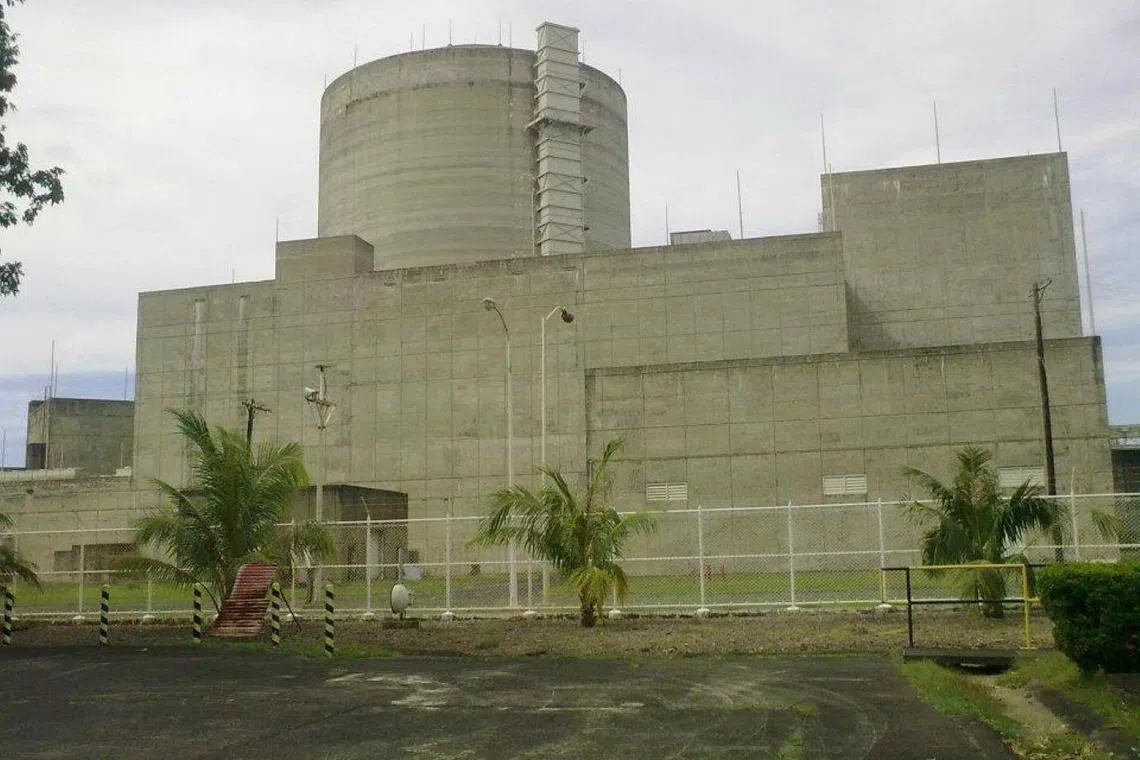
The Philippines is the only country in South-east Asia with a nuclear power plant, but the Bataan nuclear power plant has not been operational since it was built in the 1980s owing to safety concerns. The country is considering having SMRs developed by Oregon-based NuScale Power.
As for Vietnam, it had committed to build nuclear power plants in Ninh Thuan province in 2009. However, such plans were shelved in 2016 due to financial constraints. It is considering resuming plans to develop nuclear power to ensure stable electricity supply to support its economic growth. At the same time, Vietnam is also contemplating deploying SMRs, given their smaller upfront capital cost.
Turning to Singapore, a spokesperson from the Energy Market Authority (EMA) said: “Singapore has not made a decision on whether to deploy nuclear energy to meet the country’s growing energy needs.
“Any decision to deploy new energy technologies, including nuclear, will be carefully considered against their safety, reliability, costs and environmental sustainability in Singapore’s context.”
Meanwhile, the Republic continues to build its capabilities in nuclear science and technology. For instance, it supports research through initiatives such as the Nuclear Safety Research and Education Programme, and through academic institutions like the Singapore Nuclear Research and Safety Initiative.
This helps the city-state to assess the implications and benefits of evolving nuclear energy technologies, as well as regional nuclear energy developments, noted EMA.
Four South-east Asian nations have signed the 123 Agreement with the US, which permits the transfer of nuclear material, equipment and information. Singapore signed the pact most recently on Jul 31, while the other three Asean countries are Indonesia (with the pact entering into force in 1981), Vietnam (in 2014) and the Philippines (in July 2024).
This is an export control mechanism that focuses on the principles of nuclear non-proliferation. “Given that the US has always been at the forefront of nuclear security, its longstanding stance on non-proliferation will not waver towards South-east Asia, which is designated as a nuclear weapons-free zone under the non-proliferation treaty,” noted Dr Chew.
He also said that the US is trying to regain its competitiveness in the global nuclear industry after losing out to Russia, and possibly China.
“It is certainly wooing newcomer states with SMRs globally, but it is an export control law; (and) in order for countries to work with, collaborate or buy nuclear reactors from the US, they will need to enter into a 123 Agreement with the US,” he added.
Technical unreadiness
Experts pointed out that Asean countries do not have the technical expertise and regulatory readiness to adopt nuclear energy options, specifically SMRs, just yet.
Dr Chew noted that only two SMRs are being deployed currently, the first in the Akademik Lomonosov – a floating nuclear power plant operating in Pevek, Russia; and the second is the HTR-PM at Shidaowan in China’s Shandong province.
There is very limited knowledge and expertise in operating SMRs, said Dr Chew, adding that the regulatory guidelines for SMRs have not been developed for international deployment.
Grant Hauber, strategic energy finance adviser for Asia at the Institute for Energy Economics and Financial Analysis (IEEFA) said: “The reality is that the technical expertise for regulating and overseeing a nuclear programme is complex and expensive to establish.”
He noted that design inspection and testing regimes are needed, nuclear-waste storage and handling have to be considered, as well as scenario planning for disasters, among other factors.
The cost factor
Global energy consumption is projected to continue increasing significantly. Several tech giants such as Google, Microsoft and Amazon have turned to SMRs as a potential source of energy to run their data centres.
SMRs hold promise, with Dr Chew highlighting that their output capacity is smaller and almost similar to a coal or gas-fired plant. SMRs can thus be a direct replacement for carbon-intensive fossil fuel plants.
While SMRs are able to provide baseload electricity, BMI’s senior power and renewables analyst David Thoo cautioned that unlike intermittent solar and wind, SMRs still tend to have higher initial capital costs.
“Governments will have to balance costs and the nature of electricity supply (baseload versus intermittent) to cater to their market’s needs,” he added.
Hauber also noted that SMRs have not yet been proven to be any cheaper, with recent announcements from prospective manufacturers indicating that costs have risen to a point on a par with large-scale plants.
As for whether SMRs affect decarbonisation goals, he believes there needs to be a large number of them built to make a material impact on decarbonisation targets.
Even so, what Asean needs to support its energy demand and decarbonisation is massive-scale deployments of clean energy sources. SMRs are meant to be small scale and, by definition, do not fit the bill, added Hauber.
Long road ahead
Experts caution that Asean still has a long way to go in terms of adopting nuclear energy.
BMI’s Thoo noted that sentiments in Asia remain “relatively against” nuclear power reactors, reflected in the limited development of new plants over the past 10 years, particularly in South-east Asia.
Given the current developments, he maintains his forecast that the emergence of nuclear power is unlikely till 2033.
IEEFA’s Hauber pointed out that even if concerted efforts are made starting today, from a technology perspective, nuclear energy in Asean “is a 2040s idea”.
Apart from financial concerns, where nuclear is by far the most expensive type of energy source, the fastest per-unit construction time for a full-scale nuclear plant currently is about eight years per unit.
That assumes one already has a site, the environmental studies and approvals, as well as a completed and regulator-reviewed or approved design, said Hauber.
One critical challenge for Asean to overcome is that of public acceptance, given the nascent understanding of nuclear energy in the region.
However, RSIS’ Dr Chew said that over time, nuclear energy will be more ubiquitously adopted, with the region understanding the role it plays in building a more sustainable future.