



US raid in Venezuela is worrying for small countries: SM Lee
Washington is more willing to act unilaterally when it sees that its national interests require this, he says
 Add BT as a preferred source
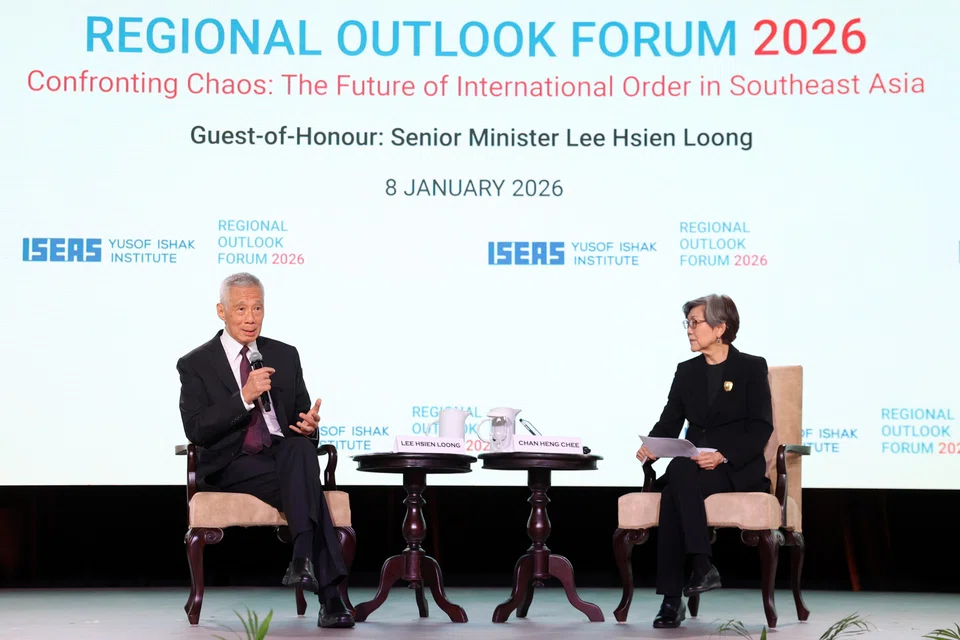
[SINGAPORE] The US’ military intervention in Venezuela is quite clearly a contravention of international law, and its longer-term consequences are something smaller countries like Singapore have to worry about, said Senior Minister Lee Hsien Loong.
The raid in Caracas underscores how Washington has been more willing to act unilaterally when it suits its national interests, he said, describing it as one of the key strategic changes the world has seen.
The US launched a military operation in Venezuela on Jan 3 that ended with the capture of Nicolas Maduro, who had been the country’s president until the shock ouster.
Maduro is now in custody in a Brooklyn jail with his wife, Cilia Flores, following their capture. Venezuela is currently run by the country’s vice-president, Delcy Rodriguez.
“I think in this case, it is quite clear, it is a contravention of international law,” said Lee, who was speaking at the Iseas-Yusof Ishak Institute’s Regional Outlook Forum held on Thursday (Jan 8) at the Marina Bay Sands Expo and Convention Centre.
While Venezuela is a “complicated country” – with questions over the legitimacy of its government, among other issues – “that does not justify a military intervention by one country into another, unilaterally, and without any proper authorisation”, he said.
The senior minister reiterated that Singapore is “gravely concerned” by the US move.
“We have always stated our position unequivocally on these matters, whichever the situation − whether it is Ukraine a couple of years ago, whether it was Grenada in 1983, which was an invasion by the US − and we have voted accordingly at the UN,” he added.
The US and a coalition of Caribbean countries invaded Grenada in October 1983. The invasion was triggered by strife within the People’s Revolutionary Government, which led to the house arrest and execution of Maurice Bishop, the second Prime Minister of Grenada.
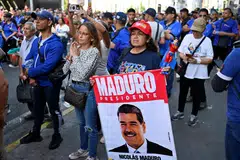

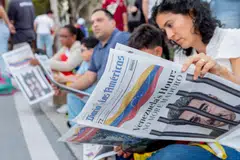
While the immediate consequence of the US raid in Caracas may be that “it works” and it was “a spectacular military success”, its longer-term consequences on the international system are something smaller countries have to worry about.
“From the point of view of a small country, if that is the way the world works, we have a problem,” Lee said.
His comments follow a statement by the Ministry of Foreign Affairs on Jan 4, which said that Singapore has consistently opposed actions contrary to international law by any parties.
US more willing to act unilaterally
In a dialogue with Professor Chan Heng Chee, who chairs the Iseas-Yusof Ishak Institute’s board of trustees, Lee said: “To some extent, that has always been the way the world works. The US has done this many times over in different parts of the world... And other powers do it too.
“But you look at the situation, you look at the impact of it, and you ask yourself: ‘Is this a plus or a minus?’ I do not think this is a plus.”
At the event attended by about 650 academics, diplomats and people from the business community both online and in person, SM Lee looked back at the key strategic shifts the world has undergone in the past year.
One major change, he pointed out, is how the US has been “more willing to act unilaterally”, when it sees that its national interests require this.
He cited examples such as the American airstrikes on Christmas Day on Isis targets in Nigeria, its actions in the Middle East, in which US forces struck Iran’s nuclear facilities last June, as well as its options for acquiring Greenland.
“What has happened is that we have undergone a sea change,” said Lee.
“We are now in a different world, and we are going to see the consequences of the sea change in the economy, as well as in the security area in 2026, and for many years to come.”
Asean needs to work together as one, and cooperate more closely to deal with our external problems, said Lee. The bloc has some “very difficult” problems to resolve, such as Myanmar and the Thailand and Cambodia armed conflict, but Asean has to try and resolve them.
Decoding Asia newsletter: your guide to navigating Asia in a new global order. Sign up here to get Decoding Asia newsletter. Delivered to your inbox. Free.
Copyright SPH Media. All rights reserved.
TRENDING NOW

Simba ordered to pay S$700,000 in damages to indoor skydiving operator Altitude Xperience for trespass
Malaysian tycoon Vincent Tan’s sell-downs point to pruning rather than an exit plan
The bright side to the CSE Global clash

StarHub deputy CEO Matthew Williams to succeed Nikhil Eapen as chief executive

