


Asean Business logo
SPONSORED BYUOB logo

Vietnam automaker VinFast seeks breakthrough in South-east Asia’s EV market

Jamille Tran
Published Fri, Jun 16, 2023 · 05:50 AM
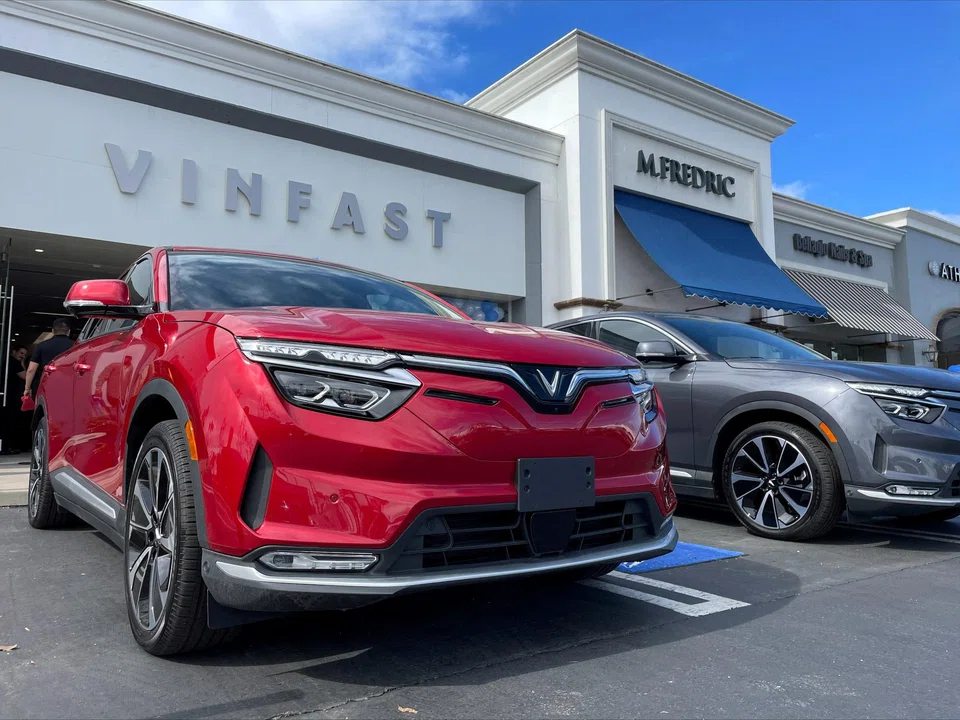
    • Despite a weakening global economy, VinFast expects to sell up to 50,000 electric car units globally this year, almost seven times more that what it managed last year.
    • Despite a weakening global economy, VinFast expects to sell up to 50,000 electric car units globally this year, almost seven times more that what it managed last year. PHOTO: REUTERS

    [HO CHI MINH CITY] Having already made a big push into the United States and Europe to varying degrees of success, Vietnam automaker VinFast has signalled its intent to spread its wings closer to home – in South-east Asia’s fast-growing electric mobility sector.

    The planned regional expansion comes as the company says it could break even by the end of 2024 and be profitable the year after if – in the words of its founder Pham Nhat Vuong, the richest man in Vietnam – “things go as planned”.

    As things stand, VinFast – a member of Vietnam’s largest private conglomerate, Vingroup – expects to sell up to 50,000 electric vehicles (EVs) in 2023, almost seven times more that what it managed last year.


    VinFast has not specified which markets in South-east Asia it wants to target first. However, at a summit on future mobility held in Bangkok in May, the company revealed that it will introduce right-hand steering versions of its lower-priced EV models to cater to buyers in the region.

    Drivers in Singapore, Malaysia, Indonesia, Thailand and Brunei all use cars with right-hand steering.

    Hirotaka Uchida, a partner at management consulting firm Arthur D Little in Thailand, told The Business Times that VinFast could face challenges in making inroads in some South-east Asian markets, where the cost of owning an EV may prove prohibitive.

    Uchida, who leads the Belgium-based firm’s automotive and manufacturing practice in South-east Asia, noted that the total cost, including charging and maintenance expenses, is the top concern for potential EV buyers in the region. The availability of charging stations and the variety of EV options available on the market are also key considerations, he added.

    VinFast has focused on cars with left-hand steering because it was looking to sell in North America first.

    But things did not go according to plan: the company was forced to recall every vehicle in the first batch that was shipped to the US last year on the back of the US authorities issuing a safety warning.

    In May, the US National Highway Traffic Safety Administration said that all 999 of VinFast’s premium VF 8 cars had a software error that prevented important safety information from being displayed on the dashboard. This “may increase the risk of a crash”, it warned.

    A batch of 111 units of the VF 8 that was delivered to US customers in the past few months received mostly-negative reviews in several reputable US auto magazines, mainly for the model’s poor performance on the road and lack of comfort.

    Nguyen Manh Dung, the head of institutional equity sales at Maybank Investment Bank in Vietnam, said that it would be difficult for VinFast to gain acceptance in overseas markets in the initial stage because of consumers’ lack of familiarity with the brand.

    Despite the setback in the US, VinFast has said that it will deliver 2,500 cars to North America and Europe by July, as part of the 55,000 orders it had received as at end-2022. VinFast’s plant in Vietnam can produce 250,000 vehicles a year, and plans are afoot to open a second plant in North Carolina in the US in 2025.

    Dung said that VinFast’s main growth market in South-east Asia over the next five years should still be Vietnam, given that the country’s car ownership rate is among the lowest in the region.

    In Vietnam, there are at least 12,000 VinFast EVs on the roads. However, this number is minuscule compared to the estimated 60 million motorcycles in use in a country with a population of 100 million.

    “However, while waiting for the Vietnam market to mature (in terms of charging infrastructure and EV awareness), VinFast will need to explore other markets to achieve the desired sales quantity to be able to break even,” said Dung. “(Selling cars in the US) will also help increase the confidence of buyers in Asia.”

    Financial headwinds

    To finance its cash-burning car manufacturing business, VinFast announced in May that it will list in the US via a merger with Hong Kong-based special-purpose acquisition company Black Spade Acquisition. 

    The deal is expected to close in the second half of 2023, bringing the enterprise value of the new entity to US$27 billion. This valuation, including debt, would be the third-largest such transaction in history.

    While observers feel that VinFast will not earn much through this so-called “backdoor listing”, Maybank’s Dung said that this move will go a long way to raise brand awareness in the world’s largest capital market, where investors are hungry for new stocks.

    In the past year, VinFast has grown its global footprint by opening more than 30 retail stores and service centres in the US, Canada, Germany, France and the Netherlands.

    “Right now, they need to burn a lot of money to deliver consistent quality and build the brand. The problem is, how are they going to be able to sustain that in the long run?” asked Dung. 

    VinFast’s cumulative spending expenditures over the next two years are estimated at US$3 billion, based on its initial public offering prospectus filed with the US Securities and Exchange Commission earlier this year. The company received a US$2.5 billion injection from parent Vingroup and founder Vuong.


