



Vietnam ends state monopoly on gold bar production; local price premiums may narrow
Its central bank will grant production licences to certain qualified enterprises and commercial banks

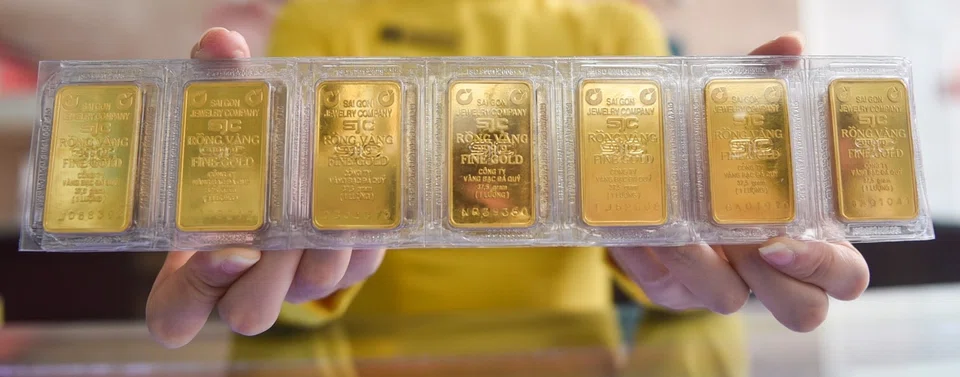
[HO CHI MINH CITY] Vietnam, one of the largest gold markets in Asia, has initiated a major overhaul by ending over 13 years of state monopoly on gold bar production, which was previously held by state-owned Saigon Jewelry Company (SJC).
According to a decree released on Tuesday (Aug 26), the State Bank of Vietnam (SBV) – the country’s central bank – will extend production licences to certain qualified commercial banks and enterprises. These firms can also import and export gold bullions and materials within allocated annual quotas.
“Multiple gold bar brands are expected to re-enter the market, reducing reliance on SJC and helping narrow the domestic-global price gap,” Tyler Nguyen, chief market strategist at Ho Chi Minh City Securities (HSC), wrote in a note.
Vietnam’s combined gold demand for jewellery and physical investment reached 56 tonnes in 2023, making it the second-largest gold market in East Asia and the ninth-largest globally, indicated a Metals Focus report.
However, limited supply has widened the local-global gold price gap. Quotations for SJC-branded gold bars hit a new high on Aug 27, at 126 million dong (S$6,157) per tael for sellers and 128 million dong for buyers – a premium per tael of about 19.7 million dong above the international rate.
Before state monopoly was established in 2012, the price gap remained minimal, as Vietnam permitted the free trading and importing of gold. Multiple domestic gold bar brands were in circulation, including those from private firms including Phu Nhuan Jewelry, as well as commercial banks such as Sacombank, Asia Commercial Bank and Agribank.
In an effort to combat the “goldenisation” of Vietnam’s economy, the country then tightened the market by centralising gold-related activities, along with restricting supply over the past decade, discouraging citizens from hoarding bullion to preserve wealth.
As a result, total gold demand almost halved from 100 tonnes in 2013 to 56 tonnes in 2023, according to data provided by Metals Focus.
However, the widening gap between local and global gold prices has fuelled demand for the US dollar on the so-called black market, as importers smuggling the metal from overseas turn to the greenback, further depressing the local currency.
Saktiandi Supaat, head of FX research at Maybank, believes the gold reform, together with an anticipated further decline in the US dollar, could support the strength of the Vietnamese dong in the coming period.
The local currency has slipped by more than 3.2 per cent against the greenback since the beginning of the year, even as the US dollar index has fallen by around 10 per cent in the year to date. It remains the worst-performing currency in Asean thus far.
In April 2024, as Vietnamese dong came under pressure – having fallen 3 per cent since the start of the year – and investors flocked to gold as a safe-haven asset amid political uncertainties, the central bank intervened by holding its first gold bar auction in 11 years, aiming to boost supply and curb surging prices.
During that period, the authorities also intensified its crackdown on gold smuggling, speculation, manipulation and the exploitation of policies to inflate prices.
“Enabling a higher supply from higher imports and production should also reduce non-official sources of gold, which is beneficial for macro stability,” said Adam Ahmad Samdin, an economist at Oxford Economics.
However, he noted the impact of deregulation on local-global price differentials and unofficial gold trading largely depends on the implementation and details of licences, such as the volume of the potentially assigned quotas as well as local capacity to adjust to these changes.
“As with the broader reform push that other segments of the Vietnamese economy are going through, execution risks may mean the intended positive effects may come in slower and to a lesser degree than desired,” the economist added.
Under the new regulation, Vietnam will also strengthen market oversight and transparency by requiring e-invoice usage by jewellery producers, as well as payments via bank accounts for any gold purchase or sale worth 20 million dong or more per day.
The government has also mulled the introduction of a regulated gold exchange, especially within the country’s International Financial Centre, to enable transparent public trading and prevent market manipulation.
TRENDING NOW

If Europe goes to war, the fallout will be felt in East Asia

Shanmugam says firms linked to haze probe pledge cooperation; government to table changes to haze law

Indonesia stocks suffer worst plunge in nearly 30 years as MSCI proposes standalone status

Keppel seeks US$1 billion for Vietnam investments as it joins country’s international financial centre

