



Vietnam holds first gold auction in 11 years to stabilise market
Central bank resumed auction of gold bars on Tuesday to stabilise prices, which have hit record high
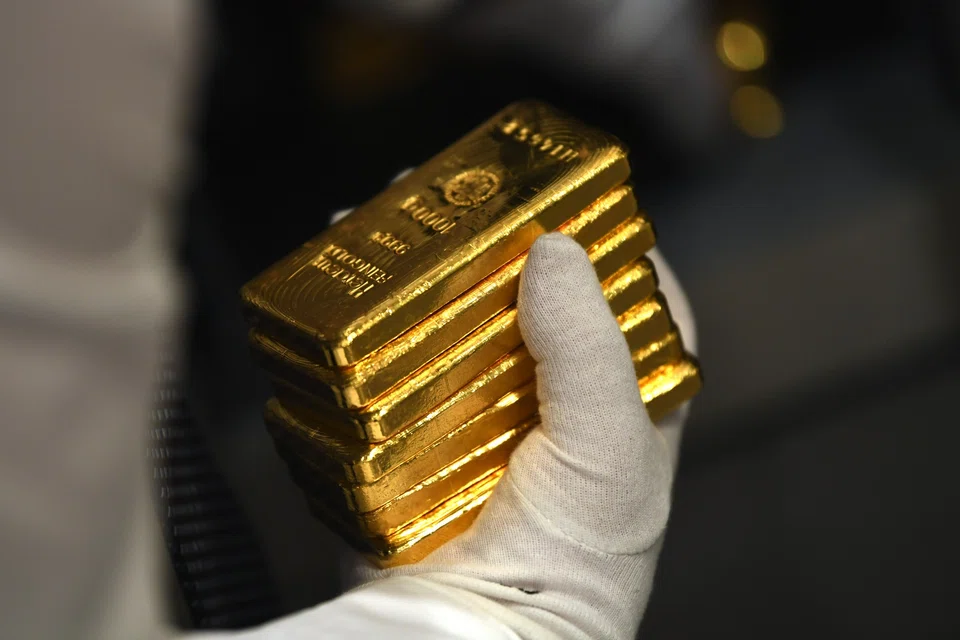
[HO CHI MINH CITY] State Bank of Vietnam (SBV) on Tuesday (Apr 23) held its first gold bar auction after an 11-year suspension in an effort to stabilise the market amid record-high prices.
SBV sold 3,400 taels of SJC-branded gold bars at the auction for between 81.32 million dong (S$4,355) and 81.33 million dong per tael. It is only one-fifth of a total of 16,800 taels offered at a reserve price of 81.3 million dong per tael.
The imbalance between supply and demand has driven domestic prices of the commodity in the South-east Asian country well above global prices, with gaps widening to as much as 18 million dong for each tael at some points this year.
A tael is equivalent to 37.5 grams or 1.21 troy ounces.
Gold auctions aim to boost supply, reducing the domestic prices of the precious metal and its premiums over the international benchmark.
Auctions aimed to stabilise prices
The reserve price for Tuesday was reduced by 500,000 dong from the initial amount set for Monday’s auction, which was cancelled due to a lack of buyer interest.
“The reserve price (for Monday auctions) was too high,” said Nguyen Huu Huan, head of the financial markets department of Ho Chi Minh City University of Economics. “This would not motivate businesses to make purchases and would be challenging to lower domestic prices.”
Around 9 am on Tuesday in Ho Chi Minh City, prior to the scheduled auction, Saigon Jewelry Company (SJC) bought gold bars at 79.8 million dong per tael – 1.5 million dong lower than SBV’s winning bids on the same day. The firm sold a gold tael at 82.3 million dong, marking a 12 per cent year-to-date increase in the metal price.
On the global market, the yellow metal has gained over 12 per cent year to date. Each tael was at US$2,778 as at 4.46 pm NY time, about 11.6 million dong lower than Vietnam’s domestic price.
Market insiders noted that the required minimum bid to buy 1,400 taels at SBV’s auctions is substantial, and it could take firms weeks to sell this volume. This raises the risk of losses and deters participation, particularly in light of Monday’s sharp decline in global gold prices.
Eleven out of 15 qualified businesses, which include commercial banks and gold companies, took part in the auction on Tuesday morning. Only two won the bid.
Although gold bar auctions are intended to enhance supply conditions, Huan noted that anything less than 17,000 taels per session is a relatively small quantity, designed primarily to boost investor confidence in the short term.
According to a post on the government website on Tuesday, the central bank has called for collaborations from related government bodies to facilitate its imports of gold for auctions.
Back in 2013, the country’s central bank conducted a series of 76 auctions in which more than 1.8 million taels were sold.
Flight to safety
In the past year, international gold prices have soared amid increased political uncertainty, prompting central banks to stockpile the metal and investors to flock to the safe-haven asset.
Gold’s value also rose sharply as it became a sought-after commodity amid hawkish expectations of the Federal Reserve for the interest rate trajectory.
As a result, there has been a surge in flight-to-safety demands for gold in Vietnam, leading to record-high prices of the precious metal in the local market.
The price premium over the international rate has also continuously widened from roughly four million dong in 2013 to around 11 million dong in the past few days, with the limited supply by the state mainly to blame.
According to regulations issued in 2012, the central bank has an exclusive right to produce gold bars and to import raw gold to produce bars. SBV has also authorised the wholly state-owned SJC as the sole producer of gold bullion in Vietnam.
Fighting ‘goldenisation’
During last month’s meeting of the National Advisory Council for Monetary Policies, experts recommended revising the current regulations to eliminate the state monopoly on gold imports and production.
The council said that the regulation has proven to be successful in fulfilling its purpose of combating “goldenisation” in the economy.
Due to those strict rules on gold imports, Vietnamese gold buyers such as jewellery producers often source the precious metal from illegal channels.
Over the past month, the country has intensified its crackdown on gold smuggling, speculation, manipulation, and the exploitation of policies to inflate gold prices. This has resulted in the temporary closure of numerous jewellery stores nationwide in recent weeks, as they fear potential exposure of their violations.
“I think the current enforcement actions to curb gold smuggling are not sensible as they might only add to people’s anxiety amid the rising demand for gold,” Huan said. “Enabling legal venues for quota-based gold imports is a longer-term method to quench people’s thirst for this commodity in the country.”
Earlier this month, as part of efforts to dismantle the state monopoly in the local gold market, the Vietnam Gold Trading Association proposed allowing three companies to import approximately 1.5 tonnes of gold annually for jewellery processing. The organisation said that this move could lower domestic prices and narrow the gap with global levels.
Shoring up the dong
The intervention by the central bank comes as Prime Minister Pham Minh Chinh urged “immediate” measures to stabilise and regulate the domestic gold market.
He requested SBV to take steps to reduce the gap between local and international gold prices, preventing “goldenisation” in the economy and avoiding “adverse impacts” on exchange rates as well as national financial and monetary safety and security.
Higher local gold prices frequently lead to increased demand for the US dollar in the so-called black market, as importers use the greenback to smuggle the metal from offshore markets. This activity has exacerbated the weakening of the dong, which is hurting the economy.
“(SBV’s auctions could) reduce gold arbitrage incentives and speculative activities. Eventually, the selling pressure on the VND could weaken,” noted Fiona Lim, a senior FX strategist at Maybank.
To support the dong, the SBV intervened last week by selling US dollars from its foreign exchange reserves to some banks at 25,450 dong per dollar. Additionally, it implemented liquidity controls through open-market operations over the past month.
Despite the regulator’s efforts, the domestic currency still dropped to a record-low 25,463 against the dollar last Friday. The SBV also weakened the dong’s reference rate to the lowest level of 24,275 on Tuesday. The currency is allowed to trade as much as 5 per cent on either side of the regulator’s reference rate.
“SBV intends to keep credit conditions accommodative in order to support growth and this accommodative stance could continue to weigh on the VND,” Lim noted. “As long as the USD and US rates continue to climb, USD/VND may continue to creep higher.”
She anticipates that the country’s central bank will maintain its current measures to buy time and slow the rise of the currency pair until a broader turn in the US dollar, expected in the second quarter of 2024 following the ongoing hawkish repricing.
TRENDING NOW

Ex-Nvidia CEO Jensen Huang carried a secret for more than a year. It led to his downfall

South-east Asia has lost Nvidia’s best salesman

Demand, tech capabilities position Apac and AI as Skyscanner’s next growth frontiers: CEO Bryan Batista

Jensen Huang discusses comeback as Nvidia CEO with allies: report

